
Support Honest History in Texas Public Schools
Over the next few months, the Texas State Board of Education (SBOE) will make decisions with profound implications for the future of history and social studies instruction in Texas public schools.
Texas Essential Knowledge and Skills (TEKS) standards for social studies establish academic benchmarks to evaluate student learning. The TEKS revisions process depends on robust participation from teachers, curriculum specialists, subject matter experts, and the wider public.
On April 7, 2026, the SBOE will hold a public hearing on proposed draft TEKS for social studies and vote on first reading, potentially initiating a period of public review before final adoption.
We encourage supporters of public education in Texas to urge the SBOE to develop social studies TEKS that are responsive to the needs of all Texans, grounded in honest history, and designed to support educators in preparing students for success.
How You Can Help
Make Your Voice Heard
On April 7, 2026, the Texas State Board of Education will hold a public hearing on proposed draft TEKS for social studies and vote on first reading, potentially initiating a period of public review before final adoption in June.
This meeting will likely provide historians’ best opportunity to influence the final version of the standards. You can sign up to offer two minutes of public testimony in Austin on Tuesday, April 7. Late registration is available on-site up to 30 minutes prior to the start of the meeting.
Even you cannot attend in person, your input can make a meaningful difference. Please consider one or more of the following:
- submitting written testimony by email to testimony@sboe.texas.gov
- emailing more detailed comments on the draft to the TEA at teks@tea.texas.gov. Please note that the TEA will only consider feedback that is specific and actionable. All suggestions should reference a specific course (e.g. world geography) and/or address a standard in the draft TEKS by reference number (e.g. fix the error in World History Studies 17.B. It was Louis XVI–not Louis XIV–who was executed in the French Revolution).
- writing directly to the SBOE member who represents your district
- contacting other state elected officials in both parties to share your concerns.
Prepare Your Messaging
Important Information
At this stage in the process, the SBOE is still making decisions about the content to be included in the new TEKS, as well as the skills to emphasize in the standards. When developing your testimony, you might consider articulating some of the following points:
Honest history and historical thinking are essential knowledge and skills for students preparing to enter the 21st-century workforce.
- Students deserve an honest, accurate, and full account of both US and world history. Anything less than this fails to meet the SBOE’s stated goal for this TEKS revision to “ensure that the standards are rigorous, reflect current topics and up-to-date research, and address the essential knowledge and skills at the appropriate grade levels.” The TEKS revision process is an opportunity for scholars, educators, and supporters of honest history to emphasize how evidenced-based scholarship might inform the content of K–12 social studies courses across Texas. The AHA’s “Criteria for Standards in History/Social Studies/Social Sciences” contains language and ideas that might help you to formulate your own points to advocate for a history-rich education.
- Texas law mandates the SBOE to adopt TEKS that prepare students to be college- and career-ready, and the Texas Higher Education Coordinating Board and the Texas Education Agency convened faculty teams that articulated what that means. The required College and Career Readiness Standards for Social Studies are listed on pp. 23-27 of this pdf.
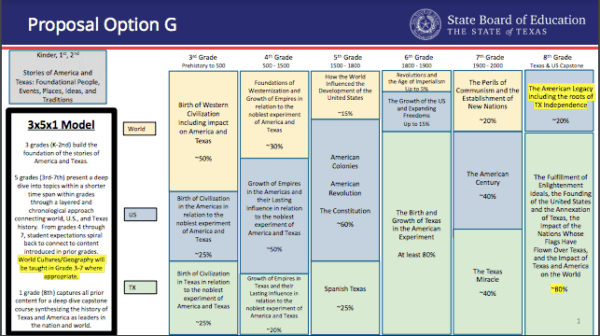
- The new course sequence approved in September structures 100% of course content in grades K–8 as a blend, from most coverage to least, of Texas, US, and world history. This unusual K-8 framework significantly reduces coverage of US and world history in the standards. The SBOE revised sequence eliminates five current courses: two standalone courses in US history (grades 5 and 8), two standalone courses in Texas history (grades 4 and 7), and a course in world geography (grade 6), running counter to legal requirements for the social studies curriculum.
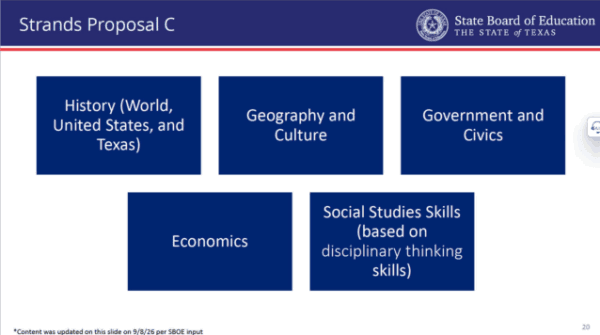
- The new strands (subjects selected for emphasis across grade levels) are incompatible with the K-8 course sequence. The SBOE has elected to eliminate or combine existing strands in citizenship, culture, and science, technology, and society in favor of creating a sequence with no time explicitly assigned to coverage of government, economics, civics, and geography. Texas law requires the inclusion of these subjects in social studies TEKS, and pushing them to the margins threatens to severely undermine the quality of history instruction.
- Texas law (TEC Sec. 28.002 h-2) also requires that social studies TEKS “for each grade level from kindergarten through grade 12” develop each student’s ability to “analyze and determine the reliability of information sources,” “formulate and articulate reasoned positions,” “an understanding of… the structure, function, and processes of government institutions at the federal, state, and local levels,” and “an appreciation of the importance and responsibility of participating in civic life,” Achieving these and similar, required civics outcomes will require substantial scaffolding and instructional time; they merit explicit attention in the standards.
- Will students, parents, and families recognize a K-8 sequence that includes no courses in US history, world history, Texas history, geography, civics, or government? Is it fair to assume that all of these subjects will be adequately addressed, if some are absent from the course sequence?
The new scope and sequence will almost certainly make TEKS standards harder to implement and less useful to teachers.
- The SBOE has adopted a K-8 course sequence designed around an untested, experimental approach, raising serious questions about implementation. No Texas teacher will have trained to teach courses with “a layered and chronological approach connecting world, US, and Texas history;” no district has curricular materials for the adopted framework; no undergraduate teacher training program is preparing future teachers to teach courses structured in this way.
- Educators and researchers agree that there is substantial room for improvement in history education, especially for younger learners (K–2). The SBOE has embraced a radical change in social studies instruction, but no steps taken thus far address the main complaint about current elementary social studies in Texas—the absence of dedicated instructional time. On the contrary, the disruptive K-8 sequence will likely lead principals to further deprioritize social studies, as costs far outweigh potential benefits.
- Implementing these standards effectively would require a massive investment of money and resources in teacher preparation and retraining, professional development, textbooks, and curricular materials without evidence that any of these changes would benefit students, families, and communities. Districts will struggle to find curricular materials designed to support student learning along these lines. Who will foot the bill?
The integrity of the TEKS revision process must be defended.
- The TEKS belong to all Texans, and should reflect input balanced across all SBOE districts and a range of varied perspectives. The TEKS Review Administrative Procedures (updated 2023) clarify that work groups must include representation from all SBOE members. The SBOE has assembled two TEKS work groups for social studies, as outlined in the SBOE-approved TEKS Review Work Group Build Process (2023). Some Board members have reported irregularities in TEA’s implementation of typical priorities.
- TEKS work groups provide a forum for key stakeholders to participate in decisions about what students will be expected to learn. Texas Education Code § 28.002 (c) specifies that the SBOE creates TEKS “with the direct participation of educators, parents, business and industry representatives, and employers.” The SBOE-approved TEKS Review Process (2018) clarifies that TEKS work groups include representatives of each of these groups in order to satisfy statutory requirements.
- It is imperative that the SBOE follow both the spirit and the letter of the law to preserve the educational quality and public legitimacy of the revised TEKS.
- The social studies TEKS must prioritize student learning over any ideological agenda. Some Texans have voiced concerns over the controversial views of individual Content Advisors. The TEKS revision process was designed to ensure balance and compromise—both of which are essential to preserving the integrity of the social studies standards. It is important to hold the SBOE accountable, should it fail to uphold its own standards.
Live Updates from the April 7 SBOE Meeting
On Tuesday, April 7, 2026, Whit Barringer, AHA program and data analyst, will share live updates regarding the Texas State Board of Education social studies TEKS revision on her Bluesky account, @drwhit.bsky.social.
“You cannot censor your way to great schools.”
~Julia Brookins (AHA) before the Texas State Board of Education, 2022
TEKS Revision Process News & Important Dates
AHA History Education Initiatives
AHA State History Standards Support
As part of its mission to promote historical thinking in public life and professional integrity in history education, the AHA monitors and offers guidance on state-level academic frameworks.

Criteria for Standards in History/Social Studies/Social Sciences
The AHA's criteria outline foundational elements for history-rich education that can be adapted to account for local priorities.
Teaching History with Integrity
The AHA leads or participates in several initiatives to provide resources and support for history educators facing intensifying controversies about the teaching of the American past.
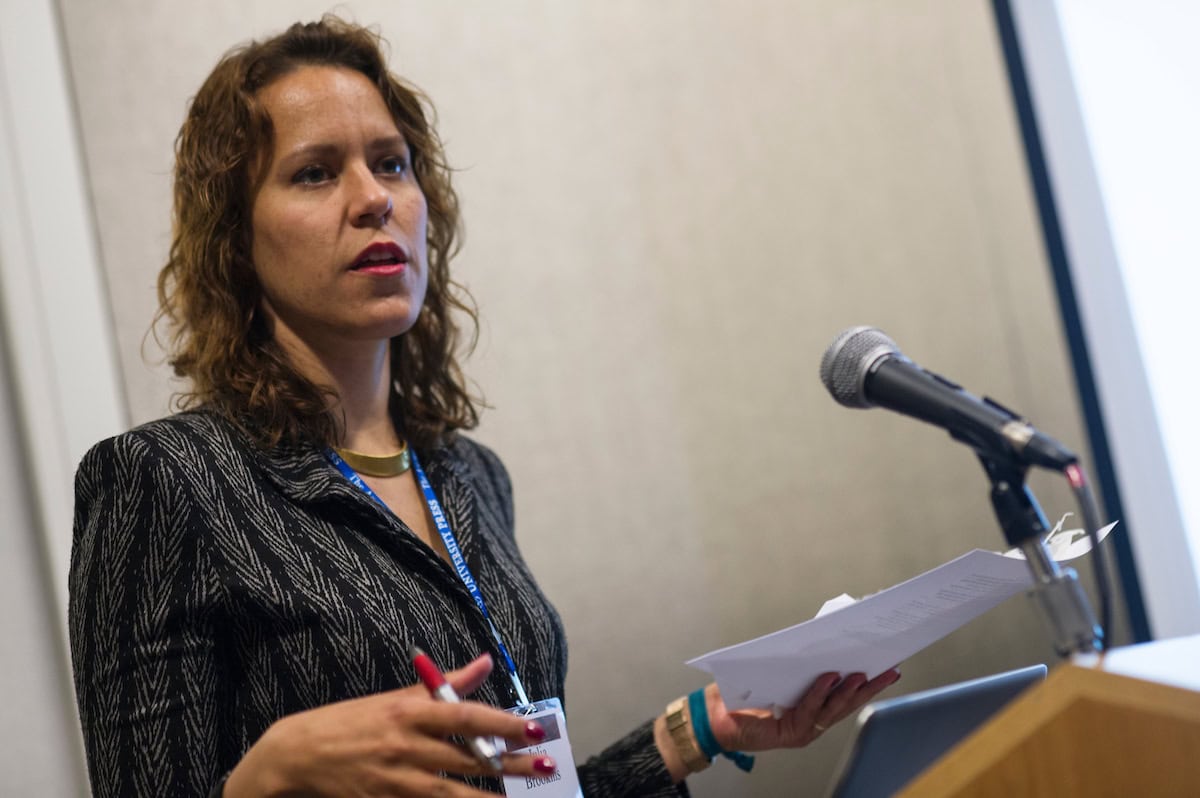
AHA Testimony Before Legislatures and Boards of Education
AHA staff have delivered public testimony highlighting the challenges educators face from legislation restricting the history education and issues related to teaching history with integrity.
American Lesson Plan: Teaching US History in Secondary Schools
The AHA’s 2024 report shares findings from the most comprehensive study of secondary US history education undertaken in the 21st century. The report provides empirical evidence and rigorous analysis to inform current debates over how history is taught in our schools.
AHA Advocacy in Texas

November 14, 2025
Social Studies TEKS Revision Action Alert
Over the next few months, the Texas State Board of Education (SBOE) will make decisions with profound implications for the…

September 19, 2025
Update on TEKS Social Studies Sequence
For the Press
If you are a member of the media and would like to submit a request for a referral or interview, please email press@historians.org. Please provide any pertinent deadlines and we will do our best to accommodate your request. The AHA can find you a historian for any topic, and assists with dozens of inquiries each year.
Perspectives on History Education in Texas
Maintaining Standards
In the late summer of 2022, the Virginia Board of Education (VBOE) rejected its own procedures, established under state law,…


Support AHA Advocacy
The American Historical Association provides leadership for the discipline, defends academic freedom, and promotes the critical role of historical thinking in public life. We need your support for this and our ongoing advocacy efforts at the federal and state levels. Please join join or donate today.