
By Maysan Haydar
This essay excerpt is part of the AHA’s Career for History Majors (2nd Edition). The full booklet may be purchased on OUP’s website.
History has long been a reliable undergraduate major, both for assuring future job prospects and for building a richly satisfying personal life. A degree in history supports many potential career pathways. Forty percent of America’s social studies teachers have undergraduate degrees in history, but teaching is just one of many options. Twenty percent of history majors choose to work in education, a rate only slightly higher than that for all college graduates (18 percent). Our field can provide a strong foundation for civic participation, leadership, and community engagement. History is the second most common degree among members of Congress. More than one-third of those working in culture fields like libraries, museums, and publishing hold history degrees, and history remains one of the most recommended fields of study to prepare for a career in law.
Career Fields of History Majors
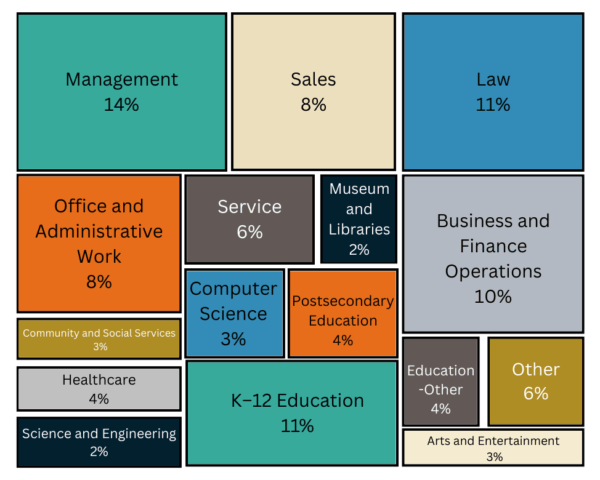
Data: US Census Bureau, American Community Survey 5-Year Public Use Microdata Sample (2017–21).
Graduate study can further expand the range of opportunities available to students trained in history. More than half of history degree earners enroll in graduate or professional programs. Prepared to apply historical thinking skills in other contexts, history students consistently rank among the top performers by major across the GRE, the LSAT, the MCAT, and the GMAT. Historical training also prepares students to think about the long term, and to account for change over time. Regardless of major, federal data shows that salary depends largely on educational attainment and staying in the workforce.
Some other majors may make more immediately upon graduation, but history majors stack up well when it comes to lifetime earnings, career satisfaction, and other measures of long-term success. The Hamilton Project, a 2020 initiative by the Brookings Institution, tracked lifetime career earnings by undergraduate degree. Median career earnings for history degrees in 2018 were approximately $1.3 million, which is $1.65 million adjusted for inflation in 2025. The upper distributions take a strong upturn, beginning in the 75th percentile, at $2 million in career earnings ($2.58 million, adjusted for 2025).
Median Annual Earnings of Full-Time, Year-Round Workers Ages 25–34, by Educational Attainment (2012–22)
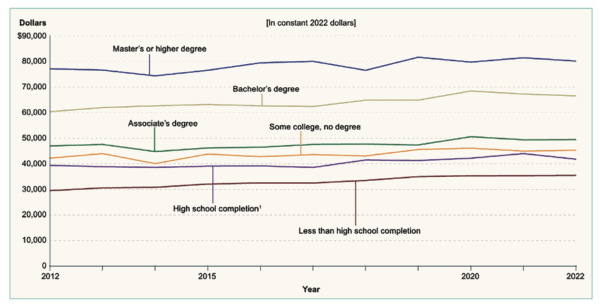
Data: National Center for Education Statistics, Annual Earnings by Educational Attainment. Condition of Education, US Department of Education, Institute for Education Sciences, 2024.
According to the Occupational Outlook Handbook from the Bureau of Labor Statistics, the career outlook for those with bachelor’s degrees in history is on pace with national growth. Unemployment for history degree earners (4.6 percent) is close to the national average, and significantly lower than some seemingly “practical” disciplines (including physics, sociology, computer science, and economics). History graduates report high overall career satisfaction. Career prospects for graduates are especially promising for occupations with imminent need to replace retirees, like in education and administration, as well as in library, museum, and nonprofit work.
Careers associated with advanced study history degrees fare even better. Job opportunities for historians are expected to grow 6 percent through 2033, double the US average across job types. Archivists, curators, and other museum staff jobs are expected to grow by 11 percent, far exceeding the national average.
As you think about your professional future, remember that you are in a position to make choices about what you value in your life, your work, and your education. Historical training prepares us to be versatile. With hands-on experience and targeted skill development, history majors can and do forge successful, fulfilling careers. How would you like to earn a living?
Related Resources

February 25, 2026
History of Vaccines

January 1, 2026
Choosing a Career Pathway
January 1, 2026