
About the Briefing
This handout was created for the AHA’s July 14, 2026, Congressional Briefing offering historical perspectives on vaccines. Panelists David Ekbladh (Tufts Univ.), Leigh Gardner (London School of Economics), and Christopher Tounsel (Univ. of Washington) discussed how US economic and diplomatic policy in Africa has evolved over time, placing it in the wider context of global development. Dane Kennedy (George Washington Univ.) served as moderator.
Three elements have defined US-Africa relations since the early 20th century: trade; security and geopolitics; and philanthropy and aid. Over the past century, these three areas have not been independent but rather closely interlinked, shaping the intensity and distribution of American interactions with different parts of the continent.
US-Africa Trade
Antebellum America
- US-Africa trade dominated by American participation in the Trans-Atlantic Slave Trade, the export of cotton textiles primarily to East Africa, and whaling in southern Africa and Atlantic islands.
Late 19th Century to World War I (c. 1870–1914)
- Rapid growth and structural change in the US economy affected its trading relationships with the rest of the world, while African production of cash crops and minerals was growing as well.
- Limited US investment in shipping, communications, and financial infrastructures of global trade meant African trade was primarily conducted via European capitals rather than directly.
World Wars and Interwar Period (1914–45)
- European interventions in commodity markets prompted efforts to increase direct trade links, especially with South Africa and British West Africa. Important African imports included cash crops like cocoa and palm oil as well as minerals like manganese and chrome.
- Africa’s share of US foreign trade peaked during World War II when the Japanese invasion of Southeast Asia cut off important supplies of strategic goods.
Decolonization and the Cold War (1945–99)
- African exports became an important source of dollar earnings for European governments indebted to the US following World War II.
- Composition of trade shifts from cash crops to a broader range of minerals and oil.
- Oil discoveries, combined with the removal of colonial trade restrictions, expanded the range of important trading partners, which now included parts of Francophone Africa.
Post-2000
- US trade with Africa in the 21st century has been dominated by the 2000 African Growth and Opportunity Act.
- Trade continues to be dominated by minerals and oil, though oil imports from Africa have declined in recent years due to increasing domestic production.
- China’s economic footprint on the continent has continued to grow and sharpened attention on US-Africa trade.
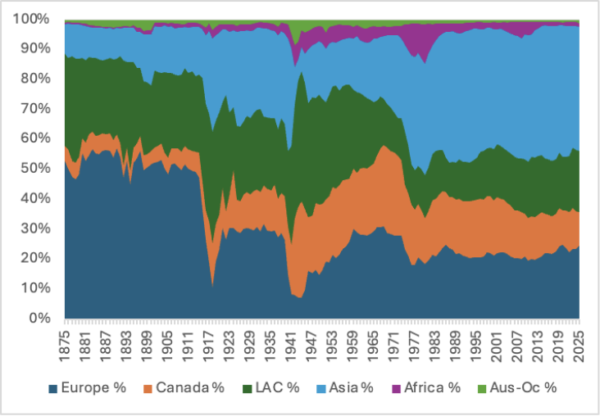
Fig 1a. Regional origins of US imports, 1875–2025
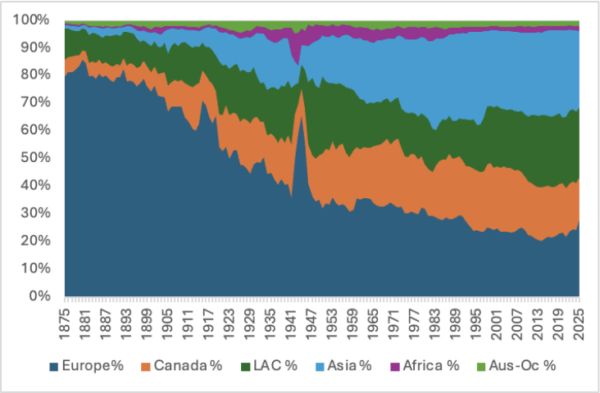
Fig 1b. Destinations of US exports, 1875–2025
Source: US Census Bureau, Historical Statistics of the United States, Colonial Times to 1970; IMF trade data.
Geopolitics and Security
Interwar Years
- Interest in Africa focused on questions of how empires should be administered, informed by case studies of Africa. Despite increasing direct trade, geopolitical relationships with Africa continued to be mediated through European governments.
- During the Great Depression, there was discussion of whether redistribution of African colonies and trusteeships could solve raw materials concerns, population problems, and the territorial demands of Nazi Germany and fascist Italy.
World War II
- North Africa and East Africa were key battlegrounds, vital for control of communications and supply routes. This was true not only of the Mediterranean and Atlantic but also of the Cape of Good Hope and the Indian Ocean.
- During the war, Africa provided labor—including troops for European empires—along with essential raw materials.
Cold War
- Decolonization, beginning in the late 1950s, increased direct US government contact with independent African states. These relationships were complicated by the United States’s record on civil rights and the US government’s sometimes ambivalent attitude towards European empires.
- Africa was the site of several proxy conflicts, with the United States and Soviet Union competing for influence.
Since 2000
- Africa has become the second most important theater of US counterterrorism operations, after the Middle East.
Philanthropy and Aid
Interwar Period
- American missionaries were already present across a wide range of African countries by 1925, providing education and medical services.
- The emergence of large philanthropic organizations, such as the Rockefeller Foundation and the Carnegie Corporation, saw the beginnings of secular programs in education and public health, in addition to support for colonial government initiatives.
Decolonization and Cold War
- The Cold War era saw the emergence of significant development aid, influenced by both new thinking on the role of states in economic development and strategic imperatives.
- Some aid is direct and some channeled through international organizations established after World War II. Aid flows varied over time, reaching a high point in the 1960s, and could take the form of grants, technical aid or loans.
- Aid was increasingly conditional on the adoption of particular policies, the most prominent example being the structural adjustment programs of the 1980s.
Since the 1990s
- US resources deployed to address famines in Ethiopia and Somalia, West Africa’s 2014 Ebola outbreak, and cyclone Idai in 2019.
- Public health initiatives targeting Africa but with global impacts have included the President’s Emergency Plan for AIDS Relief (PEPFAR).
- The US Commission on International Freedom has produced several reports on African nations since its creation in 1998.
- Foreign aid flows have decreased dramatically in recent years.
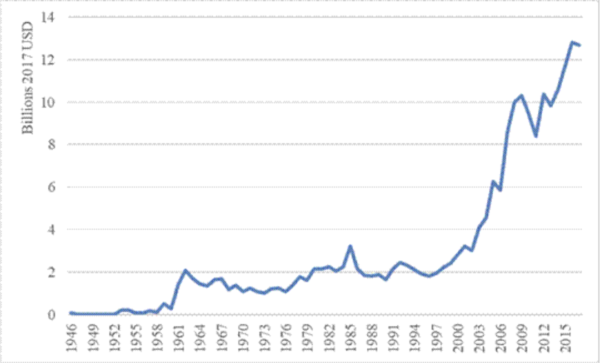
Fig 2. US Economic and Military Assistance to Sub-Saharan Africa, 1946–2017
Annual obligations in constant 2017 USD. Source: US Overseas Loans and Grants.
Watch the Recording
The recording of the briefing is available to watch on Youtube.
Participant Biographies
David Ekbladh is professor of history and core faculty in international relations at Tufts University. His books include Beyond 1917: The United States and the Global Legacies of the Great War (with Thomas Zeiler and Benjamin Montoya, Oxford University Press, 2017); The Great American Mission: Modernization and the Construction of an American World Order (Princeton University Press, 2010), which won the Stuart L. Bernath Prize of the Society of Historians of American Foreign Relations; and Plowshares into Swords: Weaponized Knowledge, Liberal Order, and the League of Nations (University of Chicago Press, 2022). He has been a Fulbright Scholar and held fellowships at Yale University, Harvard University, the American Academy of Arts and Sciences, the National University of Singapore, the University of Sydney, and the Norwegian Nobel Institute. He has worked for the Carnegie Corporation of New York (now the Andrew Carnegie Foundation) and with the Carnegie Commission on Preventing Deadly Conflict.
Leigh Gardner is professor of economic history at the London School of Economics and Political Science and a research associate at the University of Stellenbosch. Her research focuses on the economic history of Africa, particularly its long-run political and economic development and interactions with the global economy. She is the author of Taxing Colonial Africa: The Political Economy of British Imperialism (Oxford University Press, 2012); The Economic History of Colonialism (with Tirthankar Roy, Bristol University Press, 2020); and Sovereignty Without Power: Liberia in the Age of Empires, 1822–1980 (Cambridge University Press, 2022), which won the Lindert-Williamson Prize for Best Book in Global Economic History. Her current research project, supported by a British Academy Mid-Career Fellowship, uses the history of US-Africa relations during the interwar period to examine African responses to geopolitical shifts.
Christopher Tounsel is the Walker Family Endowed Professor in History and director of the African Studies Program at the University of Washington. He specializes in the history of Sudan and Black internationalism, with a focus on the uses of race and religion as political technologies. He is the author of Chosen Peoples: Christianity and Political Imagination in South Sudan and his latest book, Bounds of Blackness: African Americans, Sudan, and the Politics of Solidarity. He helped to organize South Sudan’s National Archive during its first year of independence and serves as an associate editor for Global Black Thought, the official journal of the African American Intellectual History Society.
Dane Kennedy is professor emeritus at George Washington University. He is the author of eight books, including The Imperial History Wars: Debating the British Empire and Decolonization: A Very Short Introduction. He served as director of the National History Center from 2014 to 2020 and president of the North American Conference of British Studies from 2011 to 2013.
Related Resources

February 25, 2026
History of Vaccines

January 1, 2026
Choosing a Career Pathway
January 1, 2026