
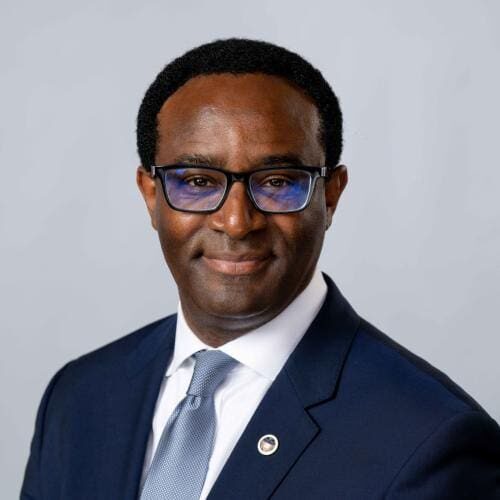
Presidential Address
Reflections on Our Times: Higher Education in Focus
Biography
Ben Vinson III is currently the Presidential Research Professor at the Baker-Nord Institute for the Humanities, Case Western Reserve University. He was formerly the 18th president of Howard University and a tenured professor of history in the university’s College of Arts and Sciences. He was previously provost and executive vice president at Case Western Reserve University, responsible for all facets of the academic programs and research of the university.
From the 2025 Presidential Biography booklet
By Joseph M. H. Clark, University of Kentucky; Norah L. A. Gharala, University of Houston; and Paul T. Zeleza, Howard University
Discurso de Vida
Ask anyone who has spent time with Ben Vinson to describe his disposition, and they will almost certainly mention his energy. Ben is as tireless as they come, with a seemingly inexhaustible reserve of excitement, curiosity, and positivity. This attribute no doubt comes in handy when balancing the demands of scholarship, university administration, and disciplinary leadership—and doing all three while also raising three kids.
As positive and forward-looking as Ben is, it would be a mistake to regard his positivity as a blind optimism. Ben is a deeply critical thinker, with a firm and clear-eyed sense of the challenges that face our scholarship, our discipline, and our world. He chooses positivity because he is at heart an institution builder whose view is fixed on the horizon. This is true of his scholarship—which blends cultural perspectives of the Black Atlantic with the social history that has long been the bedrock of colonial Latin American history—as well as his administrative and community-focused work. As an administrator, Ben’s work is typified by a laser focus on interdisciplinary collaboration, not just within the humanities but across divisions between humanities, social sciences, and natural sciences. In his many leadership roles—at Johns Hopkins, George Washington, Case Western Reserve, and Howard Universities—he has emphasized not only the importance of history and humanities in the academy but the interdependence of academic disciplines, and their potential to build strong communities and societies. Meanwhile, in his public-facing work, he has built bridges between the United States and Latin American academies and carved spaces for inclusivity.
To what can we attribute this commitment to collaboration, connection, and exchange? One of Ben’s defining qualities comes to mind: he listens. In the fields of colonial Latin American history and African diaspora studies, Ben is an authoritative voice, with the ability to speak with clarity and depth on the major questions of the field. But while he does use this voice, he is primarily an engaged listener. In the classroom, in seminars and conference panels, in one-on-one meetings with graduate students, and in casual conversations, he engages other people’s interests. He does not hold court or give long soliloquys or discursive lectures. He learns by listening. He teaches through questions. For Ben, scholarly connection, collaboration, and exchange are not a means to an end but the end itself.
As a graduate student, Ben’s skill for listening had clear value: you could see that he cared deeply about your thoughts and took your contributions seriously. At the same time, you often came out of meetings wanting to know more about what made him tick, where he came from, and who he was. His feedback was not guarded but measured, judicious, as if he did not want to put his thumb too heavily on the scale. At Hopkins, in private conversations that took place in the graduate workroom or over coffee at the now- shuttered Carma’s Cafe, Ben’s graduate students (who know him affectionately as “El Profe”) began to piece together the puzzle of our advisor’s origin story from among the breadcrumbs he scattered throughout our meetings. We knew that his father, Ben Vinson Jr., had served as a master sergeant in the United States Air Force, and that his mother, Lillie M. Hill Vinson, had been an elementary schoolteacher. Both of his parents were deeply involved in his life and work, even collaborating with him in archival research and oral interviews for his second book, Flight: The Story of Virgil Richardson, A Tuskegee Airman in Mexico (2004).
Attendant with his father’s military career, we also knew that he had moved around as a child, but we didn’t know exactly when or where or how long. He sometimes discussed his childhood in Sovizzo, Italy, where he learned Italian as the only American student at his school. But then he also told occasional stories about growing up in Rapid City, South Dakota, his ancestral home in the Alabama steel belt, or his high school years in Washington, DC, where he became a devoted fan of the Washington Commanders football team. Of course, this kind of roving trajectory is not at all uncommon for people from military households (or academic households, for that matter). But as graduate students prone to mythologizing our mentor, every time a new reference landed the plot got a little thicker. It also helped explain his dedication to listening—growing up an only child and always on the move, he had to adapt to his surroundings and meet people where they were.
From Washington, Ben went on to Dartmouth, where he double majored in classics and history and plotted a future career in law. If you pay strict attention, you can still see the clear imprint of his classics training sprinkled throughout his speaking and writing, in references to Cicero and Virgil. But his trajectory took an unexpected turn when he was awarded a Mellon Mays Undergraduate Fellowship, which enabled him to travel to Venezuela to research Afro-Latin festival culture and religious syncretism under the tutelage of cultural historians including Leo Spitzer, David Lagomarsino, and Raúl Bueno-Chávez. The experience ignited a fascination with the intertwined histories, diverse modalities, and common experiences of Blackness throughout the Americas. He transitioned away from the law track to a doctoral program in colonial Latin American history at Columbia University, where he apprenticed with the eminent social and economic historian Herbert S. Klein.
While Ben’s undergraduate work in cultural history honed his command of hermeneutics, in his work with Klein, who had been at the forefront of data-driven history, he quickly developed a facility for large-scale quantitative reasoning. In his first year at Columbia, Klein would regularly call Ben over to his apartment at odd hours to process colonial census records over takeout. It was in these sessions that Ben was first exposed to quantitative historical methods, which offered new ways of approaching questions of social, ethnic, and national belonging of Afro-descendants in Latin America. It was also in these sessions, working on the 1811 municipal census of Mexico City, that he was introduced to Mexico as a site of African diaspora.
Equipped with the tools of both cultural and social history and a new interest in Mexico, Ben went to Mexico City in summer 1993 with the support of a Tinker Foundation fellowship to work in the Archivo General de la Nación (AGN). There, he not only pursued his research but laid the foundation for friendships and collaborations that would last decades. For graduate students who followed him to Mexico many years later, simply mentioning the name “Ben Vinson” opened doors and brightened faces. This was true in academic contexts—at the Universidad Nacional Autónoma de México, the Instituto Mora, or the Universidad Veracruzana—but also in places like the Casa de las Americas in Colonia Tabacalera, a Quaker guesthouse where Ben often arranged housing for his students. “Ask for Nico,” he told us, “Tell him Ben sent you.” Likewise, at the AGN, it was not only the archivists and scholars who responded favorably to Ben’s name but the security guards and porteros. The relationships Ben built in Mexico in the 1990s literally opened doors decades later.
If Ben’s gift for making a lasting impression made a path for his students years later, the archive itself made a path for Ben. For those who have not had the opportunity to work at the AGN, it is a singular experience even for the most seasoned “archive rats.” Since 1980, the archive has been housed in the Palacio de Lecumberri, a 19th-century panopticon-style penitentiary located in the far northeastern corner of the federal district, near the appropriately named San Lázaro bus station. The archive’s carceral and remote setting sits in marked contrast with the capacious quality of its contents, particularly in the colonial period. For Ben, who first arrived in 1993 with the goal of studying the 1793 military census, the AGN revealed a richly detailed colonial world, offering multiple pathways for examining racial dynamics, social consciousness, and cultural belonging.
One of these was through the corporate institution of the free-Black militia, which became the subject of Ben’s dissertation and first book, both titled Bearing Arms for His Majesty: The Free- Colored Militia in Colonial Mexico (2001). In 1995–96, a Fulbright- Hays dissertation grant funded Ben’s return to the AGN to research what would become the first authoritative study of the Mexico’s free-Black militia. It was during this second research stint that he also began collecting research notes that would contribute to many subsequent projects, including a series of ethnographic interviews he conducted in the remote Costa Chica region of Mexico’s Pacific Coast, home to a large concentration of Mexico’s Afro-descendants. The interviews he conducted there with community leaders and activists in Mexico’s Black-identity movement, such as Trinidadian priest Fr. Jemmot Nelson, helped frame the questions that permeate Ben’s entire scholarly corpus, namely how the colonial legacies of race and caste live in Mexico’s national consciousness in the 20th and 21st century.
“Shadows of the Deep Past Linger into the Present”
Completed in 1998, Ben’s dissertation came at a critical juncture for Afro-Mexican history.1 While several Mexican scholars had been working on the history of African diaspora in Mexico for years, the subject remained relatively understudied in the American academy (with a few significant exceptions), particularly in contrast to the rich scholarship there was on the African diaspora in the colonial histories of the United States, the Caribbean, and Brazil. Building on the work of Patrick Carroll and Colin Palmer, Ben’s dissertation was at the forefront of a new wave of Afro-Mexicanist history in the American academy, alongside the pathbreaking work of Herman Bennett, Joan Cameron Bristol, Nicole von Germeten, and Trey Proctor.
What was critical about this moment in Afro-Mexican history was that it did not turn on the work of one scholar but many all at once. Collectively, the New Afro-Mexicanists demonstrated for Anglo-American scholars of Black history the extraordinary depth of the Mexican archive—not only the AGN, but also Mexico’s many provincial, municipal, notarial, and ecclesiastical archives and libraries. These scholars brought colonial Mexico’s mountains of paper to bear on old questions of race, ethnicity, creolization, resistance, and accommodation that had troubled historians of Afro-American societies for decades, pointing ways forward for scholars not only working on Mexico but across the Americas.
Along with other scholars of his generation, Ben recognized how much could be done with the Mexican archives to answer questions circulating in global scholarship on African diasporas. Bearing Arms mined the rich sources produced by and about Black militiamen. Their sense of pride as a group united by Blackness drove the enduring and compelling arguments of this early work, founded in petitions produced by milicianos demanding that the colonial regime and the wider society recognize their dignity and privileges as men of honor. The main questions that motivated his scholarship concerned life on the ground and the deep roots in Mexico of African-descended communities. The staggering volume of documents relating to Afro-descendants and Blackness across Mexico required making sense of the abundance of information and why it had not reached readers in the Anglophone world.
Ben is a hemispheric thinker who follows the trail of documentary proof in a particular style made possible by the nature of his sources. From the early days of his career, Ben created scholarly partnerships to promote the archives of the Spanish Americas as a destination for scholars of the African diaspora. His collaboration with his former academic advisor, Herbert Klein, on a second edition of African Slavery in Latin America and the Caribbean (2007) has been cited hundreds of times across disciplines. Ben further introduced readers to cutting-edge archival possibilities, including trends that today motivate vital discussions in our field, in edited volumes including Black Mexico: Race and Society from Colonial to Modern Times (2009), co-edited with Matthew Restall.
Ben’s interest in anthropology followed a long tradition in Mexican and Latin American scholarship of exchange between the fields. With anthropologist Bobby Vaughn, Ben wrote Afroméxico: El pulso de la población negra en México: Una historia recordada, olvidada y vuelta a recordar (2004), which moves freely between the distant past and the present. Ben’s early work focused on community formation and Black self-fashioning in the historical record in Mexico. In Africans to Spanish America: Expanding the Diaspora (2012), which he co-edited with Sherwin K. Bryant and Rachel Sarah O’Toole, this focus expanded to the larger Spanish American empire. His third monograph, Before Mestizaje: The Frontiers of Race and Caste in Colonial Mexico (2017), explored the foundations of social mobility in the Spanish empire: a fluid understanding of race and a rapidly expanding population of mixed ancestry. On the phenomenon he refers to as “racial mixture,” Ben argues that “its beginnings in the New World spawned a crisis of order; its growth thrust to the fore existential questions on the essence of being.”2 Looking at the “outliers of racial mixture” allowed Ben to interrogate new and old questions about categorization and draw out their meanings over space and time.3 The book marked a major contribution to how Latin Americanists think about the meanings of race and caste in the colonial period, winning the Latin American Studies Association’s Howard F. Cline Book Prize in 2019.
Readers will note Ben’s engagement with modalities of Blackness across the Americas and on an individual plane. While his scholarship of New Spain is a testament to the vitality of archival methods, we can also draw an arc across decades in which Ben has used his scholarship to find connections between past and present and across North America. With Flight, Ben embarked on an entirely different genre (biography), found it inadequate, and decided to produce a book that “blended” his historian’s voice with that of Virgil Richardson in order to situate Mexico as an “overlooked place of black refuge during the era of Jim Crow.”4 Twenty years later, Ben returned to a scholarship of facilitating the publication of Black life histories that crossed national borders. Frank O. Etheridge: Musician of the African Diaspora (2024) invites readers into the world of an African American musician by contextualizing his previously unpublished writings.
Across his many scholarly efforts, Ben’s work exemplifies how a skilled historian uses human stories to connect the past and the present: finding continuities in the performance of identity and the distribution of status, as well as grassroots efforts toward more inclusive, equitable, and just social systems.
Becoming El Profe
After graduating from Columbia, Ben walked across Broadway and took up a teaching position at Barnard College. It was around this time that, for his later graduate students, other aspects of “Vinson lore” began filtering into evidence, specifically his sideline in music. A saxophonist, in the late 1990s Ben married his love of music with his capacity for historically informed cultural criticism, publishing newspaper columns and appearing on radio stations across the country to discuss the “Latin explosion” in pop music and its tendency to elide Afro-Latin contributions to Latin America’s rich musical legacy. Then, when Ben left Barnard for Penn State University around the millennium, he brought his saxophone with him. In State College, he formed a cover band along with some other music enthusiasts in the Department of History, including fellow Mexicanist and saxophonist Matthew Restall, with whom he also collaborated on an edited volume. But when Ben left Penn State in 2006 to become the founding director of the Center for Africana Studies (CAS) at Johns Hopkins, it was the loss of a bandmate that stung Matt a bit more than the loss of a colleague. Fittingly, two decades later, both Ben and Matt have now brought their talents as historians to bear on the history of music: Ben by editing and publishing the writings of jazz musician Frank O. Etheridge in 2024, and Matt with his 2025 cultural history of the New Wave scene in the 1980s.5
Before Ben arrived at Hopkins, he spent significant time in the Research Triangle of North Carolina, first as a postdoctoral fellow at University of North Carolina at Chapel Hill, and later as a 2005–06 fellow of the National Humanities Center, where he revised Klein’s classic African Slavery in Latin America and the Caribbean. It was in Chapel Hill that he met a fellow postdoctoral scholar, a molecular biologist named Yolanda Fortenberry, who was studying potential treatments for thrombosis at UNC’s School of Medicine. They bonded over their passion for scholarship and commitment to family. In July 2005, the two were married in a ceremony in Yolanda’s hometown of New Orleans. Three years later in Baltimore, while Ben was serving as CAS director and Yolanda was assistant professor at the JHU School of Medicine, they welcomed their first child, Allyson, followed in 2010 by twins Brandon and Ben IV.
With three kids, two monographs, two co-authored books, and one edited volume to his name—all at the tender age of 40—Ben was not quite ready to settle. In 2010, he took an administrative position as vice dean for Centers, Interdisciplinary Programs, and Graduate Education at Hopkins and in 2013, he was named dean of the Columbian College of Arts and Sciences at George Washington University. The move to GWU allowed the Vinsons to keep their weekly brunch appointment at Miss Shirley’s Cafe in Baltimore’s Inner Harbor. But it was also the position that allowed Ben to hone his approach to building a truly transdisciplinary, diverse, and inclusive university.
Scholar-Administrator and Builder of the “Next-Gen HBCU”
Following Ben’s move into university administration traces the evolution of a distinguished historian of the African diaspora into a transformative academic leader whose work has reshaped major US universities. Across Johns Hopkins, George Washington, Case Western Reserve, and Howard Universities, he has consistently championed equity, interdisciplinarity, and institutional renewal, positioning the academy as both a site of intellectual inquiry and a driver of public good.
At Johns Hopkins, Ben focused on building interdisciplinary bridges. From 2006 to 2013, he served first as professor of history and director of the Center for Africana Studies, and later as vice dean for Centers, Interdisciplinary Programs, and Graduate Education in the Krieger School of Arts and Sciences. He was the first permanent head of the newly established Center for Africana Studies, broadening its academic profile and expanding course offerings, faculty participation, and civic partnerships.6 Under his leadership, the center deepened its focus on the global African diaspora and developed collaborations linking humanities, social sciences, and public policy. He strengthened ties with Baltimore’s cultural and civic institutions, positioning the center as a model of engaged scholarship that bridged campus and community.
In 2010, Ben was appointed vice dean for Centers, Inter- disciplinary Programs, and Graduate Education.7 In that capacity he oversaw more than 20 cross-disciplinary units, enhanced graduate training, and improved coordination of interdisciplinary initiatives. His leadership brought coherence to Johns Hopkins’s expanding network of centers while maintaining its intellectual vitality. The experience refined his administrative philosophy: that research, teaching, and engagement must operate as an integrated system—a vision he would carry into all subsequent roles.
In 2013, Ben made the move to George Washington University. As dean of the Columbian College of Arts and Sciences (CCAS), he led the institution’s largest and most complex academic unit, where he launched an ambitious agenda of academic integration, structural growth, and public engagement.8 He guided the integration of the Corcoran School of the Arts and Design into CCAS, uniting one of the nation’s oldest art schools with a major research university.9 Ben emphasized shared governance, faculty collaboration, and curricular alignment, ensuring that Corcoran’s creative traditions found a durable home within GWU’s academic structure. In public statements, he called the integration “an opportunity to reimagine art and design education in the twenty-first century.”10
In this period, alongside the dean of engineering, Ben oversaw the opening of Science and Engineering Hall, a $275 million, 500,000-square-foot facility that embodied GWU’s commitment to cross-disciplinary STEM education.11 The project coincided with new internal research funds—including the Dean’s Research Chair Award—and initiatives to promote collaborative inquiry across departments. Under his leadership, new majors in neuroscience, cognitive neuroscience, and environmental studies were launched, linking liberal-arts education to emerging global fields.12
Ben’s tenure was equally defined by inclusion and civic partnership. He expanded the Dean’s Scholars in Global Engagement Program to support student research abroad and founded new institutes such as the Cisneros Hispanic Leadership Institute and the Loeb Institute for Religious Freedom, positioning GWU as a national leader in ethical and multicultural education.13 His deanship also delivered unprecedented philanthropic results: more than $90 million raised to endow chairs, advance graduate fellowships, and strengthen interdisciplinary research.14 Faculty and trustees credited him with unifying the college through a vision of “education as civic enterprise.” When he departed in 2018, he left a college newly energized by academic innovation, financial stability, and community trust.15
Ben next became provost and executive vice president at Case Western Reserve University (CWRU).16 His leadership was immediately defined by the launch of Think Big, a strategic planning framework aligning research, teaching, and service around four thematic “pathways.” The plan emphasized inclusive participation, designating faculty, staff, and student “Pathway Leaders” to ensure collaborative implementation.17 Under his direction, Think Big became a living blueprint for transformation. During the COVID-19 pandemic, he recalibrated institutional priorities toward digital infrastructure, remote learning, and community well-being while sustaining momentum in research through the Veale Institute for Entrepreneurship. Faculty and student projects emerging from Think Big ranged from environmental-justice initiatives to university- community data collaborations that deepened local engagement.18
Ben distinguished himself as a thought leader through initiatives that shaped CWRU’s public discourse. He established the Critical Conversations series—forums convened by the Office of the Provost to engage students, faculty, and staff in civil dialogue on controversial topics such as race, free speech, and democracy.19 In 2022–23, for example, his office hosted discussions on “Gun Violence and the Second Amendment” and “Conflicts in the Middle East.”20
As provost, Ben convened several university-wide committees to confront national and institutional challenges: one on the Futures of Education, which examined shifts in pedagogy, technology, and access in a postpandemic world, and another on affirmative action, formed after the 2023 Supreme Court decision restricting race- conscious admissions. These committees produced frameworks for maintaining diversity and excellence while adhering to new legal parameters.
Equally transformative were his efforts to revive the Cleveland College for Lifelong Learning.21 The program sought to expand noncredit courses and public lectures for professionals, retirees, and adult learners across northeast Ohio, reconnecting the university to its historic civic mission and democratizing access to education.
Ben further advanced diversity initiatives by creating the Provost’s Advisory Council for Diversity and Inclusion and strengthening local pipeline partnerships. He co-led the Humanities in Leadership Learning Series, a $2 million Mellon Foundation project developing leadership pathways for underrepresented humanities faculty nationwide.22 By 2022, underrepresented-minority enrollment among incoming students had risen from 17 to 25 percent, and gender gaps in STEM fields had narrowed. CWRU faculty described his leadership as fostering “a culture of connection” grounded in empathy and shared accountability.
In 2023, Howard University’s Board of Trustees appointed Ben as its 18th president.23 Facing a structural deficit and operational fragmentation, he implemented a multiyear budgeting process, strengthened fiscal controls, and reorganized academic and administrative units. He stressed that financial integrity was essential to academic freedom. Central to his reforms was the Howard University Hospital, long burdened by financial and governance challenges. Working with trustees, consultants, and the College of Medicine, Ben created a vision for a unified academic health system linking the hospital with the Colleges of Medicine and the allied health sciences. He oversaw management and billing reforms, grant accountability, and personnel realignment, leading to improved financial performance and higher clinical standards.
Ben’s presidency ushered in record-setting philanthropy. In 2024, Howard’s College of Medicine received a $175 million endowment gift from Bloomberg Philanthropies’ Greenwood Initiative, the largest single gift in Howard’s history and part of a $600 million national investment in Black medical schools.24 The donation doubled the college’s endowment, expanded scholarships, supported biomedical research, and fortified Howard’s leadership in health-equity training. He also brokered partnerships with corporations and federal agencies in artificial intelligence, climate resilience, and data science, embedding Howard at the forefront of innovation.
Navigating Washington’s polarized climate, Ben worked constructively with the second Trump administration to sustain and expand HBCU funding through executive orders and federal appropriations. He engaged legislators on both sides of the aisle to preserve the HBCU Capital Financing Program and increase research allocations. His balanced, nonpartisan approach allowed Howard to influence federal higher-education policy while maintaining credibility across administrations.25
Under Ben’s leadership, Howard achieved Carnegie R1 classification, joining the top tier of research universities, the first HBCU to reach that level. He established interdisciplinary clusters in artificial intelligence, social-justice analytics, and climate resilience, while expanding undergraduate research fellowships. His Bison Engagement Tour, open forums held across campus, embodied transparent, inclusive governance. Although operational issues such as billing errors and hospital transitions posed challenges, Ben’s administration addressed them decisively. By 2025, Howard’s financial health, research profile, and morale had all strengthened. Upon announcing his resignation effective August 31, 2025, he affirmed that the foundation for the “Next Gen HBCU” had been secured.26
Legacy
Across two decades of leadership, Ben has redefined the scholar- administrator model. His record, rooted in historical scholarship yet oriented toward institutional innovation, illustrates how universities can align mission, equity, and excellence. From Africana studies at Johns Hopkins to the systemic reform of Howard University, Ben’s work exemplifies higher education at “maximum strength”: rigorous, inclusive, and transformative.
Meanwhile, despite taking on roles in university leadership, Ben has always remained active in research, publishing, and mentoring junior scholars—not only his own doctoral students but many others he has mentored informally, who can be found throughout the field of Afro-Latin American history. While he has gained a bird’s- eye view of the modern academic landscape—the challenges and opportunities that face not only the history discipline but higher education as a whole—he has not lost a ground-level perspective of the questions, motivations, and methods that drive the daily pursuit of scholarship. Most recently, he has applied this unique vantage to the challenges of generative artificial intelligence, a subject he has lately been studying from a humanistic angle, reiterating the need for technological development to honor human dignity, both past and present.
For his students, Ben’s latest pursuits add to the ever-growing catalog of “Vinson lore.” Upon learning at a recent reunion about his new turn to the topic of artificial intelligence and the humanities—a subject about which he gave the 2025 Compton Lecture at the Massachusetts Institute of Technology and on which he is co- authoring a book—one former student remarked appreciatively: “Classic Ben. He’s everywhere. South Dakota, Italy, Mexico, and now somewhere in the ether. He never stops.” He never does stop; never stops learning, never stops listening, never stops advocating for the place of humanities in the modern university and in our society, not only to “give depth to our days,” but to “cultivate lives of meaning and dignity” and “pursue justice.”27
Select Bibliography
Books
African Slavery in Latin America and the Caribbean, 2nd ed. Co-authored with Herbert S. Klein. Oxford Univ. Press, 2007.
Africans to Spanish America: Expanding the Diaspora. Co-edited with Sherwin K. Bryant and Rachel Sarah O’Toole. Univ. of Illinois Press, 2012.
Afroméxico: El pulso de la poblacion negra en México, una historia recordada, olvidada y vuelta a recordar. Co-authored with Bobby Vaughn. Fondo de Cultura Económica, 2004.
Bearing Arms for His Majesty: The Free-Colored Militia in Colonial Mexico. Stanford University Press, 2001.
Before Mestizaje: The Frontiers of Race and Caste in Colonial Mexico. Cambridge Univ. Press, 2018.
Black Mexico: Race and Society from Colonial to Modern Times. Co-edited with Matthew Restall. Univ. of New Mexico Press, 2009.
Flight: The Life of Virgil Richardson, A Tuskegee Airman in Mexico. Palgrave Macmillan, 2004.
Frank O. Etheridge: Musician of the African Diaspora. Routledge, 2024.
Journal Articles
“African (Black) Diaspora History, Latin American History—A Comment.” The Americas 63, no. 1 (July 2006).
“Afro-Mexican History: Trends and Directions in Scholarship.” History Compass 3, LA 156 (September 2005).
“Articulating Space: The Free-Colored Military Establishment in Colonial Mexico from the Conquest to Independence.” Callaloo 27, no. 1 (February 2004).
“Counting Heads: Race and Non-Native Tribute Policy in Colonial Spanish America.” Co-authored with Cynthia Milton. Journal of Colonialism and Colonial History 3, no. 3 (2002).
“Fading from Memory: Historiographical Reflections on the Afro-Mexican Experience.” Review of Black Political Economy (Summer 2005).
“Free-Colored Voices: Issues of Representation and Racial Identity in the Colonial Mexican Militia.” Journal of Negro History 80, no. 4 (Fall 1995).
“Introducing the New African Diasporic Military History in Latin America.” Co- authored with Stewart R. King. Journal of Colonialism and Colonial History 5, no. 2 (Fall 2004).
“La categorización racial de los afromexicanos durante la época colonial: una revision basada en evidencia referente a las milicias.” Memorias de la academia Mexicana de la historia correspondiente de la real de Madrid XLIV (2001).
“Los milicianos pardos y la construcción de la raza en el México colonial.” Signos históricos 2, no. 4 (July–December 2000).
“Race and Badge: The Free-Colored Militia in Colonial Mexico.” The Americas 56, no. 4 (April 2000).
“The Racial Profile of a Rural Mexican Province in the ‘Costa Chica’: Igualapa in 1791.” The Americas 57, no. 2 (October 2000).
“West Side Story: Free-Black Labor in the Mexican Pacific During the Late Colonial Period as Seen Through the Revillagigedo Census.” Journal of Colonialism and Colonial History 10, no. 3 (2009).
Notes
- Subtitle quote from Ben Vinson III, Before Mestizaje: The Frontiers of Race and Caste in Colonial Mexico (Cambridge Univ. Press, 2017), 204. [↩]
- Vinson, Before Mestizaje, 15. [↩]
- Vinson, Before Mestizaje, 16. [↩]
- Ben Vinson III, Flight: The Story of Virgil Richardson, A Tuskegee Airman in Mexico (Palgrave Macmillan, 2004), 7. [↩]
- Matthew Restall, Ghosts—Journeys to Post-Pop: How David Sylvan, Mark Hollis and Kate Bush Reinvented Pop Music (Sonicbond Publishing, 2025). [↩]
- “Wholly Hopkins: The Center for Africana Studies Gets Its First Permanent Director,” Johns Hopkins Magazine, November 2007. [↩]
- “KSAS: New Structure at the Top,” The Gazette, September 20, 2010. [↩]
- “Ben Vinson III Named Dean of the Columbian College of Arts and Sciences,” GW Today, June 3, 2013. [↩]
- “Columbian College Dean Outlines Corcoran School’s Progress,” GW Today, October 10, 2014. [↩]
- “Columbian College Dean Outlines.” [↩]
- “Science and Engineering Hall Opens,” GW Today, January 10, 2015. [↩]
- “Dean Vinson Departing CCAS to Become Provost of Case Western Reserve University,” Columbian College of Arts and Sciences, George Washington University, March 15, 2018. [↩]
- “Cisneros Hispanic Leadership Institute Launches,” GW Today, June 2015; “Loeb Institute for Religious Freedom Announced,” GW Today, October 2016. [↩]
- “Dean Vinson Departing.” [↩]
- “CCAS Dean Named Provost of Case Western Reserve University,” GW Today, March 12, 2018. [↩]
- “Meet New Provost Ben Vinson III,” Think Magazine, Fall 2018. [↩]
- “Provost Ben Vinson III Announces Think Big Pathway Leaders,” CWRU News, January 30, 2020. [↩]
- “Think Big Announces Spring 2021 Plans,” Case Western Reserve University, Office of the Provost, March 4, 2021. [↩]
- “Programs and Events: Enhancing Civility and Connection,” Case Western Reserve University, Office of the Provost, 2024. [↩]
- “Critical Conversation #4: Gun Violence and the Second Amendment,” Case Western Reserve University, Office of the Provost, December 2, 2022; “Critical Conversations,” CWRU Newsroom, January 24, 2023. [↩]
- “Siegal Lifelong Learning Program Offers Courses Beginning January,” CWRU News, January 5, 2018. [↩]
- “Humanities in Leadership Learning Series (HILLS) Grant to CWRU,” Mellon Foundation press release, 2019. [↩]
- “Howard University Appoints Revered Historian and Academic Leader Ben Vinson III, PhD, as 18th President,” The Dig, May 2, 2023. [↩]
- “Howard University Receives Transformative $175 Million Gift from Bloomberg Philanthropies to Bolster College of Medicine Endowment,” The Dig, August 6, 2024. [↩]
- “Secretary McMahon Tours Howard University,” US Department of Education press release, July 22, 2025. [↩]
- “Howard University’s 18th President Steps Down; University’s Board of Trustees Appoint Interim President,” The Dig, August 22, 2025; Nick Anderson, “Howard University President Ben Vinson III to Depart after Two Years,” Washington Post, August 22, 2025. [↩]
- Ben Vinson III, “AI in an Age After Reason: A Discourse on Fundamental Human Questions,” Compton Lecture, Massachusetts Institute of Technology, March 17, 2025. [↩]