
The American Historical Association is a member of the recently established National Parks Cultural Resource Coalition, which held its official kickoff event on March 5, 2026, at the US Capitol. Sarah Weicksel, AHA executive director, served as a panelist on the America250 and Beyond panel and delivered the following comments at the Coalition’s press conference.
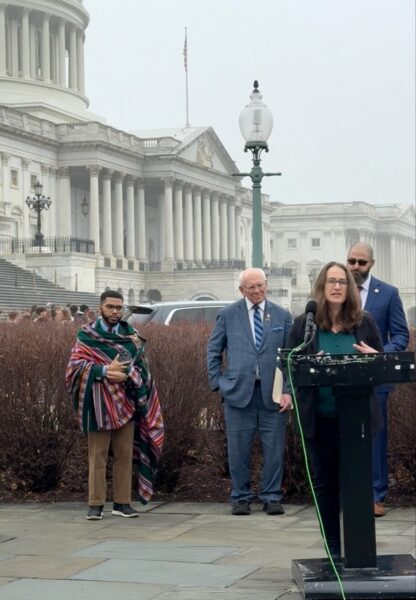
AHA executive director Sarah Weicksel delivering her remarks at the press conference
The American Historical Association was founded in 1884 for the promotion of historical studies in the United States. We provide leadership for the discipline of history and promote the critical role of historical thinking in public life. Our organization is tasked with ensuring that historians can teach, write, curate, and present history with integrity. That means ensuring that the entirety of history can be presented in its full and unvarnished context, based on historical evidence.
Our work applies to wherever history is taught and presented—from classrooms in high schools and colleges to museums to the historic sites and parks of the National Park Service.
Americans place a great deal of trust in the accuracy of history presented at historic sites and in museums. These places interpret history where it happened and through the things that survived—the letters, diaries, documents, images, artifacts, recordings, videos, and so many other forms of evidence, that people left behind.
The public trusts that historical experts interpret that history as it happened. They want to learn the nuances, the complexity, the parts of our history that inspire us. And they want to know about the difficult, even violent, moments of our history—and to see how we emerged from the most difficult moments of our past.
The trust that the public places in our shared institutions, like the National Park Service and the historic sites that it preserves, is broken when partisan efforts attempt to alter that history, to erase that history, and to deny historical evidence.
History is an evidence-based discipline and those of us who work in history, no matter what our role or our institution, we agree to work by a set of professional standards. Those standards require us to abide by, to respect, and to protect the integrity of the historical record.
This is not to say that historical interpretations never change. They do—as new evidence and new ways of understanding emerge, and as new questions are asked. But never do we erase history; never do we deny the facts of what happened.
History requires us to grapple with the entirety of past events, places, people, and the things that they left behind. We must be committed to telling the entire American story in all of its complexity, with all of its twists and turns. And if we fail to protect the integrity of history, if we deny historical evidence, then the American public is left without a usable past—without a usable past to chart a pathway for our future.