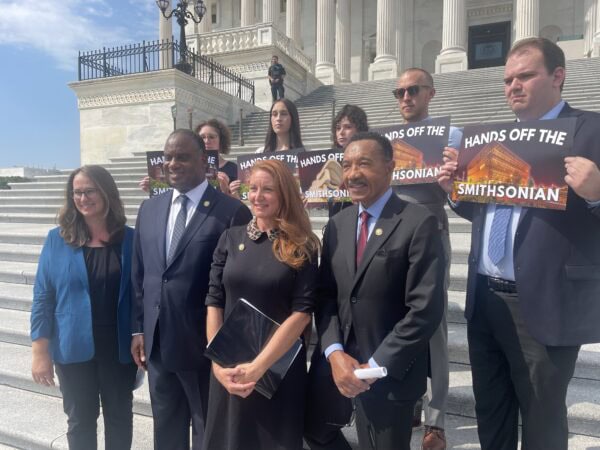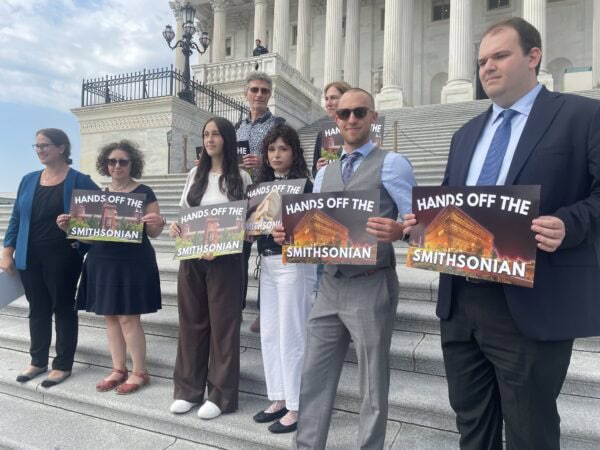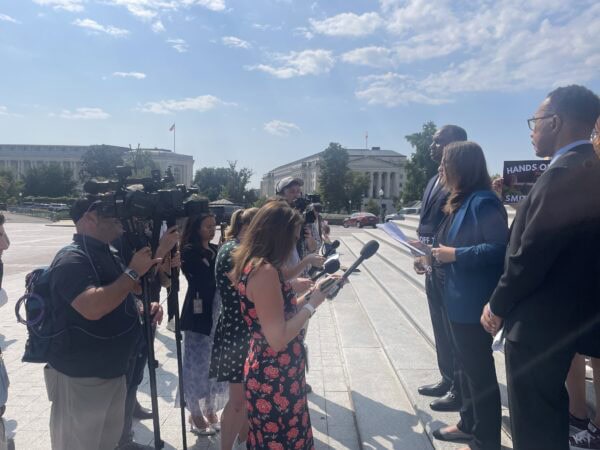
AHA executive director Sarah Weicksel delivered the following remarks at a press conference hosted by Representatives Melanie Stansbury, Jonathan Jackson, and Kweisi Mfume on September 17 announcing the introduction of the Smithsonian Integrity and Historical Independence Act of 2026.
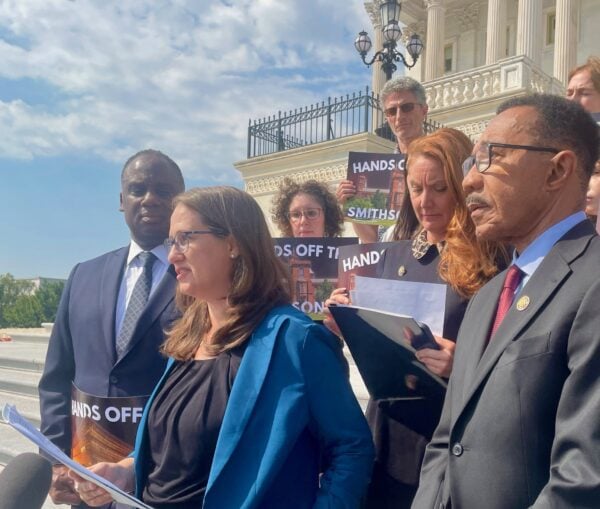
AHA executive director Sarah Weicksel (center) with Representatives Jonathan Jackson (left) and Representatives Melanie Stansbury and Kweisi Mfume (right).
I’m here today to support the independence of the Smithsonian Institution for the benefit of all the American people. I want to thank Representative Stansbury, Representative Mfume, and Representative Jackson for introducing the Smithsonian Integrity and Historical Independence Act of 2026.
Millions of visitors walk through the doors of Smithsonian museums every year. It is a beloved institution that has earned the trust of the public since its founding in 1846. And it has earned that trust because of its independence.
The people who work at the Smithsonian’s history museums are ordinary people—people from many backgrounds and perspectives. They love history; they bring their own families to enjoy the museums on weekends; they work hard as employees and public servants. And they do that work with integrity—as historians, curators, educators, conservators, and in many other roles through which they bring knowledge to the American people.
When historians and other museum professionals decide to pursue this kind of work, we commit ourselves to basing our work on one thing: historical evidence.
History is interpretive, but our evidence-based interpretation draws upon the documents, photographs, paintings, objects, and all of the bits and pieces of the past that people left behind. We spend years learning how to weave that evidence together to tell complex narratives about the past.
Historians do not distort evidence. We do not fabricate evidence. We do not ignore evidence. We practice our craft with great integrity.
By preserving the Smithsonian’s independence, we—all of us—preserve Americans’ trust in its exhibitions, programs, educational materials, and research.
We ensure that Americans continue to benefit from the decades of deep research that curators and others who work on exhibits bring to their work.
We ensure that the Smithsonian’s collections are preserved for future generations of Americans. And we do so by enabling conservators to make decisions based on scientific evidence—decisions about how long an artifact can be exposed to light or in what conditions it can be displayed. They make those decisions so that artifacts ranging from George Washington’s uniform to the space shuttle Discovery can be preserved and continue to inspire the Americans who will come after us.
We ensure that Americans can walk into a museum and learn about themselves, their communities, and the full tapestry of the American past. We ensure that they are able to learn the entirety of the American story from various vantage points of the many Americans who lived out and made that history.
The independence of the Smithsonian means that the institution can continue to set the highest standards of museum practice, do cutting-edge research, and continue to collect a wide range of artifacts that will enable future historians to tell the full story of the moment in which we live.
We ensure that visitors can walk into a museum, learn, and come away with a new appreciation for the people who came before them and with new questions to explore for themselves.
When people walk through the doors of the Smithsonian, they are inspired, surprised, excited, moved to tears—all by the artifacts and the stories they find there. Preserving the Smithsonian’s independence ensures that visitors can continue to learn from the entirety of the American story and that it continues to be one of the United States’ most beloved and trusted institutions.