About This Module
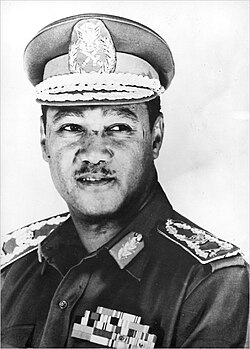
Ja’afar Nimeiri in 1974. Wikimedia Commons
This module offers a chance to explore the how authoritarian regimes assess potential threats to their rule.
The setting is the complex internal politics of authoritarian rule in Sudan after a 1969 military coup. Having come to power with the backing of one wing of the communist party as well as the military, the regime’s political orientation would shift dramatically over its time in power, from communist to socialist, to center-right, and finally to reactionary Islamist before being ousted in another civil uprising in 1985. These swings in politics were accompanied by a progressive centralization of power by the military regime. When the regime first came to power in 1969, it did so with support from one wing of the communist party. But communist officers became concerned by their marginalization over time. They attempted an ultimately failed coup in the spring of 1971 that created a crisis of legitimacy for the regime. The primary source is a weekly security report compiled by the Sudanese security apparatus two months after the unsuccessful coup written by the regime’s police, army and national security-related agencies. Professor Rebecca Glade provides a teaching plan that helps student see how the document reveals the security concerns of the state and why it perceived particular communities as threats to the regime. As part of Authoritarianism 101, this module enables teachers to explore the themes of authoritarian practice and limits to authoritarian control.
Access Full Module
Contributor
Rebecca Glade
Rebecca Glade is a visiting research associate at Makerere Institute of Social Research and associate editor of the Makerere Historical Journal, the journal of the Department of History, Archaeology, and Heritage Studies at Makerere University. Her book manuscript, Sudanese Political Movements and the Struggle for the State, 1964–1985 examines the intersections between political competition and state formation in the contested politics of early independence Sudan.
Have you used this module with your students?
We want to hear from you! Give us your feedback here.