About This Module
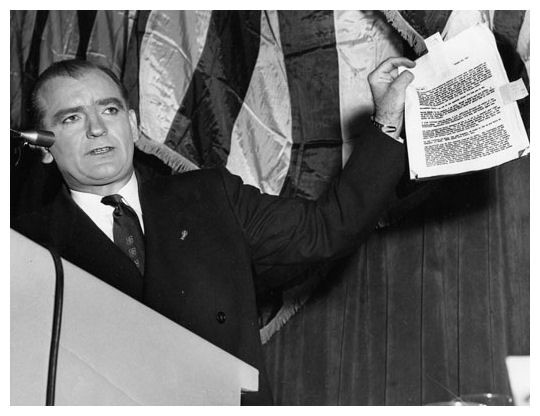
Senator Joseph R. McCarthy of Wisconsin holding up a report on Democratic Presidential candidate Adlai E. Stevenson. Wisconsin Historical Society.
This module explores how American Cold War rhetoric advanced authoritarian ideas about punishing dissent and consolidating political power.
The setting is a Republican Women’s Club meeting in Wheeling, West Virginia, in 1950. McCarthy claimed in this talk that he had a list of government officials in high places who were actually “communists” and “traitors,” thus staking out his persona as a famous and fiery anti-communist who could root out subversion at the height of the Cold War. Although many educators use this document to teach the history of McCarthyism, Professor Darren Dochuk suggests we can also use it to explore a strain of authoritarianism in the United States. He asks how McCarthy’s populist language–an “us versus them” rhetoric laced with threats about purging “disloyal” U.S. citizens–could advance authoritarian ideas about consolidating political power and punishing dissenters. The teaching plan guides a close inquiry of the speech’s important Cold War dimensions, but its questions also offer a chance to discover linkages between authoritarian ideology and McCarthy’s anti-communism–a connection history educators do not often draw. As part of Authoritarianism 101, this module explores the theme of authoritarian practice by examining the modes and methods of authoritarian ideology and political control.
Access Full Module
Contributor
Darren Dochuk
Darren Dochuk is the Andrew V. Tackes Professor of History at the University of Notre Dame. He researches the intersections of religion and politics in the United States and has published widely on this topic, including his edited collection Religion and Politics Beyond the Culture Wars: New Directions in a Divided America (University of Notre Dame Press, 2021), Anointed With Oil: How Christianity and Crude Made Modern America (Basic Books, 2019), and From Bible Belt to Sunbelt: Plain-Folk Religion, Grassroots Politics, and the Rise of Evangelical Conservatism (Norton, 2011).
Have you used this module with your students?
We want to hear from you! Give us your feedback here.