About This Module
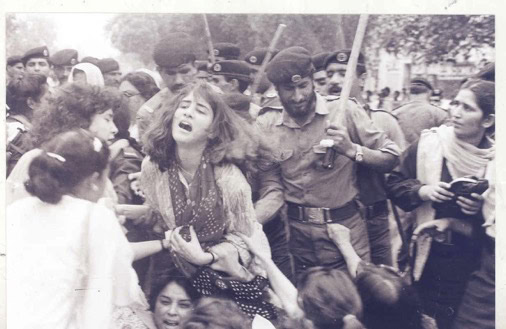
Photograph of the Law of Evidence Protest, February 1983, by Rahat Ali Dar, February 12, 1983. Courtesy of Shirkat Gah Women’s Resource Center, Lahore, Pakistan.
This module explores how women have advocated for their rights under authoritarian regimes.
The setting is a nonviolent march in 1983 organized by local women’s groups in Pakistan against a newly proposed law that defined women as secondary citizens. As Professor Durban Mitra explains, the law would have made women’s testimony in court worth only half that of men, with potentially far- reaching consequences in cases of rape and assault against women. The march also defied the total ban on public assemblies under military authoritarian rule in Pakistan and met with a violent show of force. The primary source is a photograph of the march at the moment when the police charged the crowd with raised batons, beating people and arresting dozens of women. The police also fired tear-gas to break up the crowd, creating an environment of chaos and fear. Mitra offers a broad context for the photograph as a source for writing the long history of nonviolent protest in the colonial and postcolonial world, street marches against authoritarianism and global histories of policing and carceral state politics. The teaching plan provides a guide to help students undertake a deep reading of the image itself, focusing on understanding the operation of feminist movements for equal rights against prejudicial laws in authoritarian regimes. As part of Authoritarianism 101, this module enables teachers to explore challenges to authoritarianism from civil society.
Access Full Module
Contributor
Durba Mitra
Durba Mitra is the Stanley Kelley Jr., Visiting Professor for Distinguished Teaching in Princeton University’s Program in Gender and Sexuality Studies. She is a feminist historian and interdisciplinary scholar who specializes in histories of South Asia, South Asian diasporas, and global histories of women, gender, and sexuality. She is the author of two books, The Future That Was: A History of Third World Feminism Against Authoritarianism (Princeton University Press, 2026) and Indian Sex Life: Sexuality and the Colonial Origins of Modern Social Thought (Princeton University Press, 2020).
Have you used this module with your students?
We want to hear from you! Give us your feedback here.