About This Module
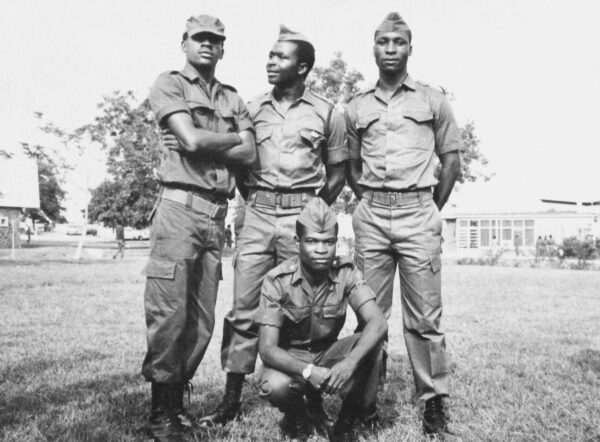
Student-soldiers at the University of Kinshasa, ca. 1971–1972. Source: Mbuyi Kapuya.
This module explores how authoritarian regimes suppress dissent, with a focus on students.
The setting is the Congo, which had achieved independence from Belgium in the 1960s. In years following, political upheaval fostered the conditions for a military coup and the seizure of power by General Joseph-Désiré Mobutu in 1965. Mobutu restricted the rights and activities of political parties, labor unions, the media, and even churches. Yet, as Professor Pedro Monaville shows, college students proved harder to control. They demanded a democratic education that rejected the mindsets and practices of the Belgian colonial past. Mobutu’s government, therefore, saw them as a threat, using violence and, ultimately, conscription into the army, to contain student dissent. The aim was to convert student protesters into obedient soldiers. The teaching plan enables a close read of a set of drawings from a university handout on military regulations for these student-soldiers, opening up discussion about how authoritarian rulers perceive youth as a threat and how they try to manage that threat. As part of Authoritarianism 101, this module enables teachers to explore the theme of authoritarian practice and to develop students’ visual literacies through analysis of the visual cultures of authoritarianism.
Access Full Module
Contributor
Pedro Monaville
Pedro Monaville is associate professor of history at McGill University. His research focuses on colonial and postcolonial Congo, political subjectivities, memory work, and the connections between visual arts and history. He is the author of Students of the World: Global 1968 and Decolonization in the Congo (Duke University Press, 2022) and the co-editor (with Nancy Rose Hunt) of Congo’s Super Star of Street Comics: Interventions, Memories, and Histories around Papa Mfumu’Eto 1er (forthcoming with Leuven University Press in 2026).
Have you used this module with your students?
We want to hear from you! Give us your feedback here.