About This Module
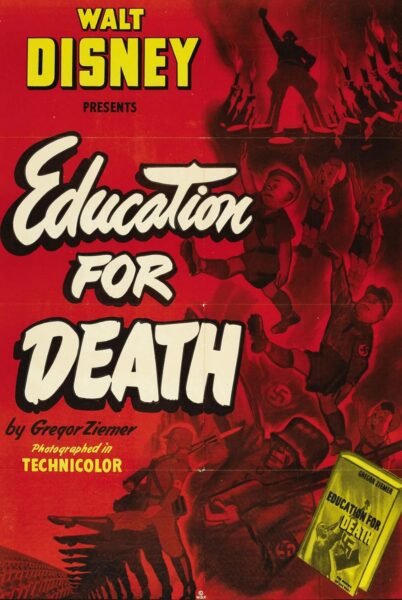
Poster for Education for Death: The Making of the Nazi. Walt Disney Studios, 1943.
This module explores how people become followers of authoritarian leaders.
It focuses on the work Marie Langer whose critique of a World War II era Disney anti-Nazi propaganda film Education for Death: The Making of the Nazi (1943) offered transformative new insights into how people become fascists. Langer was an Austrian-born, Argentine Jewish intellectual who fled Europe from the Nazis and became an early founder of psychoanalysis in Argentina. Two primary sources anchor this module. It contains the full ten-minute Disney cartoon film that tells the story of a child subjected to Nazi propaganda along with excerpts from Langer’s 1947 essay in which she draws on the cartoon to illustrate how fascism expressed individual and collective psychological tendencies that center violence and hatred. Professor Federico Finchelstein provides a wider context for understanding Langer and her work. She was one of many Jews escaping the German Nazi regime who entered Argentina and other Latin American countries before and during World War II. Finchelstein also shares that his own grandparents were among the Jewish refugees who settled in Argentina and notes the country was deeply divided between support for and secular resistance to fascism and antisemitism. His teaching plan provides a set of guided questions for students to consider as they view the Disney film that focus on unpacking a single scene Langer uses in her writing to examine the role of self-victimization, violence and paranoia in authoritarian propaganda. As part of Authoritarianism 101, this module enables teachers to explore the themes of authoritarian practice and the visual cultures of authoritarianism.
Access Full Module
Contributor
Federico Finchelstein
Federico Finchelstein is an expert on fascism, populism, and dictatorship and is the University in Exile Research Professor and professor of history at the New School for Social Research and Eugene Lang College in New York City. His books include The Wannabe Fascists (University of California Press, 2024), A Brief History of Fascist Lies (University of California Press, 2022), and From Fascism to Populism in History (University of California Press, 2019).
Have you used this module with your students?
We want to hear from you! Give us your feedback here.