About This Module
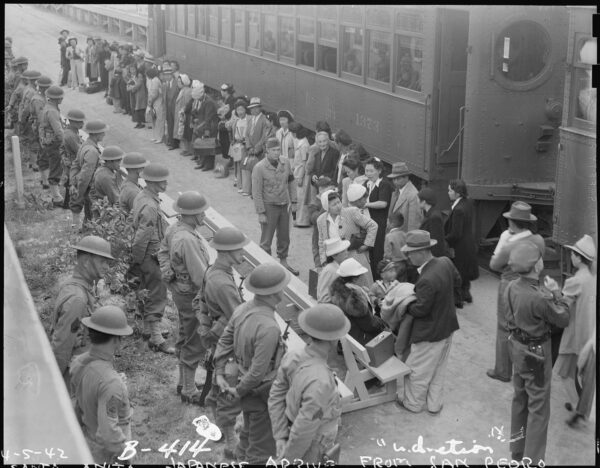
Japanese Americans arrive at the Santa Anita (California) Assembly Center before being moved inland to an internment camp. Records of the War Location Authority, National Archives.
This module offers a chance to analyze how authoritarian governments can manipulate a sense of crisis to turn a particular group of citizens into internal enemies.
The history of Japanese incarceration is well known, but this module presents a way to understand that history as a type of wartime authoritarianism built on racial panic. The setting is a congressional hearing in San Francisco, a convening to consider how to implement President Franklin D. Roosevelt’s Executive Order 9066, which authorized the Secretary of War to establish military areas from which any civilian could be removed. As Professor Hidetaka Hirota shows, the testimony of Attorney General of California Earl Warren laid the ideological foundations for the incarceration of over 120,000 people of Japanese descent. Warren drew on long held racial stereotypes of Asian peoples to argue it was impossible to determine Japanese Americans’ wartime loyalty. His testimony captures an important moment in the lead up to the decision to imprison Japanese Americans. The teaching plan enables students to ponder that decision as a type of wartime authoritarianism informed by racism and fear of the “foreigner.” As part of Authoritarianism 101, this module explores the theme of authoritarian practice by examining the evolution of authoritarian thinking and the tools of authoritarian control.
Access Full Module
Contributor
Hidetaka Hirota
Hidetaka Hirota is an associate professor of history at the University of California, Berkeley, where he serves as a faculty affiliate at the Asian American Research Center and the Center for Japanese Studies and directs the Canadian Studies Program. He is the author of Expelling the Poor: Atlantic Seaboard States and the Nineteenth-Century Origins of American Immigration Policy (Oxford University Press, 2017). His scholarship has been published in numerous journals, including the Journal of American History, American Quarterly, the Journal of American Ethnic History, and the Journal of the Civil War Era.
Have you used this module with your students?
We want to hear from you! Give us your feedback here.