About This Module
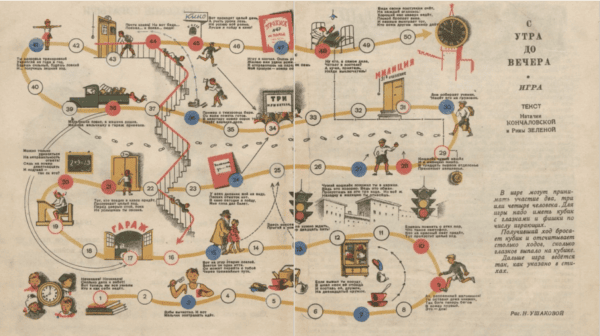
“From Morning to Evening,” Murzilka 1 (Russian State Children’s Library, 1944).
This module allows students to explore how children learn to become ideal citizens in authoritarian regimes through play.
The primary sources are two World War II era children’s board games, a 1936 Italian game “The Ethiopian War” that appeared during fascist efforts to build an empire in emulation of Rome and a 1944 Soviet game “From Morning to Evening” that appeared a few months before the Soviet army defeated the Nazis and seized Berlin. Professor Karl Quails explains how games worked alongside schools and mandatory youth groups to surround children with authoritarian messages and construct ideal types of children. The teaching plan focuses on a close examination of the two gameboards to illustrate the different kinds of socialization these games sought to foster and how children were to be raised. In the Soviet game, players learn ideal moral characteristics for children that align with Soviet vospitanie, a type of character training that permeated schools, youth groups, and leisure. Children with good behaviors are allowed to jump forward several spaces whereas poor behavior forces players backward. By contrast the Italian game centers the profit motive, gruesome depictions of violence and overt racism with little attention to children as helpful members of a community. Children learn that violence is a justifiable way to subdue their enemies in the goal of securing an Italian empire. As part of Authoritarianism 101, this module enables teachers to explore the themes of authoritarian practice and the visual cultures of authoritarianism.
Access Full Module
Contributor
Karl D. Qualls
Karl D. Qualls is the author of over two dozen chapters and articles and three books, From Ruins to Reconstruction: Urban Identity in Soviet Sevastopol After World War II (Cornell University Press, 2009) and its updated Ukrainian-language edition (Academic Studies Press, 2025), and Stalin’s Niños: Educating Spanish Civil War Refugee Children in the Soviet Union, 1937–1951 (University of Toronto Press, 2020).
Have you used this module with your students?
We want to hear from you! Give us your feedback here.