About This Module
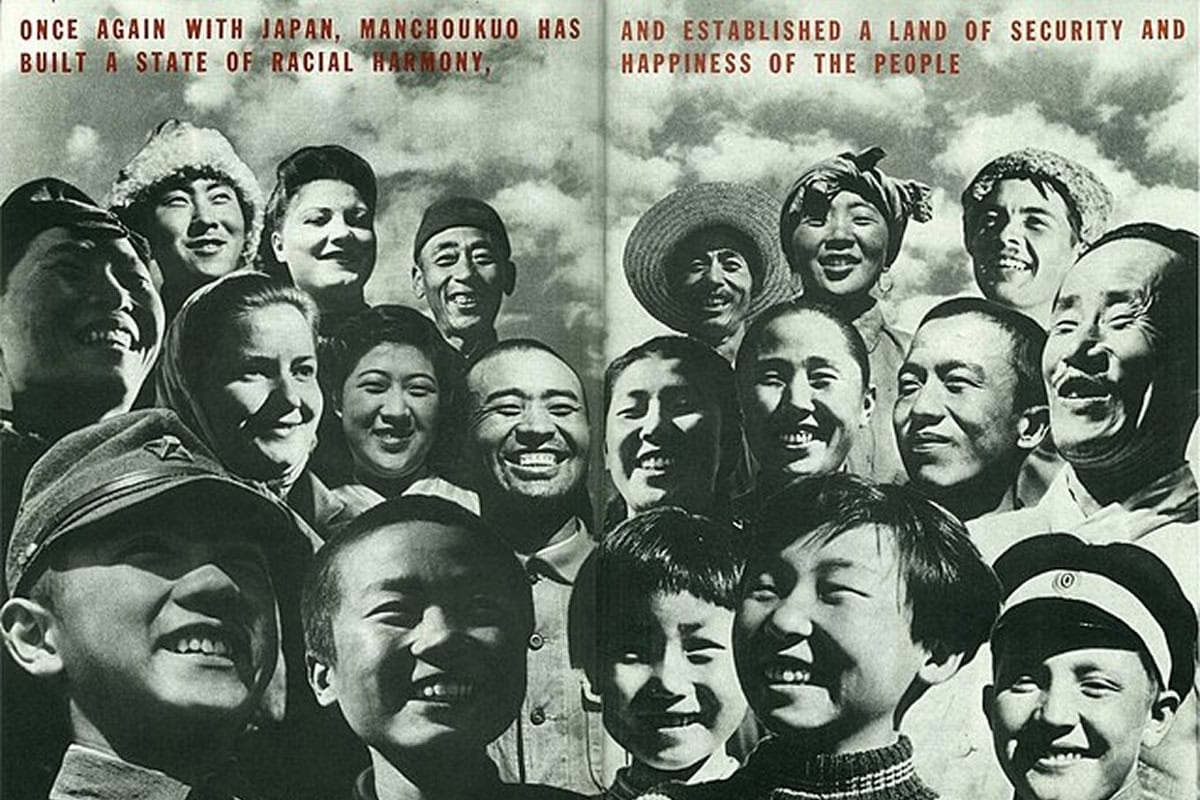
Poster from the Japanese propaganda magazine Front (1942).
This module explores the forces that produce public support for authoritarian states and their policies. The module is set in Manchuria in the 1930s and early 1940s under Japanese military occupation and rule in a period when the rise of the Japanese right and democratic backsliding had culminated in a de-facto military dictatorship in Japan itself. The primary source is an excerpt from an oral history with a Japanese businesswoman who was one of more than 800,000 Japanese migrants to Manchuria in this era and a strong supporter of the military authoritarian government. Professor Louise Young sets the broader context for what the Japanese authoritarian government called its “New Order” in Asia, the economic motivations that brought Japanese nationals to Manchuria, and the role that women played on the ground advancing the Japanese authoritarian turn. The teaching plan is designed to allow students to critically use oral history to approach everyday authoritarian history through the eyes of those who lived it. It provides a set of guided questions designed to unpack the who, what, where, when and why of the oral history account and how it contributes to understanding why authoritarian states can command everyday public support. The teaching plan also provides a role-playing exercise to help students see how larger historical-social forces including gender and empire have shaped individual attitudes toward authoritarianism. As part of Authoritarianism 101, this module helps teachers explore histories of authoritarianism in which individuals and non-state actors have supported and collaborated with authoritarian regimes.
Access Full Module
Multimedia
Contributor
Louise Young
Louise Young is Marilyn B. Young Professor of Japanese History at the University of Wisconsin–Madison. She is the recipient of multiple awards, including Fulbright, Japan Foundation, and Social Science Research Council fellowships, and is a member of the American Academy of Arts and Sciences. Her research and teaching interests include social and intellectual history, Japanese imperialism, the Asia-Pacific War, and postwar Japan. She is the author of the Fairbank Prize–winning Japan’s Total Empire: Manchuria and the Culture of Wartime Imperialism (University of California Press, 1998) and Beyond the Metropolis: Second Cities and Modern Life in Interwar Japan (University of California Press, 2013).
Have you used this module with your students?
We want to hear from you! Give us your feedback here.