About This Module
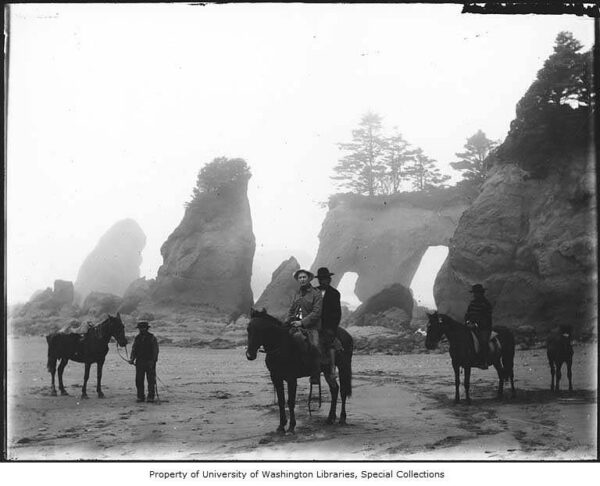
Members of the Quinaults tribe on horses at the beach. Courtesy of the University of Washington Libraries, Special Collections.
This module explores how the Quinault Indian Nation challenged the US government’s attempt to control their fishing rights and practices.
The setting is Washington state in the early twentieth century, and the two sources, a Quinault Indian Nation letter to the Commissioner of Indian Affairs and a petition from Quinault Indians to state legislators, together offer a compelling snapshot of indigenous resistance to federal governance. As part of its administration of the reservation system in the U.S., the Office of Indian Affairs sent agents to live on reservations to distribute resources, such as food and medicine, but also to surveil and regulate. Historian Ashley Lewis calls these agents “little dictators,” as in this case, their heavy-handed oversight sought to control how the Quinault fished, when they fished, and even their choice of fishing equipment. The government also attempted to compel hard labor from the Quinault before they could fish for salmon, striking at the heart of their identity as “Salmon People.” The teaching plan offers a way for students to understand Indigenous resistance as creative, strategic, and incremental. It also reveals the Quinault peoples as a nation whose leaders had to navigate and negotiate treaty economies with a governing nation far more powerful. Still, this module offers a rich case study of how Indigenous peoples resisted that power, and it offers a way to include Indigenous tribes and peoples in the long history of resistance to authoritarianism.
Access Full Module
Contributor
Ashley Nichole Lewis
Ashley Nichole Lewis is a member of the Quinault Indian Nation and a PhD candidate of history at the University of California, Davis. Her research examines Indigenous governance and resilience through Quinault relationships with Pacific Northwest salmon fisheries.
Have you used this module with your students?
We want to hear from you! Give us your feedback here.