About This Module
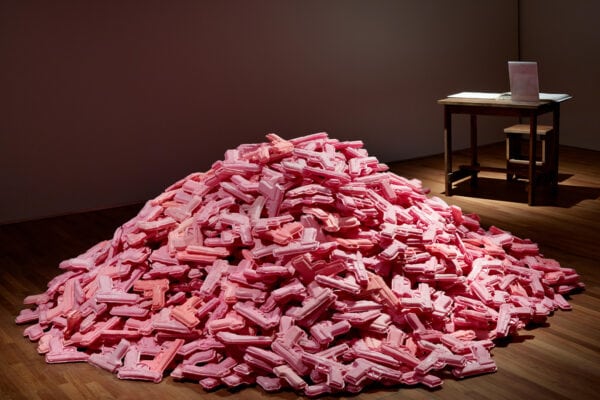
FX Harsono, What Would You Do If These Crackers Were Real Pistols?, 1977–2019. Collection of National Gallery Singapore. Image courtesy of National Heritage Board, Singapore.
This module reveals the power of visual art to convey the constraints of everyday life in an authoritarian regime.
The setting is Indonesia in the late 1970s, roughly one decade into an era of authoritarian governance known as the “New Order.” President Suharto presided over this “order,” a repressive system that contained political speech, expanded the power and presence of the military in daily life, and even limited artistic expressions that revealed doubt or resentment about Suharto’s rule. However, as Professor Mark Bradley shows, a young Indonesian artist decided to use art as argument, mounting a provocative exhibition that expressed not only his antipathy to the new order but invited his viewers to chronicle their own experiences living under authoritarianism. The primary source is a photograph of the artist’s unconventional creation, and it will enable students to do a close analysis of how the visual arts can instigate political reflection and conversation. The teaching plan takes students into the exhibition, asking them to imagine how they might navigate the constraints of authoritarian governance in their lives. It also helps students think more broadly about what resistance to authoritarianism can look like. As part of Authoritarianism 101, this module examines the modes and methods authoritarians use to solidify their rule and how citizens can nevertheless find openings in a censored society to describe their resentments and opposition.
Access Full Module
Contributor
Mark Philip Bradley
Mark Philip Bradley is the Editor of the American Historical Review and the Bernadotte E. Schmitt Distinguished Service Professor of History at the University of Chicago. His work has focused on postcolonial Southeast Asian history, the history of human rights, and the United States in the world. His current book project for Yale University Press, When the World Went South, is a cultural and visual history of the Global South in the late twentieth century.
Have you used this module with your students?
We want to hear from you! Give us your feedback here.