About This Module
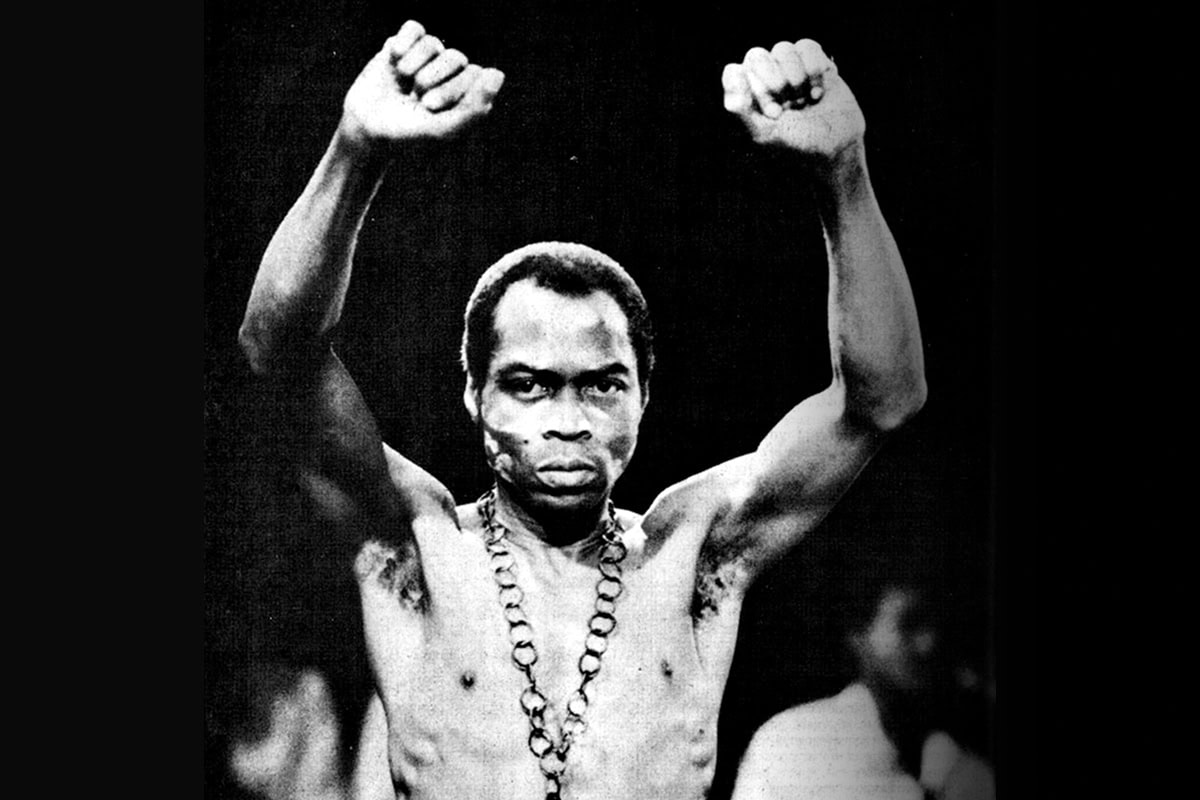
Photograph of Fela staring unsmiling at the camera. His hands are in fists and both arms are raised above him.
This module challenges assumptions about whose side the law is on in an authoritarian dictatorship.
The setting is a hearing room in Lagos, Nigeria, in the late 1970s, almost two decades since independence from Great Britain, after a brief period of democratic governance, a civil war, and then several military coups. The primary source features the testimony of a follower of Fela Kuti, the famous Afrobeat musician whose criticism of the Nigerian dictatorship and the military that sustained it made him a political target. Nigeria’s authoritarian leader, General Olusegun Obasanjo, wanted to silence Fela’s oppositional music, and his military in 1977 burned Fela’s house and nightclub. What followed was an administrative hearing, which Professor Sam Daly reveals was not designed to uncover the causes of the arson but to besmirch Fela and his followers. In this document, we see how one of Fela’s young supporters cannily found a way to turn his courtroom testimony into a platform to spread Fela’s musical critiques of Nigeria’s military dictatorship. The teaching plan asks students to think carefully about the source itself, inviting them to learn how historians scrutinize court testimony to reconstruct a past event. More broadly, the module offers the chance to think historically about the meanings of the term “rule of law,” and the varied and surprising ways resistance to authoritarianism can show up, even in repressive regimes whose power seems airtight. As part of Authoritarianism 101, this module helps teachers explore histories of authoritarian control and people’s challenges to that rule.
Access Full Module
Multimedia
Contributor
Samuel Fury Childs Daly
Samuel Fury Childs Daly is an associate professor of history at the University of Chicago. He is the author of A History of the Republic of Biafra: Law, Crime, and the Nigerian Civil War (Cambridge University Press, 2020) and Soldier’s Paradise: Militarism in Africa After Empire (Duke University Press, 2024), which has a chapter about Fela Kuti and his legal troubles.
Have you used this module with your students?
We want to hear from you! Give us your feedback here.