About This Module
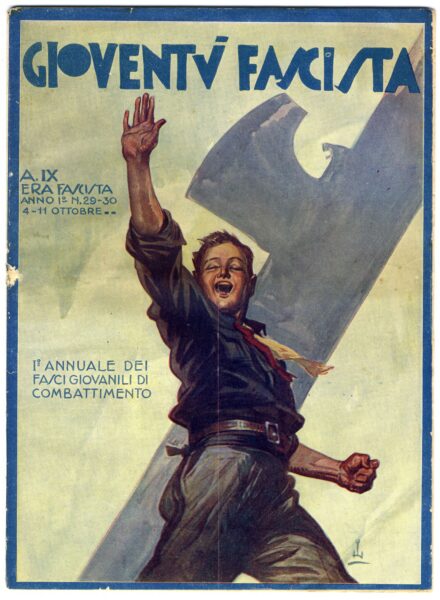
Fascist Youth (October 1931). “Gioventù fascista, 1931–1936,” Archivio storico dell’Università di Bologna
This module offers a chance to explore how authoritarian regimes tried to appeal to young people, specifically, with the aim of portraying obedience to the state not as submission but as progress.
The setting is Italy in 1931, but Benito Mussolini’s two-decade dictatorship is the larger political backdrop. The source is a 1931 cover illustration of a fascist youth magazine, a publication dedicated to promoting a new kind of youthful warrior for a reinvigorated fascist Italy. Professors Brian Griffith and Amy King present this evocative image to ask students to consider why and how authoritarian regimes appealed to youth as a way to ensure the continuation of their rule. The teaching plan offers useful approaches to analyzing the colors, symbols, and facial and physical expressions in the source, enhancing students’ visual literacy skills. It even poses questions about the relationship between Italy’s high illiteracy rates and the authoritarian regime’s choice to communicate their messages to youth through visual materials, such as this one. As part of Authoritarianism 101, this module enables teachers to explore the theme of authoritarian practice by examining some of the tools of authoritarian control.
Access Full Module
Contributor
Brian J Griffith
Brian J Griffith is an assistant professor of modern European history at California State University, Fresno (US). He is currently completing his first monograph, Cultivating Fascism: Wine, Politics, and Identity in Mussolini’s Italy.
Amy King
Amy King is senior lecturer at the University of Bristol (UK). Her first monograph, Politics of Sacrifice: Remembering Italy’s 1973 Rogo di Primavalle, was published by Palgrave Macmillan in 2024.
Have you used this module with your students?
We want to hear from you! Give us your feedback here.