In its Guiding Principles for Artificial Intelligence in History Education, published in August 2025, the AHA reported thoughtfully on the challenges presented to history teaching by generative AI. Among its many insights: that AI can produce simulations that “do not represent authentic reconstructions of the past” but rather are “fabrications based on statistical patterns.”
Agreeing wholly with this analysis, I was surprised by the appended chart suggesting that students could “ask generative AI to produce a historical image for a paper or presentation.” I was shocked by the oxymoronic quality of the concept “produce a historical image.” AI cannot produce historical images, only simulations thereof.
Rather than “produce a historical image,” which would be ahistorical, I want students to think about the historicity of real historical images and to reflect on how easily they can be manipulated. Concerned with the alteration of images I had seen on social media, I created an assignment in a fall 2024 lecture course that instructed students to modify a real historical image and then reflect on how manipulating it affected their understanding of the original image.
AI cannot produce historical images, only simulations thereof.
The course was on modern French history, and the assignment asked them to “update” a poster from May 1968. In 1968, repression of student protests helped catalyze worker sympathy strikes that eventually brought the country to a standstill in a general strike involving as many as 10 million strikers. It was important to me that the students see the actual posters and have an understanding of the labor that went into producing them, so we visited the Ludlow-Santo Domingo May 1968 Paris protest collection at Harvard University’s Houghton Library. We examined scores of posters produced by École de Beaux Arts students. Like today’s social media, the posters offered political commentary in real time—at a slower pace than what can be disseminated electronically but with impressive speed considering the production methods of the day. Produced around the clock and posted on walls around the city in the wee hours of each morning, the posters offered fresh commentary to Parisians every day.
Since I knew that students in May 1968 self-consciously altered the images as conditions changed, I got to thinking: What if my students altered the images? The assignment prompt asked students to photograph one of the posters we had viewed and “update” it with a contemporary interpretation that spoke to the historical artwork’s resonance today. The prompt read in part:
As you produce your updated poster, we ask that you consider what possible 1968 resonances might you miss by examining 1968 from an updated (~2020s) point of view. That is, does looking at it from this perspective decontextualize the image at all? In what way? What are the dangers of doing this? Conversely, what does the perspective of updating the image allow you to see that historians working in an earlier moment might have missed about 1968 entirely?
A workshop at Harvard’s Learning Lab taught students to use image software such as Adobe Illustrator, Canva, Procreate, and Pixlr. Some students also learned to make analog prints, as their counterparts in 1968 would have. Students were allowed to use AI tools if they chose, with one caveat: those doing so had to submit their prompts and write an additional paragraph reflecting on how removing their own labor from the process affected the critique that the poster and its update represented. In fall 2024, no students took advantage of the opportunity to use AI tools, but I would expect future students to use AI much more readily.
Since the most recent iteration of the course took place during a presidential election season, there were the predictable reimaginings of De Gaulle as Trump and so forth. But there were also some more unexpected and sophisticated approaches, one of which I share here to give a fuller sense of how the assignment worked.
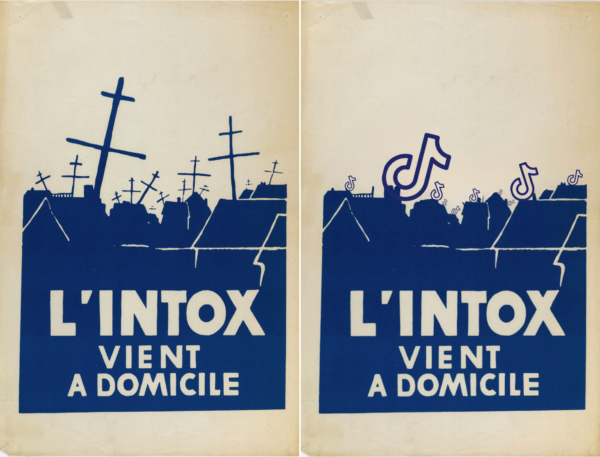
On the left, “L’intox vient au domicile,” silkscreened poster produced by students at the École Nationale de Beaux Arts, Paris (which students renamed the Atelier Populaire [Popular Workshop] during May 1968), FB9.A100.968p (49). Houghton Library, Harvard University. On the right, a version updated by Nicholas Frumkin.
Frumkin’s update was designed to critique “the ubiquity and influence of TikTok.” Both images, he elaborated, critique “how news is delivered to individuals at scale and the potential manipulation of information by the source.” But he also pointed out their differences, arguing that “power of a single media outlet was far more significant in 1968 than it is today. This is because the dissemination of information in 1968 could only happen through a few channels”—a stark contrast to today’s fragmented media landscape. The 2024 version therefore spoke to a very different viewer. But he also noted that drawing connections between the manipulation of media in 1968 and 2024 highlighted that skepticism about media is not new. While the 1968 version “attacked the monolithic control of information,” the updated version highlighted the dangers of the more diffuse social media and even—given the impending TikTok “ban”—a geopolitical dimension that was absent from the more domestic concerns portrayed by the 1968 poster. I myself would add that the 1968 poster also presumed historical literacy on the part of its viewer by making an ironic historical reference: The leader of France’s resistance to Nazism (De Gaulle as the Lorraine Cross) was now a source of authoritarian-style control.
Drawing connections between the manipulation of media in 1968 and 2024 highlighted that skepticism about media is not new.
The assignment was fun for students to complete and for me to grade. I plan to use it again, and I expect that more students will choose to use AI tools in future iterations. But more importantly, it taught several important lessons. It underscored how easy it is to manipulate images, a lesson that goes beyond the history classroom. It also helped students contextualize the original image in its own moment of production by contrast to their reworking and to think about what context got lost as they altered the image.
Finally, it asked students to reflect on what can be gained analytically from comparisons across time. Unlike what is suggested in the Guiding Principles chart, students in this course did not “produce a historical image.” They manipulated one. And learned much more about history—and dare I say about the pitfalls of simulation—by analyzing that manipulation.
Mary D. Lewis is Robert Walton Goelet Professor of French History and the director of undergraduate studies in the Department of History at Harvard University.
This work is licensed under a Creative Commons Attribution-NonCommercial-NoDerivatives 4.0 International License. Attribution must provide author name, article title, Perspectives on History, date of publication, and a link to this page. This license applies only to the article, not to text or images used here by permission.