
Robert Emmet Kennedy Jr., professor emeritus of modern European history at George Washington University (GWU), passed away on January 24, 2026, after a battle with Parkinson’s disease spanning close to two decades.
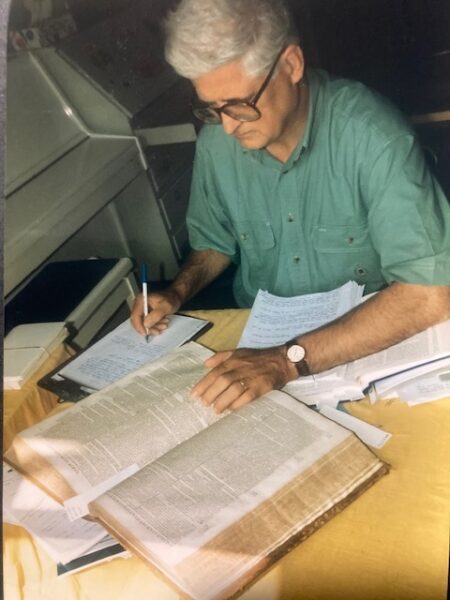
Photo courtesy Kennedy family
Kennedy was born on December 19, 1941, and received his BA from Johns Hopkins University (1963), his MA at Boston College (1965), and his PhD from Brandeis University (1973). After teaching at Kent State University (1968–69) and the Université de Toulouse II–Le Mirail (1969–73), Kennedy accepted a position at GWU, where he enjoyed a distinguished career until his retirement in 2011.
Kennedy was a dedicated and meticulous researcher who focused chiefly on the cultural and intellectual history of the French Revolution. His first monograph, A Philosophe in the Age of Revolution: Destutt de Tracy and the Origins of “Ideology” (American Philosophical Society, 1978), remains among the most often cited and significant studies of Destutt de Tracy and the revolutionary school of Idéologues.
Hot off the presses in the bicentennial year of the French Revolution’s outbreak, Kennedy’s second monograph, A Cultural History of the French Revolution (Yale Univ. Press, 1989), remains in many ways Kennedy’s crowning achievement. Written in stirring but approachable prose, the work was nominated for four national book prizes. Anchored in archival research in France, Britain, and the United States, Kennedy’s Cultural History also distinguished itself as a synthesis of the earliest revisionist historiography of French revolutionary origins, which generally privileged developments in cultural history and political culture over socioeconomic determinism. Ranging broadly across theater, opera, salon culture, architecture, practices of Enlightenment sociability, and religion, Kennedy approached the revolution by situating it in the context of longer-term structures, mentalités, and institutions, as well as transformations associated with the Enlightenment. In the book’s third part, he focused on 1789–99—a period of wide-ranging “disruption, if not destruction, of [Old Regime institutions],” but also creative “regeneration.” In the 1790s, he argued, revolutionaries attempted to culturally instantiate the value (if not always the practice) of popular sovereignty by promoting a “civil religion” based on the “apotheosis” of humanity, and a species of “secular messianism” in an “ever-future revolution” to come. In this latter respect, Cultural History foreshadowed what has, since the 1990s, become an extensive and varied body of scholarship examining the role of religion and religious change as both an origin and an outcome of revolutionary cultural history.
Throughout his long career, Kennedy was a fellow of the Wilson Center (1983–84), and, with Marie-Laurence Netter, James P. McGregor, and Mark V. Olsen, he co-authored Theater, Opera, and Audiences in Revolutionary Paris: Analysis and Repertory (Greenwood Press, 1996). In 2006, he published a provocative book, Secularism and Its Opponents from Augustine to Solzhenitsyn (Palgrave Macmillan). His last book, Abbé Sicard’s Deaf Education: Empowering the Mute, 1785–1820 (Palgrave Macmillan, 2015), is among his very best. Published shortly after his retirement and based on an impressive array of archival work in Paris and departmental archives, Kennedy’s last monograph paints a multifaceted portrait of Abbé Roch-Ambroise Cucurron Sicard (1742–1822), who narrowly survived the September Massacres to become a pioneer of deaf education and whose “codification of grammatical signs” and “dictionary of pantomimic gestures,” as Kennedy argues, proved influential on sign language systems not just in France but in the United States, the United Kingdom, and Russia.
Beyond his scholarship, Kennedy was a dedicated teacher of both undergraduate and graduate students, and for his pedagogy, he won the George Washington University Trachtenberg Prize for Teaching in 1997. To his great credit, Emmet instinctively understood that good teaching is best anchored in the art of attentive and active listening. His graduate seminars, at their best, turned on wide-ranging and thought-provoking discussions among his students, which Emmet deftly facilitated with just a few judiciously chosen questions or remarks. He approached his role as dissertation director with an open mind, trusting his graduate students and giving them space to cultivate their own distinctive interpretations. Emmet was a tireless advisor and, in later years, an erudite colleague and a good friend. His quiet generosity, good humor, and pervasive kindness will be greatly missed.
He is survived by his wife Jane McMahon Kennedy; his children Mara Pufko (George), Gaelle Frazer, and Daniel Kennedy (Naomi); and his brother, Maximus Marie Kennedy. He was predeceased by his son Peter. He is also survived by his grandchildren: Christopher and Kate Pufko; Jason, Natalia, and Alison Frazer; and Adrian Kennedy.
Jeffrey D. Burson
Georgia Southern University
This work is licensed under a Creative Commons Attribution-NonCommercial-NoDerivatives 4.0 International License. Attribution must provide author name, article title, Perspectives on History, date of publication, and a link to this page. This license applies only to the article, not to text or images used here by permission.