
Alfred J. Rieber, who died on September 9, 2025, lived a long life of scholarly exploration and achievement that spanned the better part of the turbulent 20th century and its increasingly dramatic aftermath.
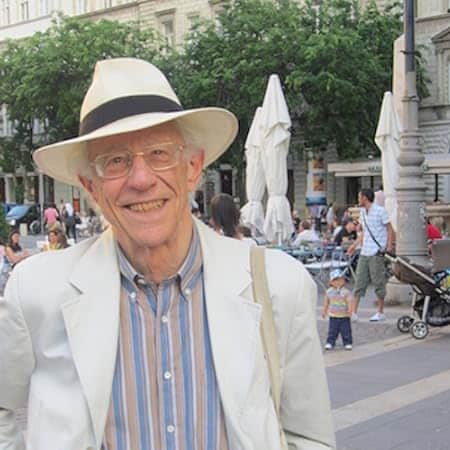
Photo courtesy Marsha Siefert
Born at the height of the Great Depression, he enrolled in Columbia University’s doctoral program in history in 1954—a year after Stalin’s death—and participated in the first American-Soviet academic exchange. From the late 1950s, Rieber’s research trips to the USSR and post-Soviet Russia brought him in touch with leading figures of Russian cultural and artistic life. These trips also sustained his lifelong interest in Russian and Soviet foreign policy, the subject that he first addressed in Stalin and the French Communist Party (Columbia Univ. Press, 1962), based on the dissertation he completed in 1959.
Rieber’s engagement with the persistent factors of Russian foreign policy continued with his extended introduction to The Politics of Autocracy: Letters of Alexander II to Prince A. I. Bariatinskii, 1857–1864 (De Gruyter, 1966) and culminated in his two-volume magnum opus The Struggle for the Eurasian Borderlands: From the Rise of Early Modern Empires to the End of the First World War (Cambridge Univ. Press, 2014) and Stalin and the Struggle for Supremacy in Eurasia (Cambridge Univ. Press, 2015). Influenced by Owen Lattimore’s Inner Asian Frontiers of China (American Geographical Society, 1940), Rieber’s preoccupation with the Russian and Soviet borderlands was also shaped by insights from the dynamic and vibrant work in social history during the 1960s and the 1970s. Apart from his book Merchants and Entrepreneurs in Imperial Russia (Univ. of North Carolina Press, 1982) and his foundational essay on Russia as “the sedimentary society” (Russian History, 1989), Rieber explored the social roots of (foreign) political developments in pioneering studies of different interest groups in mid-19th-century Russia, which were collected in The Imperial Russian Project: Autocratic Politics, Economic Development, and Social Fragmentation (Univ. of Toronto Press, 2017).
Rieber’s dedicated scholarship was matched by an equally long and distinguished teaching career. He spent nearly three decades at the University of Pennsylvania, serving as the head of its history department in 1967–72 and 1983–88. In 1995, he headed the history department at the Central European University (originally in Budapest, Hungary, and later moved to Vienna, Austria). At an age when many of his colleagues would retire, Rieber used his inexhaustible energy to help establish the CEU doctoral program in history and introduce eastern European graduate students to the fundamentals of the historian’s craft. His memorable lectures on Jules Michelet, Frederick Jackson Turner, and Fernand Braudel combined academic rigor with the vividness of a lifelong lover of theater. In his modern historiography course, Rieber emerged as a living embodiment of the historiographic tradition and a proof that US historians are disciples of Leopold von Ranke, several times removed.
Some time ago, I presented a paper on a panel with a senior Canadian historian and was surprised to find out that we were both Alfred Rieber’s doctoral students, even though my co-panelist defended his dissertation well before I was born—illustrating the special place that Rieber had in the study of imperial and Soviet Russia. In his long scholarly journey, he demonstrated a remarkable ability to cross cultural barriers while treating cultural differences in a delicate and unprejudiced way. A grandson of an immigrant from Wilhelmine Germany, he was at the same time unmistakably American—walking down the streets of Budapest in a straw fedora—and yet his contagious enthusiasm and encyclopedic knowledge helped me and other natives of eastern Europe discover the history of our region.
Above all, Alfred Rieber was uniquely capable of becoming a true friend of his numerous students well before our doctoral defenses made us comfortable to call him by his first name. For this and many other reasons, he will be long and fondly remembered by his disciples. Those who never met Rieber or engaged with his academic work can still discover his remarkable personality by reading one of his four historical novels. Published under the pen name G. K. George and featuring protagonist Inspector Vasiliev, these novels lead the reader into the complex world of tsarist policemen, aristocratic plotters, and revolutionaries of late imperial Russia, and offer a rare combination of captivating storytelling and the expertise of a master historian.
Victor Taki
Concordia University of Edmonton
This work is licensed under a Creative Commons Attribution-NonCommercial-NoDerivatives 4.0 International License. Attribution must provide author name, article title, Perspectives on History, date of publication, and a link to this page. This license applies only to the article, not to text or images used here by permission.