After my father’s younger brother died in 2019, I inherited some objects that had belonged to my paternal great-grandfather, Timothy F. Donovan (1872–1944), whom I refer to as TFD. The son of Irish immigrants, TFD enlisted in Brooklyn’s 14th Regiment in 1892 as a private and rose through the ranks to second-in-command with the rank of lieutenant colonel. It was with this regiment, reorganized to the 2nd Pioneer Infantry Regiment, that TFD served during World War I. From this period of service in Europe, I inherited an intricate World War I trench art lighter.
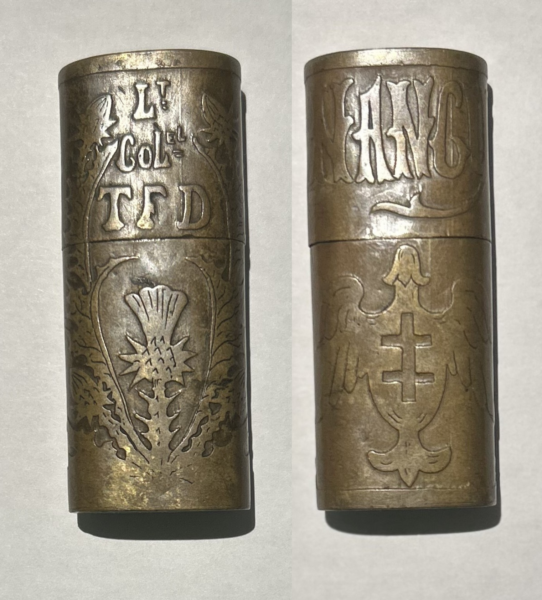
Photo: Michael S. Donovan
Dating to the Napoleonic Wars, the term “trench art” encompasses a wide range of decorative items crafted during armed conflict. During World War I, shell cases were a popular material for such projects. The firing of artillery projectiles, or shells, leaves behind an empty shell case. This metal cylinder contains the propellant that launches the projectile toward its target. Because most shell cases were made of malleable brass, they became one type of raw material that idle soldiers and artisans transformed into art in various shapes and sizes—and with over one billion artillery projectiles fired from 1914 to 1918, shells were an abundant resource.
TFD’s lighter features the personalized inscription “Lt Colel TFD.” Also visible is a distinctive thistle motif, with a traditional bulbous flower and spiked leaves. Floral designs were often used as decorative elements in World War I trench art, with the thistle sometimes appearing as an ornamental motif. The presence of thistle on TFD’s lighter likely reflects that broad decorative tradition rather than any specific symbolism.
On the other side of the lighter is a cross of Lorraine overlaid on a bird design, with “Nancy” engraved above it in decorative, Gothic-style lettering. Nancy, located in the Lorraine region of eastern France, was a key city during the war and in TFD’s service. After arriving in Europe in July 1918, TFD led a large detachment to Nancy, then to Dijon and Is-sur-Tille, and crossed into Germany to Coblenz, before finally departing for home in October 1919.
TFD’s lighter, measuring 73 by 30 by 13 millimeters, is skillfully crafted with precisely cut end caps, clean soldered seams, and balanced decorative engraving. Removing the lighter’s snugly fitted top reveals the flint and wheel assembly and the wick holder, beneath which sits the fuel reservoir. Such skillful construction suggests that a soldier did not create the lighter, since trench art produced by soldiers during the war was cruder in execution. Rather, the lighter was likely crafted by an enterprising French artisan, as evidenced by the specific regional symbols, floral design with the thistle, personalization, the inclusion of Nancy, and a unique construction style. Since family lore indicates the lighter was a gift to TFD from the soldiers he led, it was most likely a commissioned piece specifically crafted for him.
I am proud to be the current steward of the lighter, preserving a piece of our family’s history that has endured for more than a century. As a lieutenant colonel, I also received a gift from the soldiers I once led in war, a time-honored military tradition that connects me to TFD. His lighter is prominently displayed in our home alongside other reminders of his long and distinguished military service to our country. But the lighter is more than a family keepsake. This object was transformed from a piece of war material designed to deliver destruction into an enduring and personal decorative item.
Michael S. Donovan is an independent scholar and writer in Virginia. He holds an MA from the National Defense University, an MBA from Regis University, and a BS from Florida Institute of Technology.
This work is licensed under a Creative Commons Attribution-NonCommercial-NoDerivatives 4.0 International License. Attribution must provide author name, article title, Perspectives on History, date of publication, and a link to this page. This license applies only to the article, not to text or images used here by permission.