The 2026 AHA meeting is co-headquartered at the Hilton Chicago, one of the world’s great convention hotels, whose storied past includes a feature role in the political tumult of the 1960s. Indeed, the Hilton has long played a vital role in American politics.
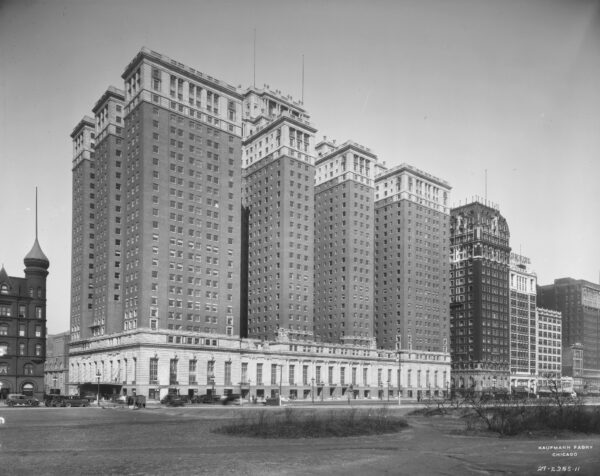
Photo: Kaufmann & Fabry Co., Chicago History Museum, ICHi-076322
In May 1927, when the Hilton—then named the Stevens Hotel—opened for business in downtown Chicago, it was the largest hotel in the world, with some 3,000 rooms. Among its over-the-top amenities were the rooftop Hi-Ho miniature golf course, a 1,200-seat movie theater, and a barbershop with 27 chairs. Its first guest was the nation’s vice president, Charles Dawes. Yet the Great Depression made it difficult to turn a profit. The federal government purchased the hotel in 1942; the US Army used it as a barracks and training facility during World War II.
After Conrad Hilton bought the hotel in 1946, it reemerged—racially integrated—as the place to be in Chicago for the nation’s politicians and their party conventions. In 1952, the Hilton was the GOP’s main delegate hotel, and in 1956, the Democrats set up shop there as well. The GOP returned in 1960; “Nixon girls” cheered the delegates as they entered and exited the Hilton.
In August 1968, when thousands of antiwar protesters massed outside the hotel during the Democratic convention, they were not there to cheer. Chicago’s Mayor Richard J. Daley had assured Democratic officials that Chicago was “the city that worked,” and their convention, he promised, would go off without a hitch. But he didn’t account for the fast-growing anti–Vietnam War protest movement and the activists who intended to target the Democratic convention to make their voices heard.
On August 28, protesters held the convention’s only officially permitted rally at the Grant Park bandshell, southeast of the Hilton. At the end of the rally, as many as 10,000 protesters sought to march to the convention center, more than five miles away. Daley and the Chicago Police Department refused to allow the march, leading to an hours-long standoff. Told to leave the area yet hemmed in by the police and the Illinois National Guard, thousands unintentionally ended up on Michigan Avenue, right across from the Hilton. The subsequent police crackdown on the milling, overwhelmingly peaceful protesters produced the images that made “Chicago ’68” infamous.
The police demanded that the protesters clear Michigan Avenue, yet provided no exit point. As the police moved in, hundreds tried to escape their wrath by moving onto the sidewalk in front of the Hilton’s ground-floor Haymarket Lounge. The police shoved those protesters until the floor-to-ceiling windows of the Haymarket gave out, and protesters fell into the restaurant through the shattered plate glass.
Other protesters refused to move. A large group sat down in the middle of Michigan Avenue, right outside the hotel at the intersection with Balbo Drive. The police—though not all of them, by any means—attacked the protesters with fists, knees, and clubs. The protesters chanted, “The whole world is watching,” as the cameras rolled. American democracy reeled. The only real winner emerging out of that week was Republican Richard Nixon, who would go on to defeat Democrat Hubert Humphrey in the November presidential election.
Chicago ’68 was certainly not good for Chicago’s, or the Hilton’s, political convention business. It was not until 1996 that Bill Clinton decided it was time for Democrats to return to Chicago, and the party convened there again in 2024. Still, they have not returned to the Hilton Chicago. The AHA, on the other hand, has met there across the hotel’s history, first in 1938, when it was still the Stevens. Undeterred by Chicago ’68, the AHA convened at the Conrad Hilton in 1974. And in 2026, the Hilton Chicago hosts the AHA for the 12th time.
David Farber is a Visiting Bye-Fellow at Selwyn College, University of Cambridge.
This work is licensed under a Creative Commons Attribution-NonCommercial-NoDerivatives 4.0 International License. Attribution must provide author name, article title, Perspectives on History, date of publication, and a link to this page. This license applies only to the article, not to text or images used here by permission.