In the Phaedrus, Socrates argued against writing. Committing ideas to text, he warned, will weaken memory and substitute the appearance of knowledge for the real thing. It is a pointed argument, made, of course, in writing. His student Plato could not have known that his transcriptions of Socrates’s dialogues would become the foundation of a 2,500-year pedagogical tradition. Every generation greets a new technology of knowledge with suspicion, and every generation eventually finds a way to teach with it.

Mathematics education has integrated calculators into the learning process. Should we do the same today with AI tools? Aaron Leffler/Unsplash
We are in one of those moments now, and faculty are, understandably, exhausted. The 2020 pandemic forced an overnight overhaul of assessment; ChatGPT arrived just two years later and demanded another. Many instructors have responded to generative AI (genAI) with skepticism, alarm, or outright prohibition. That response is not irrational. The integrity concerns are real, and the pressure to redesign every course from scratch has been relentless. But framing genAI primarily as a threat misses the possibility of teaching with it. Mathematics education solved an analogous problem half a century ago, with the calculator. (The analogy will be familiar to readers of this publication, though I use it differently here.)
In most secondary and postsecondary math courses, students spend time working problems by hand. Not because calculators are bad, but because the manual process builds the conceptual understanding that makes calculator use meaningful. At a certain point, students are not only permitted to use calculators; they are required to. The goal is fluency with both the underlying concepts and the tool. Today, nobody seriously argues that calculators have ruined math, because mathematics education adapted to integrate them thoughtfully.
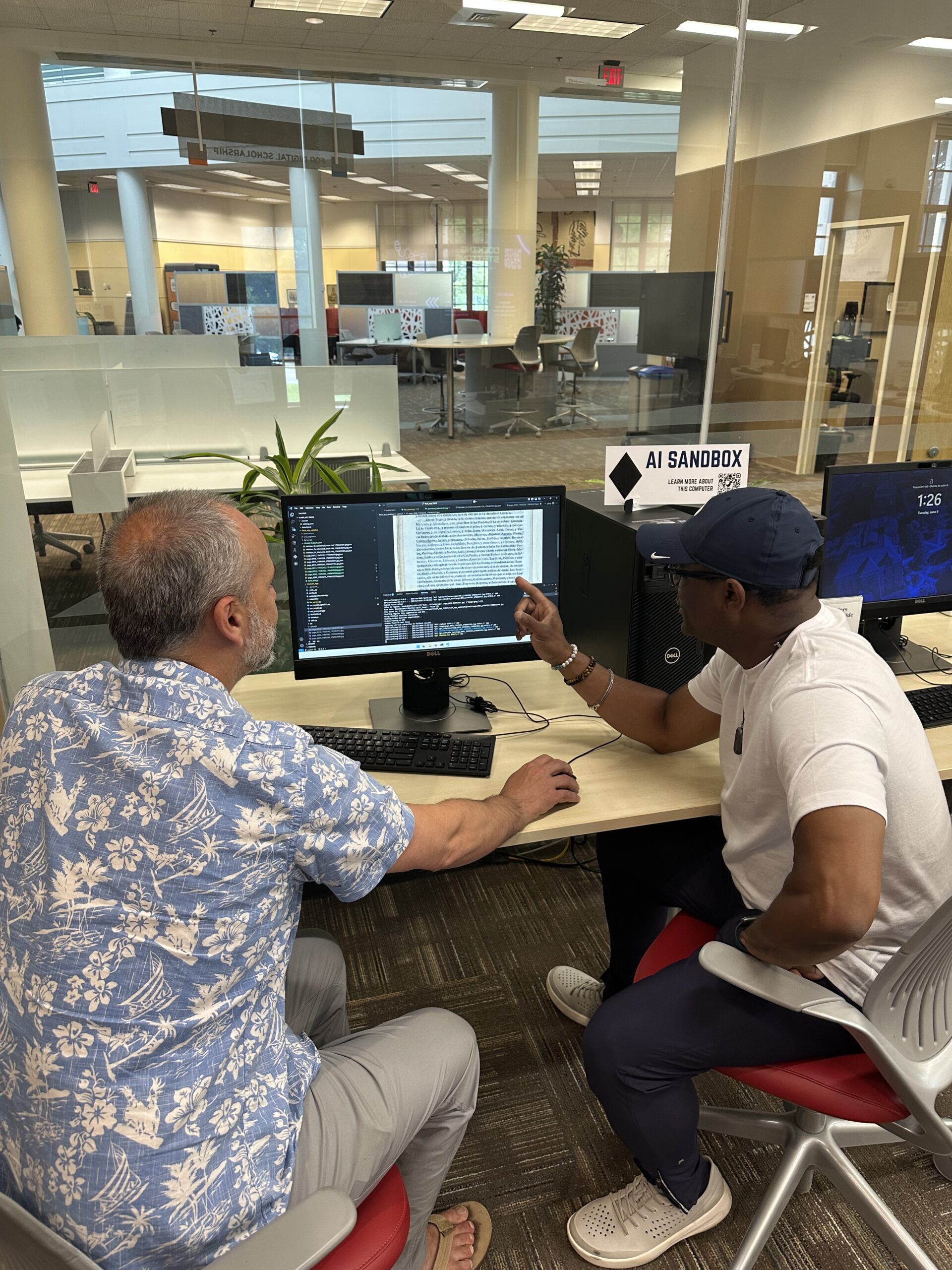
Humanities education, and history in particular, can do the same with genAI—and historians do not have to figure out how alone. The AHA’s Guiding Principles for Artificial Intelligence in History Education offer one disciplinary starting point. Liaison and subject librarians offer another. Many of us, myself included, have been thinking carefully about genAI since its release. I came to librarianship after doctoral training in history, and so I think about genAI from within both fields. Many history faculty describe feeling isolated, caught between administrative pressure to adopt these tools uncritically and teaching-center presentations from disciplines where the stakes are different. But you aren’t alone. Colleagues in your library are likely working on this problem already.
The struggle is not incidental to learning; in many cases, it is the learning.
Part of what makes this moment difficult is that genAI is not equally useful (or harmful) to everyone. For those who already possess deep disciplinary expertise, these tools can be genuinely powerful. An experienced historian who knows how to read a primary source critically can use genAI to work faster, surface connections across a larger body of material, and push their analysis further. The tool amplifies existing skill. But for a student who has not yet developed that skill, the same tool can silently substitute for the struggle that builds expertise in the first place.
Cognitive psychologists who study skill acquisition have identified what they call “desirable difficulty”: the counterintuitive but well-supported finding that conditions that make learning feel harder in the short term produce more durable, transferable knowledge in the long run. The struggle is not incidental to learning; in many cases, it is the learning. Used without reflection, genAI strips that difficulty away before students have had the chance to benefit from it.
Close reading is a useful example. It is one of the foundational competencies of humanistic inquiry: the capacity to sit with a difficult text, notice what it says (and does not say), hold it in tension with its context, and arrive at an interpretation that could not have been reached by skimming. It is also exactly the kind of task that genAI can perform quickly and fluently, producing a summary or analysis that looks, on the surface, like the product of careful reading. A student who reaches for that output before developing the underlying skill has not saved time. They have skipped the very thing that was supposed to change how they think.
The AHA’s Guiding Principles name this dynamic an “unproductive loop” in which “minimal engagement” with sources “leads to an inability to properly assess outputs, which leads to uncritical acceptance of flawed material.” My own research evaluating genAI’s performance in historical research tasks has revealed a related pattern: These tools are often quite good at identifying relevant primary sources (and, despite our fears, rarely hallucinate), but they tend to recommend archival documents or collections at distant institutions that most students will never access. This gap between what genAI promises and what it can actually deliver is invisible to a novice researcher. Expertise is what allows you to evaluate the tool; students who most need critical guidance are those least equipped to recognize when they are not getting it.
Returning to the calculator: Math education does not introduce the device at the start of a unit and ask students to evaluate its output. It introduces the calculator after students have done the manual work, after they can recognize a wrong answer when they see one. History can sequence its tools the same way. As a PhD student and teaching assistant, I taught weekly discussion sections focused on close reading and analysis of primary sources. The same kind of work happens in introductory classes at the institution where I am now a librarian. These kinds of collaborative, in-class close reading exercises can coexist with assignments that invite or even require students to use genAI and reflect critically on what it produces. The point is not to wall off one practice from the other but to sequence them deliberately. First, build the skills of the discipline in conditions where the struggle is protected, and then introduce the tool in conditions where students have enough expertise to evaluate the output.
Teaching critical genAI competency alongside foundational historical skills is collaborative work, and the collaborators are already on campus.
This does not require faculty to become AI experts. It requires something more modest: a willingness to think about genAI the way we already think about other tools and scaffolds in our teaching, as things that support or undermine learning depending on when and how they are introduced. It also helps to remember who else is on our team. Liaison librarians sit at the intersection of disciplinary expertise, research methodology, and the rapidly evolving information landscape. Often, we are already evaluating these tools against the standards of the discipline. Teaching critical genAI competency alongside foundational historical skills is collaborative work, and the collaborators are already on campus.
The anxiety Socrates expressed about writing was not entirely wrong. Writing does change the relationship between knowledge and memory. It does make certain kinds of unreflective consumption possible. But writing wasn’t and shouldn’t be abandoned. We instead developed and continue to employ pedagogical traditions (commentary, disputation, seminar discussion) that use writing while also cultivating the habits of mind that writing alone could not guarantee.
We are at an analogous moment. The response to genAI that will serve our students best is neither prohibition nor uncritical adoption. It is the harder, more interesting work of figuring out how to teach foundational humanistic skills and critical genAI literacy at the same time—how to send students into an AI-saturated world with both the deep competencies of the discipline and the discernment to know when a powerful tool is helping them think and when it is thinking for them.
Kristen C. Howard is liaison librarian at the Humanities and Social Sciences Library and an associate member of the Department of History and Classical Studies at McGill University.
This work is licensed under a Creative Commons Attribution-NonCommercial-NoDerivatives 4.0 International License. Attribution must provide author name, article title, Perspectives on History, date of publication, and a link to this page. This license applies only to the article, not to text or images used here by permission.