For years, I’ve pondered a simple question that I decided never to share, mainly because it seemed bizarre and unanswerable. However, in a world that is changing rapidly with technological advancements in artificial intelligence, my secret question seems urgent: What’s the most important word (or words) in the archives? What if it’s “us” or “we” or “me”?
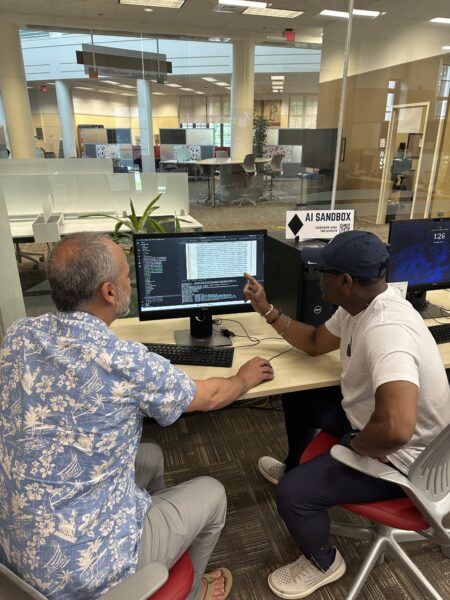
In a visit to at the Freedman Center in the Kelvin Smith Library, Ben Vinson III (right) learns about AI capabilities from digital librarian David Beales.
I came to this question based on my inquiries into colonial Latin American caste and racial identity. Throughout my professional career, I’ve been on a quest to recover the voices and experiences of enslaved, freedmen, and women of color in Latin America in the 17th and 18th centuries. Records of their voices are sparse, often filtered through others’ concerns and desires, making them hard to hear. Secondhand renditions and interpretations further distort their meaning and tone.
Take the example of runaway slave communities. These were prevalent in Latin America, sometimes achieving such density and geographic reach to be able to negotiate privileges with the government. A few even evolved into recognized townships in places like Mexico, Guatemala, Panama, Venezuela, Brazil, and Ecuador. However, colonial records often prioritize bureaucratic and landed class concerns over runaway slave community narratives. Notable exceptions exist, but we often must read against the grain to hear their stories. A lack of literacy combined with unequal access to scribes further limited their accounts in the colonial record.
Perhaps that’s why scholars of Latin America value Inquisition records. While Inquisition files are structured, formal, and Church-driven, they also contain autobiographical confessions (discursos de vida) that can provide illuminating pictures of lives beyond the trial. These documents have a compelling, first-person voice that suggests authenticity. For instance, washerwoman and domestic servant Nicolasa de las Nieves’s 1710 confession revealed her life story. Born free, she was raised among slaves, treated like one, and forced into marriage with a slave. She and her husband eventually escaped the sugar mill and reconstituted their lives, but he soon abandoned her. Struggling to survive, Nicolasa remarried after living in a consensual union for a decade. But she had never divorced her first husband and paid the price: banishment, lashes, and imprisonment in Mexico City’s notorious women’s correctional facility.
What’s the most important word (or words) in the archives?
Of course, calling Inquisition testimony (sometimes taken after years being jailed) an “authentic voice” is problematic. Nicolasa’s story, taken just days after her arrest, may not have faced the usual pressures, but fear of punishment likely influenced her response. Nonetheless, I often pause when mulatos, pardos (brown), morenos (Blacks), and others use the words “somos” (we are) or “soy” (I am) in Inquisition testimony, marriage licenses, notary records, and military records. These words sometimes provide valuable clues indicating that individuals adhered to a form of Black identity. I first noticed this during my dissertation research, reading a request from Black militia soldiers in Puebla in the 1790s who begged the Spanish king not to station white officers in their units. They wrote, “Although somos pardo in color, we are noble and sacrifice our lives for the king.” Over a decade later, I found a letter from Antonio Lopez, majordomo of a Black confraternity in Mexico City in the 1720s. As the executor of a deceased confraternity member’s estate, he pleaded to city officials to keep the property with the confraternity. He concluded, “Although somos poor morenos, we look to and have God.”
What were they saying? Were they actually saying anything? What role did the scribe and notary play in framing somos? Who is the “we”? What was the context? What did the writer convey and why? Does pausing to consider first-person verbs deepen our understanding of the human actors behind the words? Should we reflect more on somos? Does it reveal deeper history?
My questions have evolved over decades—their answers remain elusive. But conversations with colleagues using machine learning methods and who are involved in collaborative research have prompted me to wonder if we can now better understand the human dimension of words like somos and soy. And ironically, I wonder if artificial intelligence might offer a path to answering these very human questions.
Millions of instances of somos likely exist in colonial archives. Machine learning tools can analyze usage patterns across file types, enabling “distant reading” instead of close reading. We may be able to differentiate usages diachronically, regionally, and subregionally, and assess somos by class, caste, and gender. Text analysis features may reveal when somos is used as a rhetorical tool or speech act to navigate and aggregate power in the colonial world. An agentic AI can independently comb digitized archival material, creating nominal record linkages to assess somos and soy usage by individuals, allowing us to create profiles. These tools won’t answer my questions themselves—historians need to do that. But by helping to parse the archive, they can help us get closer to being able to do so, creating the potential to understand human actors, activity, and interactivity at unprecedented registers.
These are simply the musings of a colonial Latin Americanist, and a Mexicanist at that. Yet I wonder what parallels exist in other languages and time periods. What might inquiries look like comparatively? What new understandings might emerge?
To be clear, I’ve only begun to experiment with machine learning in this way. I’ve launched a project at Case Western Reserve University, in collaboration with David Beales at the Freedman Center for Digital Scholarship, to build an AI tool that can read and search colonial Latin American archives for the questions I raise here. I hope to chronicle this foray for others. But like many, I’m generally exploring how this emerging technology can benefit academia. We’ve grown accustomed to using tools like GIS, text mining, and visualization in teaching, research, and publications. These tools have greatly improved our ability to read archival documents, analyze texts, study artifacts, digitally reconstruct vanished cities and landscapes, and recreate historical scenes and figures. However, many of the current tools digital historians use require coding knowledge and training. Machine learning tools may offer a more accessible technology for those who aren’t experts in digital history, along with enhanced ideational power.
That ideational power can expand our own analytical imagination, offering new points of departure and insights. AI can assist us in generating probing questions by examining uploaded material and suggesting new investigative lines of inquiry. It can serve as a powerful digital editor, rigorously reviewing writing, interrogating arguments, and signaling weaknesses. AI can help overcome language barriers by providing translations that help us to achieve a gloss of texts that might otherwise be inaccessible. The technology excels at synthesis, recognizing connections between texts, articles and other documents. But herein lies a limitation. As an aggregator par excellence, complexity can be lost through algorithmic simplification. As historians, we thrive in complexity and ambiguity. This is our comfort zone because emerging from it comes clarities on the complexities of human life. Indeed, the wholesale appreciation of complexity and charting its course helps reveal the full annals of history.
As historians, we thrive in complexity and ambiguity.
The role of historians will not diminish, even as quantum computing further enhances data analysis and AI continues to advance. We will remain central in providing authoritative voices, finding and interpreting evidence, determining the scope and nature of the archive, and reviewing material for authenticity, context, value, relevance, and meaning. In fact, our ability to understand and interpret the human condition (from a human standpoint) and interpret it across time will become even more valuable to the craft of history.
I see three potential outcomes emerging as we enter this digital future. First, technology may turbocharge existing methodologies, delivering results at a grander scale with greater transnational and comparative reach. This could unleash a new era of global and entangled history, benefiting regional and national histories with increased access to sources.
Second, like precision medicine, we may embark upon conducting “precision history” by processing vast amounts of data to narrow, refine, and execute microscopic inquiries that extend well beyond human analytic capacities. This could help us achieve greater clarity of grand historical trends embedded in everyday existence. AI’s scalpel may make history more surgical and efficient, placing grander questions in greater relief.
Pairing machine learning with augmented, mixed, virtual, and holographic imaging promises a third outcome, a revolution in experiencing history that could potentially transform classrooms. Early experiments are already apace. It is possible today to stand in the Red Monastery Byzantine Church of Egypt or walk through a replica of the Sanctuary of the Great Gods at Samothrace from Cleveland, Ohio. I know. I’ve done so. I see even greater mixed reality interactivity, fueled by AI, along the road ahead.
As historians engage in this work, they may pursue more team-based history, with new projects transecting universities within the US and abroad. Examples include the international SETS project anchored at Stanford to help AI read like an historian, or the European AI Remembers Project, which aims to preserve, interpret and teach World War II in new ways. Digital tools might also help revitalize individual history departments, catalyzing stunning intradepartmental collaborations, enabling experts across the hall to share and integrate evidence in their research and teaching. Such collaborations could help break down silos and make history more fluid across subfields. Even professional associations like the AHA and its international counterparts might embark on ambitious projects that were previously too large, expensive, and time-consuming to ponder.
There are obvious pitfalls to navigate. Governance, equity, privacy, and environmental sustainability concerns are real questions confronting the technology and the broader industry. Equally, increasing our reliance on machine learning–driven research inquiry may cause us to miss the accidental discoveries and epiphanies that humans make while navigating archives. Such accidents have often led to new research questions and paradigm shifts. Machines may simply miss subtleties and nuances that humans detect in the archives, especially the subtle sounds of subaltern voices. Furthermore, as machines work independently, errors, hallucinations, and misinterpretations can be harder to catch. To minimize errors, we must rigorously design controls, but fallibility is inevitable. Current machine learning tools are just that. They need historians to operate and make them meaningful to the broader knowledge enterprise.
In some ways, this brings me back full-circle to my nagging human-prompted question. Today, I feel strange confessing it. But it’s actually quite liberating to look at it in the context of emerging technology tools. So what if “we” is the most important word in the archives? And what does it mean if AI can help us arrive at a better understanding of us?
The author thanks Paul Zeleza, John Schwaller, Hollis Robbins, Yolanda Fortenberry, Laura Ansley, Sarah Weicksel, Allyson Vinson, and Ben Vinson IV for reviewing earlier drafts of this essay, as well as the Baker-Nord Institute for the Humanities, National Humanities Center, and the Afro-Latin America Research Institute at the Hutchins Center (Harvard) for providing support to prepare this article.
This work is licensed under a Creative Commons Attribution-NonCommercial-NoDerivatives 4.0 International License. Attribution must provide author name, article title, Perspectives on History, date of publication, and a link to this page. This license applies only to the article, not to text or images used here by permission.