Editor’s Note: This is the second installment in a two-part column. The first column is available here.
By December 1906, as the dry winds swept across the cracked red earth of Senegal, the peanut harvest was drawing to a close. To the nearby trading town of Fatick, farmers from across the hinterland came to sell their yields for cash, credit, and imported commodities. It was there, amidst the market churn, that a routine arrangement escalated into an undeniable drama when Aly Seck Dièye accused Souma Diouf of owing his wife, Issa Dièye, 11 francs. Souma rejected the claim, insisting the debt was long settled. Yet before she could object any further, Aly reached out and tore the gold necklace from Souma’s neck.
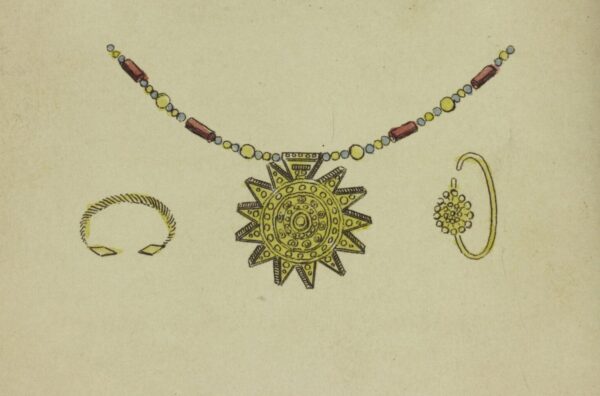
Through the eyes of European travelers, this 1821 illustration captures the remarkable gold necklaces and adornments that ordinary women across Senegal have long worn as independent capital and cherished heirlooms, uniquely passed down to their daughters.
Schomburg Center for Research in Black Culture, Manuscripts, Archives and Rare Books
What followed quickly spiraled far beyond a dispute over 11 francs: a French colonial officer intervened; Aly fled, attempted to stab a court interpreter, and was subsequently arrested. How did an alleged debt and a seized piece of jewelry turn into an attempted murder trial before a colonial tribunal? The answer lay not in the monetary value of the necklace, but in what it represented: collateral, a visible register of personal credit-building, and a public marker that rendered a woman’s social status and economic independence tangible to her community.
Alas, whether Aly ever returned the necklace, the archival record does not say. With his sentence, the paper trail goes cold: he received six months in prison for the unlawful seizure of the necklace and insults toward the French officer, another six months for attempted murder, and an additional year of confinement if he failed to restore the jewelry within 15 days. Following the trial, Souma also disappears entirely from the judicial docket, joining an incalculable number of West African women who become visible only at moments of conflict. Yet it is precisely this conflict that offers an unlikely window into their economic world, organized around unwritten obligations, moral standing, and inconspicuous measures of accumulation that no colonial ledger could record.
To understand why Souma vanished and how her stolen necklace became a legal spectacle, we must turn from the courtroom to the agrarian heartland of colonial Senegal, where life moved to the rhythms of peanuts. At the beginning of the rainy season, when cash-strapped farmers planted seeds, they relied on advances of food and grain. After the rains, when rural communities brought their harvests to commercial centers like Fatick, they settled their accounts. As merchant houses bought the crop at measly prices, colonial officers regulated exchange and chiefs extracted taxes. Yet beneath this male-dominated, debt-laden apparatus, a particular property regime took root, as brought into sharp relief by this stolen necklace.
Their economic world was organized around unwritten obligations, moral standing, and inconspicuous measures of accumulation that no colonial ledger could record.
If institutional credit and codified capital were patriarchal and extractive, the regime women built was distinctly mobile and relational. Engineered to monetize rural production for European markets, colonial law reinforced an agrarian order where women’s access to land remained strictly mediated through male household heads—granted as conditional customary subplots in exchange for unpaid labor on primary peanut fields. While female domestic labor underwrote the peanut boom, colonial authorities and European merchants directed property titles, commerce, and cash to men. However, for women, exclusion was not an end. Beyond the patriarchal or colonial purview, women wove webs of wealth around assets they could wear, pledge, and liquidate.
At the center of the conflict in December 1906 sat a gold necklace. In colonial Senegal, such pieces were never mere adornments. Rather, for women, they were deliberate and sophisticated investments. Unlike European financial instruments, gold jewelry required no signature, no notary, and no administrative approval to bear liquidity. Worn publicly, it served as a declaration of prestige and prosperity. In moments of crisis, it was a safety net. Durable and dynamic, gold jewelry enabled women to assert their status, insert themselves into networks of exchange, and carve out spaces of independent accumulation. Men were not threatened by gold jewelry itself but by the female autonomy it represented. And indeed, it threatened Aly Seck Dièye, whose wife’s dealings with Diouf and conceivably others lay beyond his reach.
Gold jewelry was thus inherently tethered to risk. The very portability and public visibility that made a necklace effective as capital and collateral also left women vulnerable to trespass by husbands, neighbors, and mercantile pawnbrokers. Yet when their arrangements ruptured, women co-opted colonial courts to defend their assets. Cracking open a legal archive that usually wrote them in as domestics or left them out otherwise, episodes like Diouf’s pose a central challenge to historians of colonialism and capitalism: How do we reconstruct economic worlds that only flash into view when they break down?
Conflicts like this one offer a vital corrective as our histories of capitalism and colonialism expand in scope. For too long, scholars have treated empire as the primary engine of market integration, measuring transformation strictly by the metrics states privileged: taxes levied, contracts drafted, titles distributed, and currencies enforced. Colonial coercion was undoubtedly central to shaping commerce, yet empire held no monopoly on capital. By equating the reach of the state and its law with the limits of commercial life, we erase the very practices that women leveraged to sustain and survive the global commodity boom of the 19th and 20th centuries.
The property regime that the gold necklace embodied in 1906 was an acute response to the upheavals of trade and colonization that swept across the agrarian hinterland. Patterned textiles, filigree jewelry, brilliant headpieces, and silver bracelets were quite literally the material fabric of an economic world that defied exclusion. Such intimate reserves of wealth tied everyday creditors and debtors to the promise of return and reimbursement, anchoring liquidity in enduring networks of communal trust. Even more critically at stake was their standing as legitimate economic actors, adjudicated by public opinion rather than state recognition.
The very portability and public visibility that made a necklace effective as capital and collateral also left women vulnerable.
Far from peripheral, arrangements like the one between Souma Diouf and Issa Dièye were the financial backbone of women’s enterprises. Gold-backed wealth provided the independent capital women needed to buy seeds and bring the resulting crops to market. Likewise, textiles enabled women to absorb household shocks when men migrated to urban centers for waged work, leaving behind mounting debts to the colonial state and trading houses. Pledged, redeemed, and recirculated season after season, these mobile assets empowered women to underwrite local economies whenever cash and institutional credit dried up. Long before historians analyzed informal economies and economists observed microfinance schemes in cities such as Dakar, rural West African women had turned their wearable wealth into means of risk mitigation and capital accumulation.
Ultimately, historians must not take archival absences such as Diouf’s as dead ends but as signposts. Where the archival record captures only the moments when these economic worlds break down, it affords unmistakable glimpses at the very mechanics of how these elusive worlds did—and did not—work. Well after colonial court cases went cold and administrative ledgers fell silent, women in Fatick and elsewhere across colonial Senegal continued to lean on their particular property regime. They dressed themselves in the very possessions that they turned into collateral and quick liquid capital. Here, the ground-level history of capitalism was never drafted by colonial decree but forged through their communal ties, quiet arrangements, and discreet repositories of value.
Becca Aponte is a doctoral student in history at Emory University, where she studies gender, law, and economy in French West Africa.
This work is licensed under a Creative Commons Attribution-NonCommercial-NoDerivatives 4.0 International License. Attribution must provide author name, article title, Perspectives on History, date of publication, and a link to this page. This license applies only to the article, not to text or images used here by permission.