
Editor’s Note: This is the first installment in a two-part column. The second column is available here.
By the time I leave my apartment for the archives, the air is already heavy with the smells and sounds of Dakar’s streets: frying oil and exhaust; the call of vendors; the honking of horns; the movement of pedestrians, horse-drawn carriages, and cars that never quite rest. My walk is a mere 15 minutes, but in that brief period, the city offers a lively demonstration of economic life that defies the quiet orderliness of the archives awaiting me.
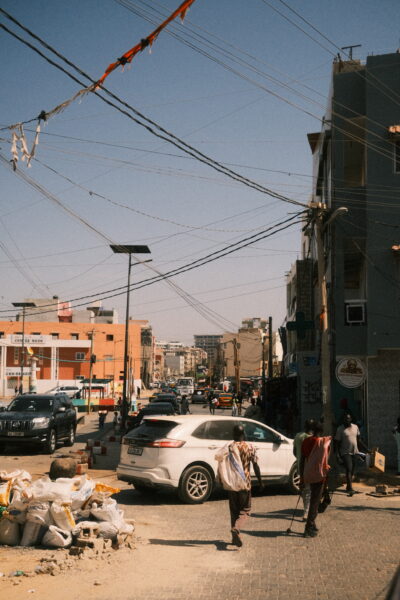
Walking is often the best means of transport in Dakar, becoming Becca Aponte’s surest way to navigate the capital’s commercial arteries. Léo Tarpin
Weaving through my neighborhood, Gibraltar (also known as “Little China”), I pass the French-owned supermarket, Auchan, surrounded by Chinese merchants and Senegalese vendors. Off to the side, women prepare pains thon and beignets at small tables. Some customers, finishing their breakfast, hop hurriedly onto the SunuBRT, the first fully electric bus network in Africa. Others latch, quite literally, onto the backs of cars rapides, old Renaults turned into rolling blue-and-yellow artworks. At first glance, Dakar appears to be a city of contradictions. The global thrusts into the local, the state-of-the-art into the out-of-date, the commercialized into the communal.
Yet the further I walk, the more I suspect that I have the Senegalese capital the wrong way around. What I initially saw as contradictions, I now realize are signs of a West African cosmopolis creatively at work. They are the very substance that brings Dakar to life every morning and ensures that it endures for another day.
To look at just one example: those small tables where women prepare and sell food. As evictions surge amid campaigns for “a clean city,” officials have pushed to regulate, if not eradicate, street vending. Yet the vendors remain unshaken by the threat of sanctions, for they have never relied on state authority to secure their place. These women, and women like them, have long been fixtures in the former colonial capital of French West Africa, feeding the workers at the corners where their routes cross my own. In return, their fellow Dakarois recognize them as their own. For these women, most of whom have no access to a bank, that recognition is its own kind of credit—advanced against not financial collateral but their name. And a name, in such a city, carries more weight than a license ever could. A name bears a reputation that the community registers: the customers who return and the neighbors who vouch for the women’s right to participate in Dakar’s economy, despite what officialdom declares.
The women vendors do not follow the rules of the supermarket and shops a few meters away. These street vendors do not pretend to run quaint versions of imported grocery stores or impoverished imitations of them. Nor do they make up a separate economy that runs alongside the officially authorized one, merely undergirding it in the shadows. Rather, the women that I see every day on my way to the archives are very much a part of the city’s visible fabric. Denied financial access and legal protections, they establish economic lives on the border between exclusion and communal recognition. In the absence of official state approval, they turn to the relationships that they build morning after morning, customer after customer. These are the ties that make one whole out of a deceptively patchwork city.
Street vendors remain unshaken by the threat of sanctions, for they have never relied on state authority to secure their place.
Contemporary as this image appears, its foundations lie in the colonial period. In the late 19th century, Dakar was remade from a fishing village into a French administrative center and a global port, through which foreign merchandise and Senegambian peanuts flowed between colony and metropole. Simultaneously, Dakar was, and remains, more than the plans that French administrators drew to benefit their own society. As workers, merchants, and migrants poured in, they made ends meet by improvising currencies, pawning goods, and holding one another to debts that made daily life possible in a city designed to serve Europeans over locals.
The French did not fail to see these conditions—in fact, they helped produce them. In Dakar and three other colonial towns called the quatre communes, France extended a measure of citizenship to some Africans. In these urban spaces, commercial houses, civil departments, and major infrastructure projects created wage-earning roles for a select few—almost exclusively men hired as clerks, port laborers, and railway workers. Yet the quatre communes were the exception. Beyond them, the vast majority of Africans were subjects, governed not by French civil law but by what administrators called “custom”: a supposedly timeless body of Indigenous traditions that those same administrators struggled to codify, worked to harden, and enforced as they saw fit. Through it, they funneled land and authority to fathers and husbands. If the French credited African men with little capacity to provide for themselves, they credited women with none. A woman’s work, they held, was domestic by definition; her earnings belonging not to her but to the household.
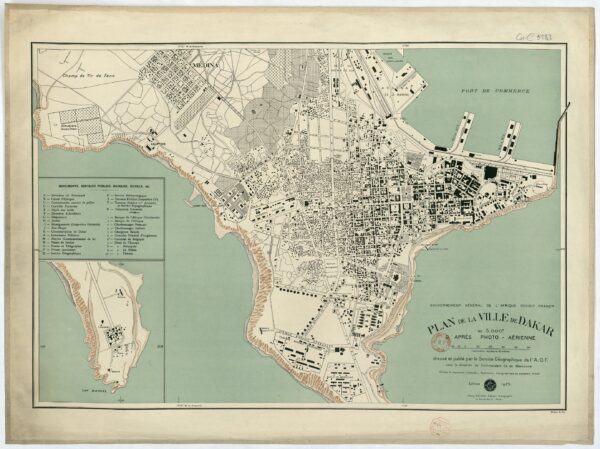
1925 aerial map of Dakar illustrating colonial monuments, public services, banks, hotels, and boundaries between European and African neighborhoods. David Rumsey Map Collection, David Rumsey Map Center, Stanford Libraries/CC BY-NC-SA 3.0.
Dakar, though, is only a fragment of the story. While the city was home to thousands, Senegal’s total population numbered well over a million in the first decades of the 20th century. Most lived in the Peanut Basin, the agrarian heart of the colony, where women were more essential to the region’s endurance than the French or their institutions ever were. When the rains and harvests came up short, it was women who kept farms and households running on credit that no colonial bank would extend. When men disappeared for years on end to find work, women kept themselves and their families afloat on debts that bound communities by obligation rather than by paper. Shut out by administrators on one side and bound ever more tightly by patriarchs on the other, women had to build their footing where neither had left them much.
This was a portrait of the economy that the colonial state refused to recognize, dismissing it as disorder or, more troublingly, as nothing at all. The vocabulary for this era of change is still the one that histories of capitalism strain to reach for, often in two-dimensional terms: the licit and the illicit, the civilized and the primitive, the market and subsistence. But these are not neutral categories, even today; they represent historical verdicts on which actors, activities, and forms of wealth would count toward French visions of commerce. To mistake the state’s record of recognition for the reflection of economic life itself, as historians too often have, is to allow the colonial past to govern what we validate as economic transformation, blinding us to the very mechanics of provision that kept the world in and beyond Dakar turning.
To mistake the state’s record of recognition for the reflection of economic life itself is to allow the colonial past to govern what we validate as economic transformation.
The categories constructed by the French do not, then, mark where the ripples of colonialism and capitalism ended. Instead, they mark where something else began. Economic exclusion was a catalyst for invention. Denied titles, women staked their claims on reputation. Refused wages, they harbored wealth in mobile and intimate reserves. Cut off from formal credit, they invested in what could be worn, circulated, and leveraged as collateral. They cultivated, albeit precariously, spaces of their own, alongside and in the shadows of those that authorities designed to shut them out.
And here I am, stepping into the archives, where the noise of Dakar’s streets fades behind heavy doors. Instead of the movement of people, I find the stillness of bound, fraying papers: stacks of administrative correspondence, governmental decrees, commercial reports, and court records. Yet to read these files today is not to recover a complete record of economic life in colonial Senegal, but to trace the boundaries of what officialdom could never bring itself to count. The rest—credit advanced against a name, debts honored without paper, wealth worn rather than banked—lived in the spaces those pages were never meant to hold. What reads as absence in the archive was never absence at all. By excluding women, the colonial state forced their economic lives outside French ledgers.
Becca Aponte is a doctoral student in history at Emory University, where she studies gender, law, and economy in French West Africa.
This work is licensed under a Creative Commons Attribution-NonCommercial-NoDerivatives 4.0 International License. Attribution must provide author name, article title, Perspectives on History, date of publication, and a link to this page. This license applies only to the article, not to text or images used here by permission.