Editor’s Note: This is the second installment in a two-part column. The first column is available here.
There is something odd about the photograph.
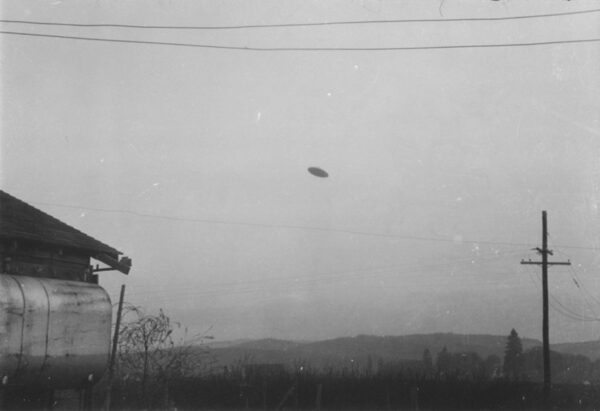
In 1950, Paul Trent took this photograph of the sky above his family farm in McMinnville, Oregon, and it became an iconic image of a UFO. Wikimedia Commons/public domain
Taken on May 11, 1950, by Paul Trent of McMinnville, Oregon, the picture captures a quiet scene on a farm. The side of a roofed garage is visible to the left. A wooden plank and wire fence run through the tall grass in the background before a hazy mountain range. A telephone pole juts from the ground to the far right, its lines drawing the eye across the overcast sky.
Then there is the thing in the center. A darkened ellipse, perhaps a disk tilted on its axis. An unsettling mark that charges the image with a strange tone. From a peaceful landscape shot of the rear of a farm, the normalcy of the image evaporates, leaving behind the uncanny trace of an unidentified aerial something.
The depiction of objects such as these—of disks, spots, orbs, lights, silvery capped objects, and oblong masses—appear as errors in otherwise conventional looking photographs. Similarly to AI-generated images, the appearance of a UFO (like an AI artifact) begins the hunt for other “tells” or proof that the image is not telling the truth.
The term “AI artifact” describes a visual flaw, error, or glitch in AI-generated media. Visual elements such as text hallucinations, anatomical mistakes, background distortion (e.g., warping, melting), overly smooth texture, and physics-defying objects emerge as outputs from prediction patterns of generative AI. Poor training data, inherent design limits, attachments to spurious correlations, or adversarial inputs may cause AI models to hallucinate and produce nonsensical outputs. As Chrystal R. China, a staff writer for IMB Think, explains, “A generative AI does not ‘know’ what is true or false. It only ‘knows’ what fits the pattern.” The insular logic of AI prioritizes outputs based on their statistical likelihood rather than real world correctness, leading to hallucinations, artifacts, or glitches.
As AI software becomes more refined, the truth has become much harder to discern
In a figurative sense, the insertion of a UFO into the image serves as a corrosive agent to the integrity of the photographs’ truth claim. Just as in the early days of AI imagery, extra fingers on a person’s hand, floating objects, and unusual shadows or blurs offered evidence that an image may be AI-generated. But as AI software becomes more refined, the truth has become much harder to discern. Visual analyses of potentially AI-generated images echo the paranoid scrutinizing of UFO photographs.
These McMinnville or Trent photographs are perhaps the most well-known images to emerge from the UFO movement. Due to their widespread and longstanding circulation, the photographs have been subject to repeated investigation by individuals skeptical of their authenticity. Investigators probe the “truth” of the image by analyzing the shadows, apparent weather conditions, and the object’s size relative to its distance to the camera. Witness statements are crosschecked with the photographs for proof of fraud. Photographic evidence therefore becomes the litmus test for whether to believe or not.
On that day in 1950, Evelyn Trent spotted a metallic disk hovering in the sky above her family’s farm as she was feeding her rabbits that evening. She called to her husband Paul to bring their Kodak camera, and with it he was able to take two shots before the object sped away. Their photographs and story were circulated in local news networks, first in the McMinnville Telephone Register, then picked up by the International News Service.
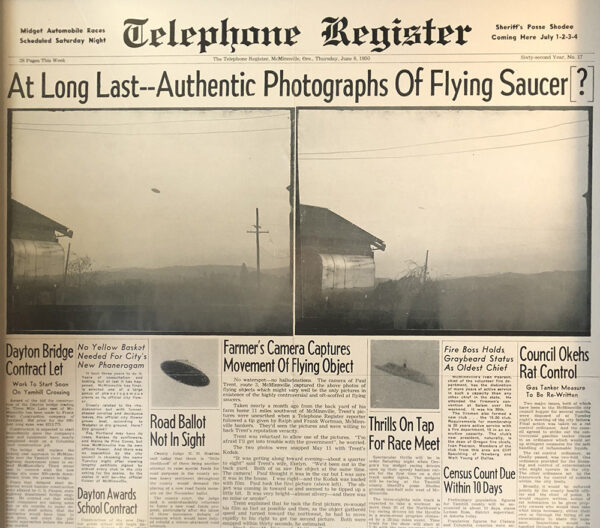
The local coverage of the Trent UFO photographs in the Telephone Register on June 8, 1950.
“No waterspot—no hallucinations. The camera of Paul Trent, route 3, McMinnville, captured the above photos of flying objects which might very well be the only pictures in existence of the highly controversial and oft-scoffed at flying saucers,” said the Telephone Register. A few weeks later, the story went national when Life magazine printed the photographs alongside a small image of Paul Trent with his camera.
The saucer story was familiar at this point, but the photographs were different. Now, the proof was in the image, not only witness testimony. While these were not the first flying saucer photographs, the images had a profound impact on the believability of the Trents’ narrative as it made its way through the media. Their visibility and repeated exposure are why the photographs remain iconic to this day.
In UFO photography, belief in paranormal images proceeds (not without dispute) from the belief in the camera’s ability to render what it sees objectively. However, that empirical basis seems eroded in the face of self-generating image machines. Reflecting on the case of the McMinnville photographs, what then is the difference today between a photographed UFO and an AI-generated artifact?
Between a UFO from the 1950s and an AI artifact from the 2020s, the difference in form and function seem almost indistinguishable. Their strange appearances are equally anomalous and unsettling. The cause of their presence remains unknown prior to extensive investigation. Neither can be taken at face value.
In the above excerpt, the Telephone Register made a point to separate the unusual object out from a water spot or hallucination, suggesting a greater significance for its presence. (They likely mean an optical or perceptual hallucination on the part of the witnesses, which the photograph works to dispel as “objective” evidence, but it is interesting to note they employ the same word we now use to describe AI-generated fabrications.) Irrespective of form, I believe it is this coding as significant that distinguishes the UFO from the AI artifact.
Though not everyone agrees that UFOs must be extraterrestrial technology—and within photographs they may be misidentified as common terrestrial objects, creatures, or phenomena—the existence of something in a photograph that is then conceptualized as a UFO carries with it an explanation and history for making sense of its presence.
Functionally, UFOs and AI artifacts act as glitches in the system—the reality “system” in the case of the former and the computer system in the latter. As glitches, their meaning is always tied to context, contingent upon the systems in which they appear. Visually, photographed UFOs and AI artifacts seem noticeably out of place: uncanny, odd, not normal, not real. While AI artifacts can be explained away as mistakes or computer errors, what happens when the error occurs in a medium like photography, which we rely upon for its ability to faithfully replicate real life?
The dissolution of public trust in the integrity of photography and video after the popularization of GenAI has obscured the persistent negotiation of authority, fallibility, and truth that occurs within photography. Photographs are not facts themselves but pieces of provisional evidence. Like a page torn from a book, an image can only tell part of the whole story.
Photographs are not facts themselves but pieces of provisional evidence.
As UFO photography illustrates, the evidentiary value of photography and video are contingent upon what they’re able to reveal within existing knowledge structures. If photographs appear to “imagine” what they show (as happens in AI-generated imagery), then their trustworthiness becomes diminished. Although AI’s threats to the rootedness of photography and video should not be understated, photographs of UFOs make clear that the information these technologies convey have never been as absolute or objective as they would seem. As Jung observed in his book Flying Saucers, “Something is seen but one doesn’t know what.”
When it comes to photographs of UFOs, for now, the something remains out of our grasp. The history of UFO photography has taught us that photographs are by and large demonstrably trustworthy but not infallible. Their partial truths are perhaps the most sure thing about them. The same photograph can be used to advance wildly divergent conclusions. Thus, the truth is often in the eye of the beholder. In an age when images can be falsified and quickly circulated without proper vetting, viewers should remain critical of what they see online or in the media, so that seeing alone does not determine the nature of what we believe.
Madalyn K. Shaw is a PhD student in art history at the University of Toronto. Her research examines visual and material culture at the intersection of science, technology, and collective imagination in the 20th century, and her dissertation explores the role of photography as evidence in the context of the UFO movement.
This work is licensed under a Creative Commons Attribution-NonCommercial-NoDerivatives 4.0 International License. Attribution must provide author name, article title, Perspectives on History, date of publication, and a link to this page. This license applies only to the article, not to text or images used here by permission.