Editor’s Note: This is the first installment in a two-part column. The second column is available here.
In March 1952, the United States Air Force launched its third formal investigation into the appearance of unidentified flying objects (UFOs) under the code name Project Blue Book. Following the 1947 saucer “craze,” which saw hundreds of Americans reporting flying discs in the sky (after the first sighting reported by pilot Kenneth Arnold), the air force was compelled to investigate once again to put concerns about national security to rest and to analyze UFO reports scientifically.
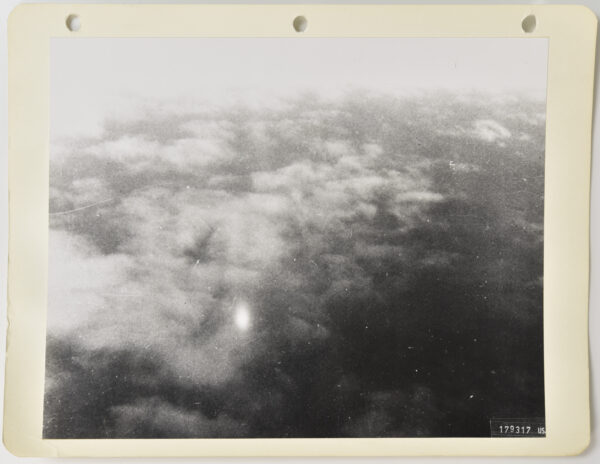
Numbered plate 54 as part of the “Scientific Study of UFOs” in the National Archives, this 1969 photo was part of the US Air Force’s investigation into the phenomenon, also known as the Condon Report. National Archives and Records Administration / NAID 295136787
Public opinion was divided on an explanation. If these saucer sightings were not optical illusions or caused by the misidentification of common terrestrial objects, some suggested that they were secret military technology (either American or Soviet) or experimental aircraft. Amid rising Cold War tensions, these conclusions made sense. Yet the seemingly impossible maneuvers of the saucers prompted a different question: What if they were not from Earth? It was amid these broader speculations that the first director of Project Blue Book, Captain Edward J. Ruppelt, renamed “flying saucers” or “flying discs” to “UFOs,” to apply a more generic and neutral framework for investigation.
Despite the perceived lack of enthusiasm and interest displayed by the government in investigating sightings, UFOs remained an enduring fascination in the public sphere. Notably, Swiss psychiatrist Carl Jung wrote a book on the topic. In a little discussed passage from Flying Saucers: A Modern Myth of Things Seen in the Skies (1959)—translated by R. F. C. Hull from the original German version published in 1958—Jung reflects on the perceptual and psychological ambiguity around UFO sightings. As an aside, he remarks:
Considering the notorious camera-mindedness of Americans, it is surprising how few “authentic” photos of Ufos seem to exist, especially as many of them are said to have been observed for several hours at relatively close quarters. I myself happen to know someone who saw a Ufo with hundreds of other people in Guatemala. He had his camera with him, but in the excitement he completely forgot to take a photo, although it was daytime and the Ufo remained visible for an hour. I have no reason to doubt the honesty of his report. He has merely strengthened my impression that Ufos are somehow not photogenic.
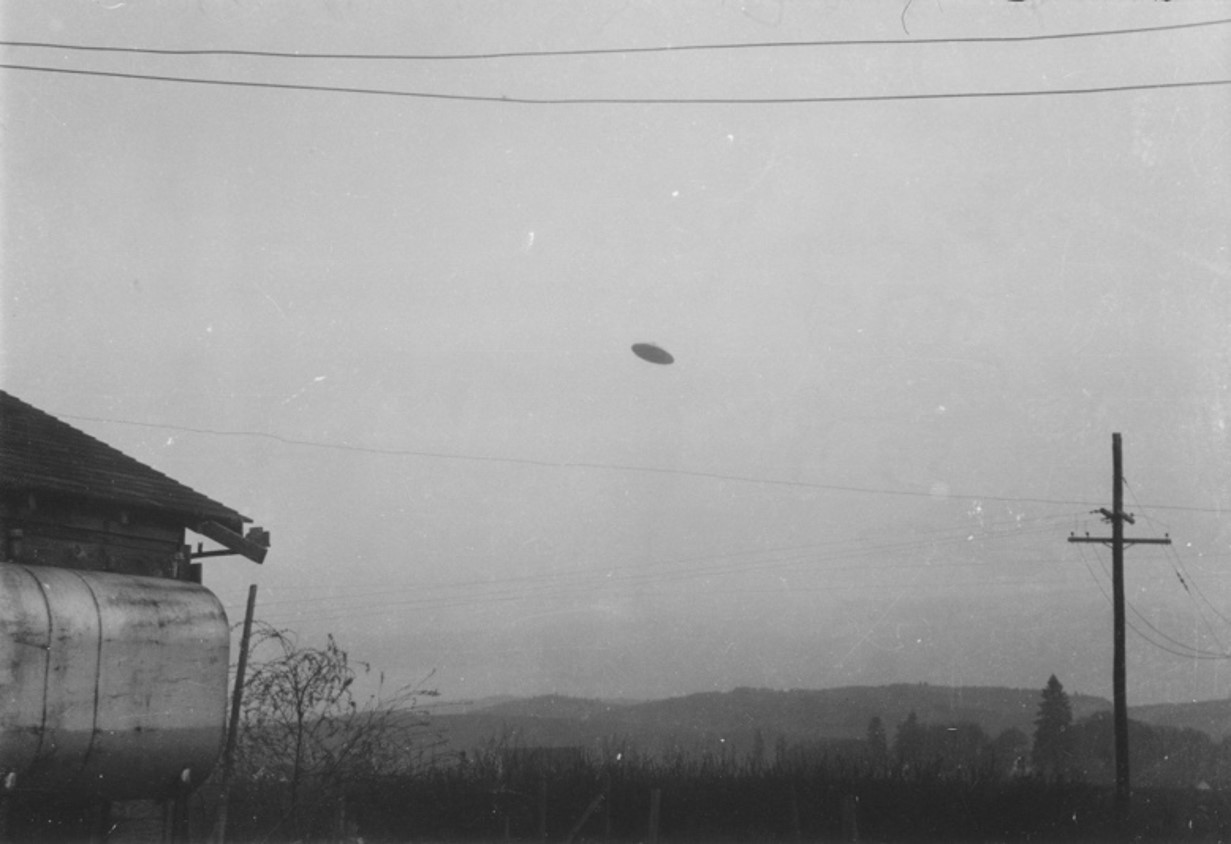
Here Jung pointed out a persistent issue noted by those working on Project Blue Book and most if not all subsequent investigations to date: the lack of quality evidence of UFO sightings. Apart from drawings and witness testimony, photographs often supply the only visual evidence that a sighting occurred. Photographs of sightings were rare and especially important for investigators who sought external confirmation.
Photographs often supply the only visual evidence that a UFO sighting occurred.
I find Jung’s choice of words in this passage to be particularly striking. The observation that UFOs “are somehow not photogenic” or simply “unphotogenic” raises questions about what we expect from photographs. What does it mean, in this context, for a UFO to be considered “(un)photogenic”?
In the early days of photography’s existence as a new imaging technology, photographs were praised for their faithful reproduction of reality. The notion that the passage of time could be frozen forever in an image fundamentally changed how people viewed the world. That the images were so lifelike and true to reality prompted various theorizations of photography that likened it to a naturally occurring phenomenon.
As art historian John Tagg wrote in The Burden of Representation: Essays on Photographies and Histories (1988), “The optical and chemical processes of photography were taken to signal a scientifically exploited but ‘natural’ mechanism producing ‘natural’ images, thus the truth of the image was guaranteed. Photographs appeared to present a ‘perfect and faithful record, free’ . . . from the imprecisions of verbal language” or artistic interpretation. Photography thus became the perfect medium for representing reality.
That said, the potential of photographic manipulation has existed for almost as long as photography has. Stereoscope cards produced in the mid-19th century featured staged historical, landscape, comedic, and sentimental images as well as more fanciful scenes of fairytales and supernatural entities. Photographers capitalized on the long exposure time of early cameras to create illusionary ghosts, as seen in the popular “Ghost in the Stereoscope” card series, published by the London Stereoscopic and Photographic Company in the mid-1850s. Such techniques were later employed by spirit photographers to make ghosts appear in their portraits of bereaved sitters. However, unlike the publishers of the “Ghost in the Stereoscope” cards, these photographers, along with many of their sitters, claimed their ghosts to be real. The history of spirit photography offers a potent parallel to debates over the reality of UFO photographs and the fears of photographic manipulation that suffuse them. As in the case with spirit photography, fervent belief in paranormal images must be combatted by “debunking.”
The practice of debunking reveals an underlying tension in our trust in photography. While we know photographs can be made to lie, we also believe in their ability to tell the truth. Jung pointed to this ambiguity, demarcating the line between what photography is believed to do (show reality) and what it actually does (show something).
Although Jung’s associate failed to take a picture of the UFO he saw in Guatemala, what might be said of the hypothetical photograph if he had? Jung already notes how surprising it is “how few ‘authentic’ photos of Ufos seem to exist,” but what does “authentic” mean here? “Authentic” tends to imply consensus and the existence of verifiable information, both largely absent in discussions of depictions within UFO photographs. While in a literal sense, any photograph of an unidentifiable seemingly airborne something could be a UFO, this is not what Jung means to convey. (Hence his emphasis on UFOs as a “modern myth” as opposed to unidentified aerial phenomena.)
For a photograph to be “authentic” in the way Jung means would require verifying the object in the photograph as a UFO (the mythic kind) and consensus around the interpretation of the object as such. From here, we can see that his conclusion that UFOs are not photogenic may result from two intertwined premises:
First, he proposed UFOs are unphotogenic due to situational obstacles, physical or affective characteristics, or photographer inaction or ineffectiveness. These reduce the number of “authentic” photographs in existence despite the “notorious camera-mindedness of Americans” and Jung’s associate having viewed the UFO for an hour alongside hundreds of other people. (We can only speculate why no photographs came from these other witnesses.)
Second, UFOs are unphotogenic because there are no “authentic” photographs. There are no “authentic” UFO photographs because people cannot agree on what is being depicted in the image, nor can they possibly validate their conclusion based on the photograph alone. The image would need to be compared to an actual UFO so as to verify the referent. (This requirement poses challenges as UFOs are reportedly quite varied in size, shape, and behavior, which would make finding the same object depicted very difficult or even impossible.)
In just a few sentences, Jung justified his impression that UFOs are not photogenic, yet the creation of the premise itself (UFOs are unphotogenic) is not part of his explanation. Jung presumably would have had to see a UFO photograph before drawing this conclusion. Thus, there is a third premise implicit here: UFOs are unphotogenic because they do not appear well in photographs.
But why don’t UFOs appear well in photographs? They are notoriously elusive, seen only in brief moments, never staying put long enough to be “identified” past their identification as a UFO. Unlike objects known to us, UFOs lack a stable physical referent. Additionally, the UFOs’ condition of ontological ambiguity places them at odds with the reality-affirming medium of photography.
In photographs, UFOs are defined and undermined by visual ambiguity, reflecting their uncertain existential nature.
Photographs are believed to have the capacity to inform us about the world, yet photographs of UFOs fail to provide knowledge about UFOs apart from their fleeting appearance. In photographs, UFOs are defined and undermined by visual ambiguity, reflecting their uncertain existential nature. The “unphotogenic” appearance of UFOs has to do with the fact that they visually transgress the boundaries of what is typically inferred by a photograph—that of a stable physical presence firmly based in reality. Jung’s conclusion that UFOs are unphotogenic can therefore be seen as a charge against photography’s claim to reveal the truth.
UFOs expose the unreliability of the camera and of vision. They demonstrate how that which is seen and that which is mechanically registered are not the same. If that which is registered cannot be identified as anything that exists in this world, the image loses its evidentiary value and credibility. Ultimately, any photograph of a UFO is unreliable (on the basis of its truth claim) and must negotiate with our belief in the truth-telling capacity of photography.
On the other hand, one might argue that UFOs invite the act of interpretation, which is the demand of all photographs regardless of their appearance. In an exploration of photography as a medium, UFOs reveal the necessity of textual explanation or analysis and lay bare how some viewers come to create new narratives or realities using the photograph as the basis of truth.
While UFOs may be unphotogenic within an understanding of reality that denies (or is at least ambiguous about) their existence, our belief in photographs can create a world in which UFOs become real, turning photographs into evidence of that fact. It’s no wonder then why we keep seeking photographs of UFOs, even though these photos will never produce conclusive evidence of the mysteries of the universe.
Madalyn K. Shaw is a PhD student in art history at the University of Toronto. Her research examines visual and material culture at the intersection of science, technology, and collective imagination in the 20th century, and her dissertation explores the role of photography as evidence in the context of the UFO movement.
This work is licensed under a Creative Commons Attribution-NonCommercial-NoDerivatives 4.0 International License. Attribution must provide author name, article title, Perspectives on History, date of publication, and a link to this page. This license applies only to the article, not to text or images used here by permission.