
Beloved colleague Quintard Taylor, who taught at the University of Washington for nearly 20 years, passed away September 21, 2025, at age 76. A prolific scholar who reinvented the field of Black history in the American West, he was equally renowned as a pioneer of online public history and the founder and director of BlackPast.org, the world’s largest encyclopedia of African and African American history. A legendary road warrior, Taylor rarely declined an invitation to speak, delivering at least 300 public lectures at universities, churches, and community centers across the United States, Africa, and Europe. He served on the AHA Council and Committee on Affiliated Societies from 2003–06.
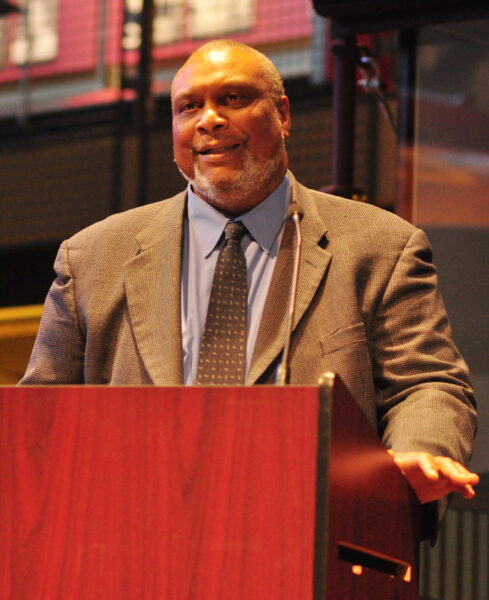
Joe Mabel/Wikimedia Commons/CC BY-SA 4.0
Taylor authored or co-authored eight books and at least 75 academic articles and book chapters; his Pulitzer Prize–nominated book In Search of the Racial Frontier: African Americans in the American West, 1528–1990 (W. W. Norton, 1998) was especially influential. A carefully argued, field-defining work of enormous scope, it broke the North-South binary of Black historiography and clarified the special circumstances of Black experiences in the American West, which included barriers limiting mass migration and multiracial demographics of Indigenous, Asian, and Hispanic peoples struggling under harsh white supremacist regimes. A vibrant field erupted in the wake of Racial Frontier’s publication; a full generation of scholarship responded to his reframing of western and African American history. Taylor’s contribution was acknowledged in numerous awards—perhaps most meaningfully in 2011, when he became the first Black scholar elected as the president of the Western Historical Association.
He did not start off in the West. Indeed, as our colleague John Findlay explained, Taylor’s career path may be seen as a series of westward steps from one coast to the other. Born and raised in Tennessee, he earned a BA in history in 1969 at Saint Augustine’s College, the historically Black university in Raleigh, North Carolina. From there, he went on to the University of Minnesota for graduate studies in American history, earning an MA in 1971 and a PhD in 1977. Meanwhile, he had begun teaching, first with an appointment in the new Black studies program at Washington State University, later joining the history faculty at California Polytechnic State University in San Luis Obispo. In 1990, Taylor moved to the University of Oregon, where he served as history department chair. His final move came in 1999, when he was appointed the Scott and Dorothy Bullitt Professor of American History at the University of Washington.
Seattle welcomed Taylor, and not only academic Seattle. One of his earlier books, The Forging of a Black Community: Seattle’s Central District from 1870 through the Civil Rights Era (Univ. of Washington Press, 1994), had already become (and remains today) a touchstone text in the city. He became an instant celebrity and was quickly called on for lectures, public ceremonies, and policy advice. His death has been mourned in Seattle newspapers, television reports, and public ceremonies.
An early advocate of digital publishing, Taylor founded BlackPast.org in 2007. It has since become an essential source for African American and global African history, with more than 64 million site users. The encyclopedia features 7,200 separate entries written by nearly 1,000 contributors. Taylor poured heart, soul, and money into BlackPast.org and along the way invented a new method of crowdsourcing. The hundreds of contributors, which include world-renowned scholars, were personally coaxed, prodded, reminded, and reminded again that they needed to contribute.
Quintard is survived by his wife Phylisha Agbor-Taylor; sons Quintard Taylor III and William Taylor; and daughter Jamila Taylor, a prominent member of the Washington State Legislature.
BlackPast.org is Quintard’s greatest legacy, and his friends and family are determined to ensure that it endures. Donations in his name will help. Quintard’s passing will also be honored at the 2026 conference of the Pacific Coast Branch of the AHA, which will feature a session honoring Taylor and assessing the field that he redefined.
James Gregory
University of Washington
This work is licensed under a Creative Commons Attribution-NonCommercial-NoDerivatives 4.0 International License. Attribution must provide author name, article title, Perspectives on History, date of publication, and a link to this page. This license applies only to the article, not to text or images used here by permission.