
John R. Wunder, professor emeritus of history at the University of Nebraska–Lincoln (UNL), died on June 25, 2023, at age 78. Wunder made foundational contributions to the study of the American West, Native American law and sovereignty, and Great Plains history. His legacy endures through his scholarship and the students and colleagues whose work he shaped.
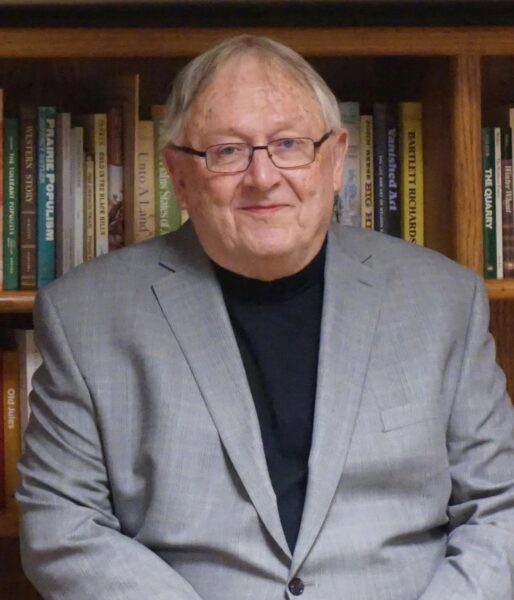
Photo courtesy the Department of History, the University of Nebraska–Lincoln
Born in Vinton, Iowa, and raised in Dysart, Wunder developed an early appreciation for regional identity and rural life that remained central to his historical vision. He earned his BA, MA, and JD from the University of Iowa and his PhD at the University of Washington. This combination of legal training and historical method characterized his scholarship, which centered Native American sovereignty and law in American history and insisted on understanding Native nations as enduring legal and political entities.
Wunder’s scholarly output was extraordinary in both volume and scope. He published 22 books, more than 60 journal articles, and nearly 150 essays, reviews, and reference entries across western history, Great Plains studies, legal history, and Native American history. His landmark book, “Retained by the People”: A History of American Indians and the Bill of Rights (Oxford Univ. Press, 1994), and his six-volume series, Native Americans and the Law (Routledge, 1996–99), helped establish Indigenous legal history and tribal sovereignty as core areas of inquiry.
His scholarship addressed a wide range of interests: frontier courts, land and environmental management, Spanish exploration of the Great Plains, the Kansas–Nebraska Act, the Kiowa people, Chinese immigrants, and the writer Mari Sandoz. Late in his career, he wrote a history of Nebraska’s eight-man football tradition with his usual seriousness of inquiry and respect for regional culture. For Wunder, law, culture, and community were inseparable areas of study.
During his tenure as director of UNL’s Center for Great Plains Studies (1988–97), Wunder expanded the center’s intellectual mission, founded the interdisciplinary journal Great Plains Research, helped launch the Encyclopedia of the Great Plains, and strengthened the Great Plains Art Museum. Drawing on his legal expertise, he helped to defend Native burial rights and facilitate the respectful repatriation and stewardship of Indigenous cultural materials in Nebraska. As president of the UNL Faculty Senate during the 2003–04 academic year, Wunder established a task force that laid the groundwork for a major reform of the university’s general education curriculum. Fundamental to his work was a commitment to expanding access to members of all ethnic backgrounds and gender identities.
Wunder’s influence extended well beyond Nebraska. Beginning in the mid-1990s, he developed a relationship with the University of Helsinki, where he served as a Fulbright Scholar and later as a permanent visiting professor in American studies. His teaching and mentorship there helped shape an international cohort of scholars working on the history of the American West and Indigenous peoples, reinforcing his belief that regional history should speak to global audiences.
For many, however, Wunder’s most enduring legacy lies in his mentorship. He advised at least 26 doctoral dissertations and 31 master’s theses, while mentoring many more students and junior scholars across institutions and disciplines. His students now occupy positions throughout the academy and public humanities, reflecting the breadth of his influence. Known for his intellectual rigor, careful guidance, and generosity of spirit, Wunder approached mentorship as a long-term professional commitment.
Wunder was also deeply committed to the history discipline and public humanities. He devoted nearly four decades to the Western History Association, serving as president in 2010. He was similarly engaged with Humanities Nebraska and the Mari Sandoz Society. In 2021, he received the prestigious Sower Award from Humanities Nebraska in recognition of his contributions to the state’s cultural and intellectual life.
Wunder once said that he hoped to be remembered as a good historian and a good mentor. Those who studied with him, worked alongside him, or benefited from his guidance know that he achieved both. His scholarship reshaped fields, his institutions were strengthened by his leadership, and his students continue to carry his influence forward.
This work is licensed under a Creative Commons Attribution-NonCommercial-NoDerivatives 4.0 International License. Attribution must provide author name, article title, Perspectives on History, date of publication, and a link to this page. This license applies only to the article, not to text or images used here by permission.