Editor’s Note: This is the second installment in a two-part column. The first column is available here.
After years of studying American history, I assumed the greatest challenge I would face as a French educator in the United States would be translating everything I had learned into meaningful classroom discussions. Instead, I found that the real difficulty was not explaining the past but understanding what gave me the authority to teach it in the first place. Over time, I became increasingly conscious of the unusual position I occupied in a US history classroom. I was asking my students to think critically about their own country, a past I knew through years of study but one I had not inherited in the same way they had. For a long time, I wondered what my relationship to that past meant for my authority as a teacher.
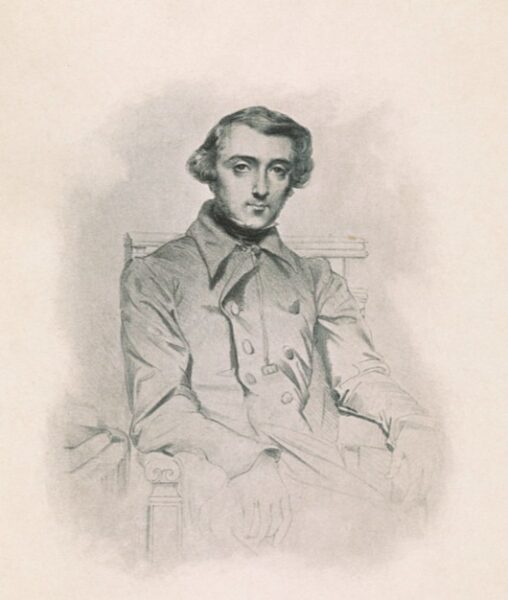
Inspired by Tocqueville’s study on American democracy, a historian from France ponders the limits of authority when teaching US history. Library of Congress Prints and Photographs Division/public domain. Image cropped.
Recently, while reading Alexis de Tocqueville for my dissertation research on incarceration, I found myself reconsidering that question. Sent by the French government to the United States in 1831 to study its penitentiary system, Tocqueville instead produced Democracy in America, a book Americans still return to when trying to better understand their society. The more I read, the less interested I became in what Tocqueville said about America. Instead, I wondered why Americans had accepted him as one of their most enduring interpreters. His foreignness was not an obstacle to his authority; in many ways, it helped form the perspective that made his observations so distinctive. He observed American society without having been formed within it, allowing him to question assumptions that might have appeared self-evident to others.
Tocqueville helped me see that the distance separating me from American history might also offer a different vantage point from which to interpret it. Perhaps the position I had worried would undermine my authority would in fact bolster it. But my experiences with students would complicate that realization, especially as our conversations moved closer to the present.
In an introductory course on US history, while working through Eric Foner’s Give Me Liberty!, my students and I discussed the changing meaning of freedom throughout the 20th century in the United States. As our conversations turned to the experiences of groups who had historically been excluded from the promise of freedom, a student raised their hand and asked, “Why don’t we talk about the oppression of white people as well?”
Tocqueville observed American society without having been formed within it, allowing him to question assumptions that might have appeared self-evident to others.
The question caught me off guard. I knew US history well enough to answer based on historical evidence, but my status as a foreigner on a temporary visa made me conscious of something I had rarely considered before: whether the person presenting the evidence mattered as much as the evidence itself. Graduate school taught me how to study the past, but it never made me think much about why others should trust me to explain it. While Tocqueville had helped me understand that being an outsider did not invalidate my authority, the classroom was beginning to show me that expertise itself had limits when my understanding of history butted up against others’ personal connections of it.
Like most people, I remember exactly where I was on September 11, 2001. I had just come home from school in southern France when the news broke, and I watched the events unfold on television from thousands of miles away. I understood the global significance of that day, but I did not experience its aftermath the way Americans did. When later I covered 9/11 as part of the same intro US history course, I approached it primarily as a historical event, tracing what happened and discussing its consequences. However, for many of my students, even those who don’t have their own memories, those events were personal. They shared stories about relatives who had worked in New York City that day or family members whose lives had changed in the years that followed. I learned that it would take more than the passage of 25 years for 9/11 to move from collective memory to distant historical event.
While historians distinguish between history and collective memory in theory, my students helped me understand the distinction in practice. I remember 9/11 but from a different national context. I had not inherited the memories and narratives through which my students had learned to understand it—often not in a history classroom but within their families or popular culture. Yet had we been discussing the coordinated terrorist attacks that happened in Paris in November 2015, our positions might have been reversed. Living in France as the attacks unfolded was an experience no amount of study could fully reproduce. We could examine the same historical evidence without ever approaching it from exactly the same place.
But even a more distant shared past did not necessarily produce a shared historical consciousness. Our discussions of World War II made that extremely clear. My students and I had all learned about Pearl Harbor, D-Day, and the dropping of the atomic bombs. But while growing up in France, I had encountered the war within a different national context. The German occupation of France, along with questions of collaboration and resistance, occupied an important place in my education but was less familiar to many of my students.
We could examine the same historical evidence without ever approaching it from exactly the same place.
In hindsight, those differences are unsurprising. Every country’s history curriculum begins from its own experience of the past. Events might be shared, but the narratives through which we learn them are not. In teaching about World War II, the asymmetry in authority I had worried about worked in the other direction. What I brought to the classroom could broaden their understanding of a history they already knew, drawing attention to parts of the narrative that had occupied less space in their own education.
Overall, these experiences changed the way I teach. I stopped making assumptions about what my students knew and began by asking them. What seemed obvious to me was not always obvious to them and vice versa. I now approach teaching less as an exercise in explaining history than in understanding the different ways we had each learned to make sense of it and then creating opportunities for students to question and expand those understandings.
The way I understand my place in the classroom has changed too. I once worried that being foreign weakened my authority to teach American history. Today, I know that being French is not something I teach despite but something I teach through. The differences between me and my students are not limitations to be overcome but part of the historical inquiry we undertake together.
Historians have an obligation to know the evidence and to follow it where it leads. But evidence alone does not determine how our interpretations are received. We all approach the past from somewhere. Recognizing where that is can sharpen the questions we ask, complicate the stories we tell, and deepen the conversations we have.
Justine Truc is a PhD candidate in history at the University of South Carolina, where she has served as a teaching assistant for more than five years. Originally from France, she earned her bachelor’s degree in American studies and her master’s degree in American history from the Université de Toulon.
This work is licensed under a Creative Commons Attribution-NonCommercial-NoDerivatives 4.0 International License. Attribution must provide author name, article title, Perspectives on History, date of publication, and a link to this page. This license applies only to the article, not to text or images used here by permission.