
In our professional development workshops on AI and history instruction, we often encounter teachers curious about platforms like schoolai.com, humy.ai, and character.ai, which invite users to “speak” with historical figures. Excited about the potential of these tools to get students engaged in history, these educators are eager for our endorsement.
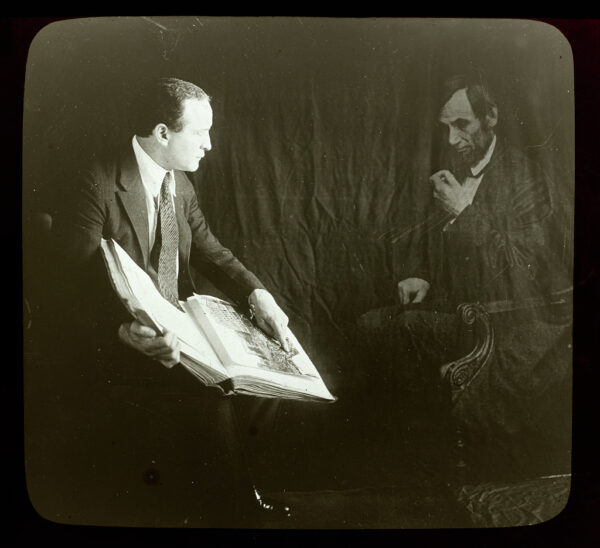
Just as Harry Houdini posed with an apparent apparition of Abraham Lincoln to demonstrate how photographic techniques could manufacture encounters with the dead, GenAI chatbots transform a constructed representation into the appearance of a direct encounter with a historical figure. Library of Congress Prints and Photographs Division, public domain
But our (and our colleagues’) experiments with these platforms have raised far-reaching concerns. During a conversation we had with a simulated Anne Frank using character.ai, she told us, “I died in the typhus epidemic in the spring of 1945.” She specified how many people were killed in the Holocaust—adding, “I have spoken with many people who lived through it”—and was excited to let us know that when she grows up, she wants to be an author “like J. K. Rowling.” The generated response was fluent but impossible. This is just one example of many that historians and educators have shared about how these AI tools at best mislead readers—and at worst lie about the past.
We write as history education faculty who work with in-service and preservice history teachers in methods courses and professional development, as well as with K–12 students in workshops and camps. Generative AI (GenAI) is an increasing part of how students encounter the past. Young people meet history not just through teachers, textbooks, or online educational resources but also through chatbots and AI image generators. In this landscape, limiting GenAI in the classroom does not keep students from using it; rather, it denies history educators the opportunity to shape the future of GenAI in education. In our minds, the task is not to eliminate GenAI but to study it, treating its output as a primary source in order to help students see how GenAI constructs history while reflecting the biases and assumptions of the present.
You likely had a reaction to reading our position (positive or negative!). The use of GenAI, in and outside of education, has produced a range of emotional responses from educators, students, and parents, with some urging integration while others advocate for outright bans. But whatever our personal opinions, the College Board reports that 84 percent of high school students had used GenAI as of October 2025, while a minority of schools had established an official policy and fewer than half had blocked GenAI platforms at their schools. By February 2026, 88 percent of higher education faculty in English, history, humanities, and social sciences reported seeing students using GenAI for writing assignments.
The AHA is one of few organizations that provides official guidance for working with AI. The Guiding Principles for Artificial Intelligence in History Education argues that bans are not a long-term solution and that history education should cultivate AI literacy. It calls for intentional engagement rooted in historical thinking. In its most practical guidance, it emphasizes clear classroom policies and routine disclosure and citation of AI-assisted work. We share that stance but aim to sharpen it by treating citation not as a box to check but as the beginning of a disciplinary problem: provenance. For history educators, one important piece of the puzzle is developing a form of AI literacy grounded in historical thinking and ethical judgments about when generating a voice or image becomes a form of speaking for others.
A palimpsest, literally “scraped again,” is a manuscript page that was reused after its original text was erased.
Long before algorithms, palimpsests offered historians a metaphor for the layered nature of recordkeeping. A palimpsest, literally “scraped again,” is a manuscript page that was reused after its original text was erased. Traces of earlier writing remained, and over time, scholars learned to read through those layers. This was no easy task, as words left behind were not always visible to the naked eye and illuminating them required technological advancement.
We can now see GenAI reenacting this process digitally. Its models are trained on immense corpora: archives, books, artworks, and metadata encoding centuries of cultural production. When the machine “writes,” it reinscribes those traces. The result is a new text or image that appears original but is haunted by what preceded it. These algorithmic palimpsests are not simply copies of what came before. Instead, they are aggregations of prior meaning smoothed into a surface so seamless that what came before disappears; sorting out where information was sourced can be difficult. The authors of the Guiding Principles warn that AI systems “reproduce existing textual and visual patterns without regard for evidence, authorship, or historical context.” A generated artifact can appear finished and authoritative when it is in fact merely speculative. Palimpsests remind us that history is layered and partial, a truth the digital version may tempt students, teachers, and historians to forget. History educators must help students learn to read through the surface.
In film, the “burden of representation” names the moral weight placed on creators who depict historically marginalized peoples. In historical film, the “burden of historical representation” extends the obligation to long-suppressed perspectives. That obligation has always existed alongside interpretation. No source is a transparent window on the past; all representations demand critical reading. What is different in the age of GenAI is not the need for interpretation but the presence of “sources” with no creator to be situated, questioned, or held accountable for representational choices. When a model produces a “voice” for Anne Frank or generates a new “photograph” of Omaha Beach on D-Day, it takes on the representational work of authors and artists without their awareness, intention, or accountability. Ethical labor once borne, however imperfectly, by authors, filmmakers, editors, and institutions is now performed by a system that cannot recognize harm, evidence, or historical consequence.
In this setting, responsibility relocates while the conditions of responsibility change. When looking at GenAI outputs, the burden of representation becomes a burden of reading. Historians and history educators must make that interpretive labor more explicit because the machine’s outputs obscure its provenance. In earlier media forms, students could be taught to analyze intention, perspective, or omission by contextualizing a source. GenAI complicates that work by mass-producing plausible narratives and images on demand. The problem is not bias alone but a persuasive surface detached from evidentiary warrant. In this way, GenAI forces us to teach historical literacy as both evidence based and media critical.
There is a reason K–12 history teachers use films and documentaries: They give historical figures cinematic afterlives that audiences often recall more vividly than they remember a primary or secondary source. Character-based AI platforms inherit and magnify that burden. A film is finite; a chatbot generates endless dialogue in a simulated tone, and when students use these platforms, the output is rarely verified in real time. What feels like a private conversation is actually a layered synthesis shaped by training data, algorithmic patterning, and user prompting. These simulations risk reinscribing harm by inviting students to consume recitations of trauma (as in our Anne Frank example) as interactive entertainment that positions the guesswork of AI platforms, however well trained, as testimony. Asking GenAI to imitate first-person historical voices—especially the voices of those who suffered or were silenced—blurs the distinction between evidence and empathy and undermines students’ capacity to think historically.
If these simulations occur in the classroom, we suggest treating them as triage, not pedagogy, in three steps: Label them as present-day artifacts, not recovered testimony. Avoid first-person role-play. Quarantine them for critique by asking where the information came from and what anachronisms or omissions appear.
Asking GenAI to imitate first-person historical voices undermines students’ capacity to think historically.
First-person historical voices that can help anchor empathy to evidence include diaries, letters, oral histories, and museum collections. When students encounter a simulated voice, instructors might redirect the discussion toward ethics: Who benefits when a machine “speaks for” the dead, and who might be simplified or harmed? Avoiding simulation means not avoiding GenAI but reframing its products as cultural mirrors rather than historical sources: What the algorithm generates tells us less about the past than about how the past is remembered.
Similar ethical tensions surface in AI-generated imagery. We asked ChatGPT to create “a realistic photo of soldiers storming Omaha Beach.” At first glance, the resulting image resembled Robert Capa’s D-Day photographs; on closer inspection, we saw that the soldiers were marching into the sea rather than onto the beach. When we pointed out those errors and asked ChatGPT to “improve” the photo, it produced an image nearly identical to Robert F. Sargent’s Into the Jaws of Death, without attribution. And while we were able to identify the original, most students could not.
This is plagiarism, but it is also a collapse of provenance. The model could reproduce the photograph’s composition but not its context—the peril, perspective, and contingency that gave the original meaning. Because AI lacks “vertical textual memory,” its representations float free of evidence.
Just as we suggest that teachers avoid having GenAI speak for the dead, we also suggest they avoid using GenAI to visualize the past as documentary evidence. If such images circulate through student projects or on social media, teachers can reframe them as objects of critique—products of the present rather than evidence of the past—and ask what characteristics make the image believable.
Pedagogy attuned to both history and technology invites students to read GenAI’s outputs as artifacts:—what we call pedagogies of the palimpsest. Rather than banning AI, history educators can reframe its products as opportunities for disciplinary reasoning while building critical AI literacy: understanding how AI generates outputs, appraising its affordances, and evaluating ethical use. Critical AI literacy and historical literacy should work together. Learning to recognize how GenAI systems generate information—and where they fit in the long lineage of media, textbooks, films, and games that mediate our relationship to the past—will help students navigate the digital epochs they already consume.
Five moves can translate a palimpsest reading into teachable habits:
- Locate the constructed narrator: Who appears to be speaking here, and with what authority?
- Analyze the voice: What emotions or assumptions make the narrative persuasive?
- Cross-examine the evidence: What can be verified, and what is invented?
- Discuss the ethics of representation: Who benefits, and who might be harmed?
- Reflect on the machine’s mirror: What does our desire to make the past “speak” reveal about us?
These moves turn the burden of historical representation into a scaffold for critical reflection. Students learn that every depiction—whether on film, in a textbook, or produced by an algorithm—embeds choices about power and perspective.
Educators already know that students learn history not only in their classrooms but from documentaries, graphic novels, family anecdotes, and video games that simulate past worlds. GenAI is the newest, most complex and increasingly ubiquitous form of cultural curriculum. Our task now is to contextualize and critique it, thereby merging historical literacy with AI literacy. Students who learn to read the digital palimpsest will come prepared to evaluate AI’s representations of the past and to recognize their own place in history.
Amy Allen is an associate professor and David Hicks is a professor of history and social science education in the School of Education in the College of Liberal Arts and Human Sciences at Virginia Tech.
This work is licensed under a Creative Commons Attribution-NonCommercial-NoDerivatives 4.0 International License. Attribution must provide author name, article title, Perspectives on History, date of publication, and a link to this page. This license applies only to the article, not to text or images used here by permission.