“When did our students learn how to write?” I asked Cathay Snyder, a historian with whom I have co-taught the general education US history introductory course at Messiah University for more than two decades.
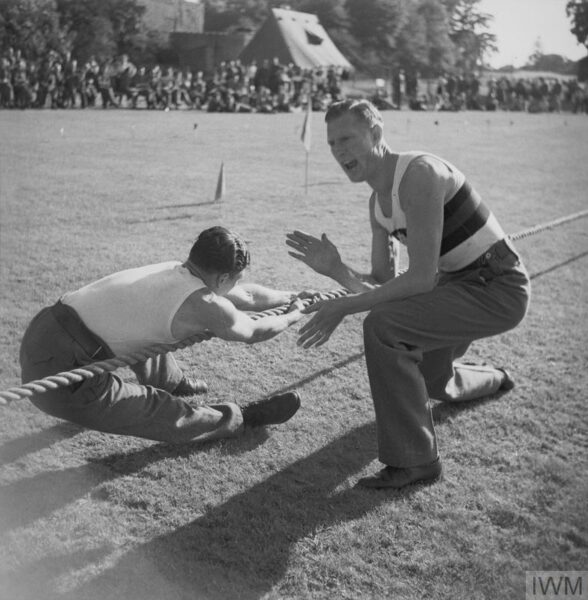
The AI age has teachers pulled between student demand for quick results and the slow, thoughtful process of learning to think historically. Imperial War Museums, War Office Second World War Official Collection, IWM (H 32586)
It was fall 2024. I had just returned from a yearlong sabbatical and was grading the first assignment: a paper on Benjamin Franklin’s Autobiography and the American Enlightenment. I noticed that students were now writing perfect sentences, and I was using less red ink than before. Many of these papers contained arguments supported by solid evidence from the text. What had changed? Cathay explained that during my time away, our students had discovered ChatGPT. “Chat what?” I replied. Being somewhat of a Luddite when it comes to new technology, I had hoped to ignore the artificial intelligence boom that started with the wide availability of large language models (LLMs). I now realize that was unrealistic.
In December 2025, after nearly 30 years in the classroom at three institutions (including 23 years at Messiah), I retired from teaching. AI was not the only—or the most important—reason I decided to step down, but it was a factor. I never figured out how to prevent my students from using LLMs to write their papers, and, at this stage of my career, I wasn’t particularly interested in trying. But that was not my primary concern with these new tools. I am retiring early, in part, because I realized AI would likely end the approach to history education that I had championed throughout my career. It was time for me to go.
AI promises efficiency, personalization, and speed. This combination is appealing to college students who are dealing with academic pressures and a fast-paced world. History teachers are now faced with the tension between student demand for quick results (which AI provides) and the slow, thoughtful process of learning to think historically. This tension is not merely about plagiarizing papers; it cuts to the heart of what it means to nurture intellectual and moral maturity at a time when universities are moving away from the humanities and neglecting the very practices that once defined liberal arts education.
I realized AI would likely end the approach to history education that I had championed throughout my career.
AI cannot do what history professors do. We ask students to engage deeply with a text, wrestle with uncertainty, and consider interpretations that may oppose their beliefs. Historical thinking fosters humility, highlights contingency, and emphasizes that human lives do not follow orderly cause-and-effect patterns. Today’s AI tools are designed to deliver answers in seconds, simplifying complexity into easy summaries and providing conclusions before students have time to formulate their own questions. When efficiency is our priority, the virtues of historical work start to seem like vices.
What are those virtues? Historian John Lewis Gaddis noted that historical thinking develops “the ability to step outside oneself.” On my office door is a quote from Sam Wineburg, author of the monumental Historical Thinking and Other Unnatural Acts: “The narcissist sees the world—both the past and the present—in his own image. Mature historical knowing teaches us to do the opposite: to go beyond our own image, to go beyond our brief life, and to go beyond the fleeting moment in human history into which we have been born.” In this sense, Wineburg notes, “History educates (‘leads outward’ in the Latin) in the deepest sense.” This outward movement—into the worldviews, mentalities, and experiences of others—helps students build empathy and moral imagination.
Or consider the way historians train students to analyze primary documents. The objective is not only to find meaning but to understand the author as a human being placed in a context that requires careful reconstruction. Historical thinking, to quote Wineburg again, demands that we ask not only what a text is “saying” but also what it is “doing.” This requires students to situate a source within its social, cultural, or political context; explore the author’s possible motives; consider alternative scenarios; and recognize that the historical record is always incomplete. AI tools, on the other hand, transform the unfamiliarity of the past—L. P. Hartley’s “foreign country”—into categories that feel familiar today.
Historical thinking is always focused on uncovering truth. It teaches students to proceed with care, constantly aware of bias—both in their sources and in themselves. Historical thinkers seek corroboration, assess competing views, and remain open to changing their minds. This way of thinking pushes back against our natural impatience with uncertainty. In a time of instant responses and automated explanations, the historian’s comfort with provisional conclusions seems countercultural. As Wineburg famously said, doing history is an “unnatural act.” LLMs, by contrast, present their answers with the confidence of an oracle—fast, articulate, and comprehensive. Learning to think historically takes time. It teaches students to evaluate evidence, understand complexity, and resist simple narratives. It prepares them to navigate a world inundated with unverified information and algorithmic influence. While AI tools speed up content consumption, historical thinking encourages us to pause and question. Knowledge is not just data; it involves discernment.
The tension between AI and historical thinking becomes clearer when we consider how colleges and universities—facing financial pressures, shrinking enrollments, and the push for majors that lead directly to jobs—are letting the humanities and liberal arts wither on the vine. History departments were once essential to general education and the university’s intellectual culture. Now they must defend their existence mainly in economic terms. Administrators decide whether to replace retiring faculty or add new full-time positions based on student interest or market demands. (I recently learned that it is unlikely I will be replaced at Messiah.) As a result, universities prioritize training for a capitalist economy over preparing democratic citizens.
AI cannot instill in students the habits of careful inquiry, reflection, and moral consideration that come from analyzing primary sources or discussing interpretations in a seminar.
In a November 2025 article for The Atlantic titled “Colleges Are Preparing to Self-Lobotomize,” Michael Clune wrote, “The skills needed to thrive in an AI world might counterintuitively be exactly those that the liberal arts have long cultivated.” Indeed, AI cannot instill in students the habits of careful inquiry, reflection, and moral consideration that come from analyzing primary sources or discussing interpretations in a seminar. It cannot replace the mentoring relationship between a teacher and a student, where ideas are discovered rather than downloaded. It cannot create a departmental culture of face-to-face learners built on the integration of scholarship, mutual learning, and, in my case at Messiah University, Christian faith. It cannot produce what historian Jennifer Ratner-Rosenhagen has called an “intellectual orientation” and a “daily practice” that goes beyond the activists’ use of the past to achieve a goal. It cannot convince young people to pursue a college education that will prepare them for life, and perhaps even nourish their souls in the process.
Of course, the solution is not to reject AI entirely. These tools can support historians by raising new questions, uncovering patterns in research, or helping with translation and transcription. But it should always be used as a tool within a humanistic context, not as a substitute. AI cannot replace the cognitive and moral effort that students should engage in. As Clune writes, “Students must be able to ask AI questions, critically analyze its written responses, identify possible weaknesses or inaccuracies, and integrate new information with existing knowledge.” In other words, AI should serve intellectual growth. But such development takes time—perhaps four years—as students gradually cultivate the habits necessary to engage with and reflect on the world responsibly.
Ultimately, the tension between AI and the teaching of historical thinking reflects a larger question: What is the purpose of higher education? Do colleges exist to prepare citizens who can think critically, empathize, and imagine? Or do they exist solely to deliver skills as efficiently as possible? How we answer these questions will determine whether historical thinking remains a key part of students’ education or becomes an artifact of a past academic culture.
John Fea is distinguished professor of history at Messiah University and Visiting Fellow in History at the Lumen Center.
This work is licensed under a Creative Commons Attribution-NonCommercial-NoDerivatives 4.0 International License. Attribution must provide author name, article title, Perspectives on History, date of publication, and a link to this page. This license applies only to the article, not to text or images used here by permission.