Introduction
In the Spring of 1985, the Committee on History in the Classroom (CHC), funded by Southeast Missouri State University, conducted the first national survey of those departments of history that employ teaching assistants.
Specifically, the survey asked department chairpersons to define their rationale for having teaching assistants, to delineate their expectations of teaching assistants, to describe characteristics of their training programs, and to evaluate how well their institutions train teaching assistants.
A related survey of approximately 1,700 teaching assistants is currently underway to determine their specific teaching responsibilities and to solicit their evaluation of the training that they receive.
The survey population was defined as all schools listed as having teaching assistants in the Educational Testing Service’s Directory of Graduate Programs: 1984 & 1985, Volume D. One hundred and ninety-six schools were surveyed using the strategies set forth by Donald Dillman in his work Mail and Telephone Surveys: The Total Design Method. The result of this approach was a 90 percent return rate (176 out of 196 departments), a rate that is close to the norm for homogeneous groups of professional educators when Dillman’s strategy is used. Two general limitations of the surveys might be acknowledged.
- First is a problem inherent to all surveys, namely, commonly used words often have ambiguous and/or multiple meanings. It became obvious in the present study that there was no standard definition of “teaching assistant.” Some institutions included graders as TAs, others did not. The sizes of institutional programs, therefore, are not always comparable since department chairpersons might have used differing definitions for the term “teaching assistant.”
- Since the number of TAs in each program depended upon the self-definition used, the results presented are based on institutional responses that are not weighted by the number of TAs within the program. Thus results from schools with small programs have been combined with schools having large programs to provide a global picture of TA training in departments of history.
Summary of Results
Descriptive data
Despite data reported in the Educational Testing Service’s Directory of Graduate Programs: 1984 & 1985, Volume D, one-third (forty-four) of the schools responding stated that they did not currently have TA programs. Two common themes emerged from respondents’ comments:
- Decreased funding caused a number of departments to give up teaching assistants, or in one instance, an entire graduate
- Some departments dropped teaching assistants because they believed that TAs did not provide an adequate quality of
In the 132 departments reporting programs, the number of TAs ranged from one to sixty-five, the median number of TAs per program was 11.5, and the total number of TAs was 1,803. Of the 132 departments, thirty-six (or 27 percent of those responding) offered masters programs and ninety-six (or 73 percent of those responding) offered doctoral programs.
Reasons for having TAs
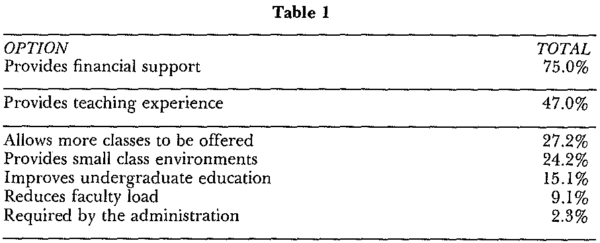
Given a list of seven options, respondents ranked their three top reasons for having T As. To provide a more accurate indication of each item’s overall importance, the percentages of first and second rankings have been combined. Table 1 provides a rank ordering of the seven reasons for having TAs.
Expectations of TAs in the classroom
Given a list of twelve classroom behaviors (see Table 4 for a complete listing), chairpersons were asked to rank order their expectations of teaching assistants from one through five. Knowing subject matter and being enthusiastic were the expectations that received the strongest endorsement, far exceeding any others. Sixty-nine percent ranked “knowing subject matter” either first or second in importance, while 67 percent ranked “having enthusiasm” either first or second. The third highest rate of endorsement was “leading an effective discussion.” It only received a total of 30 percent while “organized lectures” received a total of 15 percent. Each of the remaining eight items were less than 8 percent.
Evaluation of teaching assistant performance
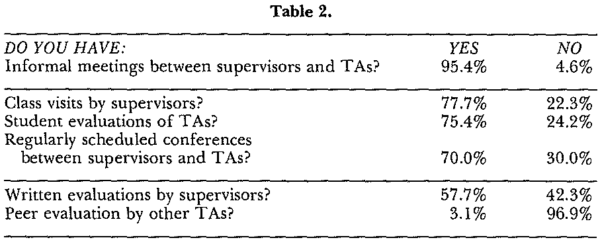
Chairpersons were asked how they evaluated the performance of their teaching assistants. Table 2 reports the specific evaluative techniques used.
These responses must be tempered by the fact that over one-third of the departments stated that they do not evaluate the performance of teaching assistants systematically.
Percentage of schools that have training programs
In response to the question “Does your institution provide some training for TAs?,” 51 percent said “Yes” and 49 percent said “No.” The following material, which will focus on training provided within departments of history, must be kept within the perspective that sixty four of the 132 institutions responding provide no training for their teaching assistants.
Characteristics of trained programs
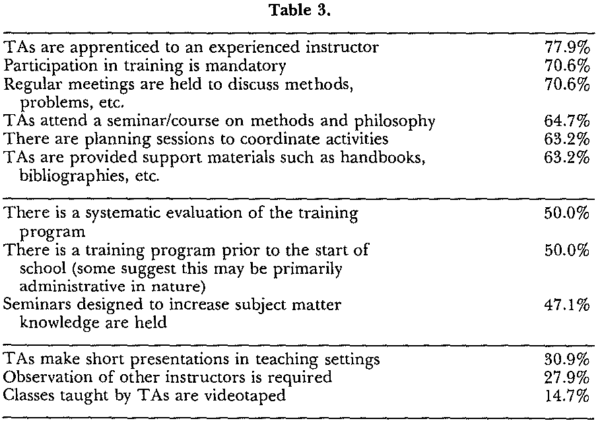
Chairpersons were asked “Does your training program have the following characteristics?” Table 3 reports twelve characteristics ranked by the percentage of positive (Yes) responses.
Evaluation of the training of teaching assistants
Chairpersons were asked to evaluate the training of teaching assistants using a five-point Likert scale ranging from “Strongly Agree” to “Strongly Disagree.” Table 4 reports the total percentage of respondents who marked “Agree” or “Strongly Agree” to the statements, “Our training . . . .”
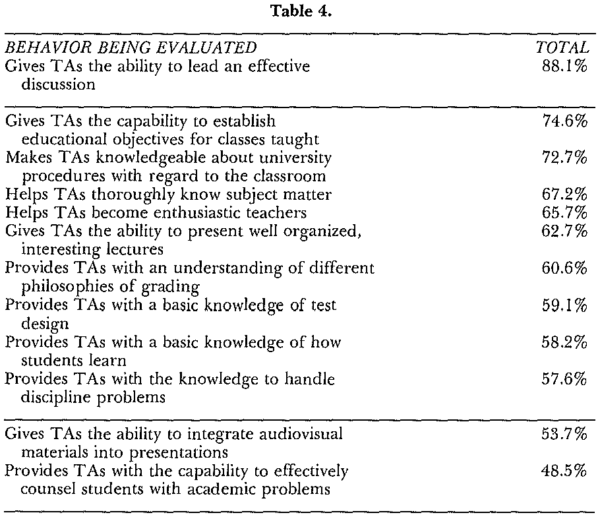
Overall evaluation of training by respondents
On a scale ranging from a high of seven (Outstanding) to a low of 1 (Poor) the median response was a value of five (Above Average).
Discussion
The most striking result of the study was the total absence of training of teaching assistants in nearly half of the departments of history. Although departments consistently stated that providing teaching experience was a primary rationale for having teaching assistants only slightly more than half (51 percent) of the institutions surveyed have training programs in any form.
Since most of this study has dealt with departments that do have training, it is instructive to place the results of the survey within the perspective of all institutions who have teaching assistants. When looking at the percentage of institutions providing specific types of training compared to the total number of institutions who have teaching assistants, the figures are bleak. For instance, only 36 percent (forty-eight institutions out of the 132 responding) stated that they provide regular meetings for teaching assistants to discuss methods, problems, etc.
Similarly, only one-third of the institutions provide planning sessions, support materials, or hold sessions to explore teaching methodologies. Approximately one-quarter of the schools have seminars designed to increase subject matter and less than 15 percent require observation of other instructors. It would appear, therefore, that teaching assistants are provided with very little formal support from the historical profession.
Rather than a formal system of training, the data suggest that departments have relied primarily upon a mentoring system for the training of their teaching assistants. Seventy-eight percent of the departments responding apprentice teaching assistants to experienced instructors, presumably with the assumption that this relationship will provide adequate training. The survey suggests, however, that the mentoring system is less effective than might be desired.
To begin with, 22 percent of the departments do not assign TAs to experienced faculty members. Although these teaching assistants may receive support from others, I suspect that they are left to sink or swim on their own. Many of those who are supervised apparently receive minimal evaluation and feedback. Over one-third of the departments stated that they do not evaluate the performance of teaching assistants systematically.
Indeed, the teaching assistants in 22 percent of the departments are never visited by supervisors. (One might surmise that these were classes of PhD candidates with extensive experience. In reality, twelve of the twenty-eight departments that do not visit classes offer an MA as their terminal degree.) Even when supervisors do visit classes, there is little evidence to suggest that faculty, trained in this same system, have sufficient knowledge to evaluate teaching.
In my own experience with the university promotion process, letters forwarded to support the teaching effectiveness of a candidate often focused on superficial mechanics such as “his eye contact was good” or hearsay evidence such as “the students say she is a good teacher.”
If as a profession we say that teaching is important, then why are we not more systematic about our efforts to train young historians to teach? At the 1985 Annual Meeting of the AHA, Milton Klein of the University of Tennessee focused on the central issue when he stated that the problem lies in the perception that a university’s primary responsibility is to train scholars rather than teachers, a value which is clearly implicit in the existing reward structure.
Also, since liberal arts faculty have such little regard for colleges of education, many historians are reluctant to express an interest in pedagogy for fear of being considered “educationists.” If Kline is correct, meaningful change in the training of teaching assistants will not occur until we examine our fundamental values with regard to the role of teaching within the profession.
Such an examination is long overdue. Most graduating PhDs will not have careers based on scholarly activity: they primarily will be teachers. We also do not have to fear the influence of the “educationists.” The historical profession itself possesses the expertise to enhance teaching effectiveness if it desires to do so. As an example, the OAH/FIPSE Project recently developed a series of teaching/learning workshops that are appropriate for instructors at any level of experience. Finally, if higher education is to achieve the much talked about goal of “excellence” in education, this study suggests that one of the most effective approaches that historians can take is to upgrade the training of TAs with respect to teaching. Teaching assistants will readily admit that they need such training and the approximately 80,000 undergraduates in their class rooms would undoubtedly agree.
Charles C. Bonwell is Professor of History at Southeast Missouri State University in Cape Girardeau.