
Two recent reports document an increase in salaries for academic historians. Average salaries in history at US universities and colleges increased by over 5 percent in the last academic year, according to the College and University Personnel Association (CUPA) and the American Association of University Professors (AAUP).
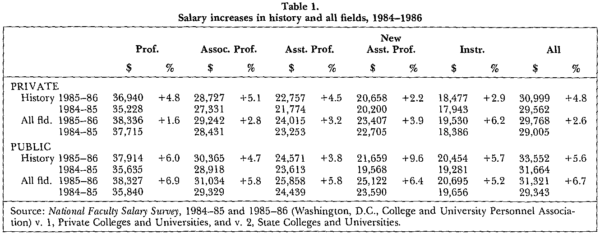
The CUPA 1985–86 National Faculty Salary Survey indicates average increases of 4.8 percent in the salaries of history faculty members in private institutions and 5.6 percent in public. These averages are slightly higher than the 4.2 percent increase in wages and salaries nationwide recorded by the Department of Labor between April 1985 and March 1986.
The average increase in history at private institutions is almost double the average increase for all academic fields at private institutions (2.6 percent), but the higher average increase for historians at public institutions (5.6 percent) is actually lower than the average increase for all fields at those institutions (6.7 percent: see Table 1). Compared to the increases in 1984–85 (see Perspectives, October 1985, p. 11), the most recent figures show that in private institutions the trend towards higher average salary increases for tenured history faculty remains true while in public institutions there has been a general leveling of the rate of increase.
The CUPA survey also provides information on the salary differences between public institutions with collective bargaining agreements and those without. The difference overall is substantial: historians working with collective bargaining agreements earn on average 14 percent more than those working without, although the average salary in crease last year was only 1 percent great er under collective bargaining agreements.
Average salaries in history increased by over 5 percent in the last academic year.
The latest salary figures also indicate that the buying power lost by academics to the high inflation of the late 1970s is slowly being regained. Salaries have increased in real terms for each of the past five academic years, and although the increases have been modest, their cumulative effect coupled with low inflation rates has been to restore lost buying power. The AAUP figures show that for 1985–86 academic salaries rose by an average of 6.1 percent, or 2.5 percent after inflation.
The slight discrepancy between the CUPA and AAUP averages is a result of the sources each association draws on for information. CUPA relies on its own members and (for the survey of public institutions) members of the American Association of State Colleges and Universities, while the AAUP survey is conducted by Maryse Eymonerie Associates of McLean, Virginia. The CUPA survey is a useful source for salary statistics by discipline and rank, and more detailed salary information according to a small batch of institutions can be obtained from CUPA; the AAUP survey gives only very general figures by discipline, but offers statistics by institution and rank. For more information, consult 1985–86 National Faculty Salary Survey (Washington, DC: CUPA, 1986), v.1 Private Colleges and Universities and v.2 Public Colleges and Universities; and “The Annual Report on the Economic Status of the Profession 1985–86,” Academe [AAUP], March-April 1986.