On a winter morning in 1870, as the Lunar New Year approached, the quiet fields outside a Panyu village erupted into chaos. What began as boys casually tossing stones swelled into a mass spectacle, with hundreds of youths surging across open ground, hurling rocks and shouting at one another while spectators roared with delight. A local gazetteer complained that these annual bouts “inevitably degenerated into bloody affrays,” where boys ignored serious injuries for fear of being mocked as milksops. Officials condemned the practice as a “barbarous custom,” but for many villagers of the Canton Delta, these ritualized rock fights were not senseless but essential.
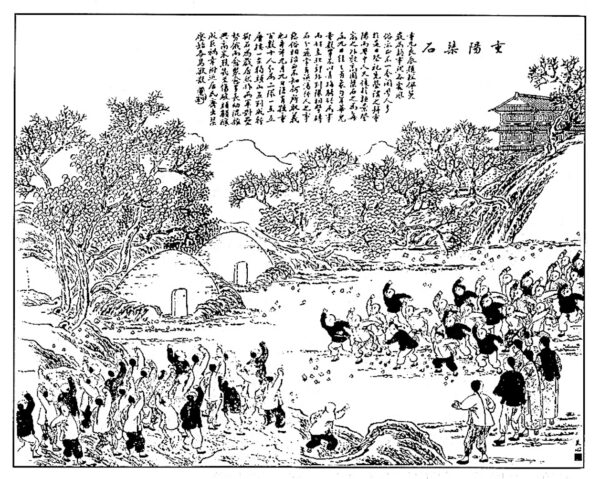
Dianshizai huabao (Shenbao Publishing House, 1885)
Although rock fighting once existed across China, the Canton Delta preserved the custom well into the 20th century. Because written materials are sparse—scattered gazetteer entries, newspaper notes, and the occasional missionary account—oral history is an indispensable source for historians. During my fieldwork in Panyu County in 2002 and 2010, elderly villagers recalled stories they heard from their elders about rock fights, offering rare glimpses into an ancient tradition whose living memory has nearly vanished.
Rock fighting has deep roots in East Asian folk culture. In ancient China, jirang contests began as hunting and martial training games before evolving into children’s stone-throwing battles by the 18th century. Korea’s seokjeon and Japan’s injiuchi shared similar origins, blending martial practice with seasonal rites meant to ensure agricultural fertility. These battles clustered around Lunar New Year festivals seeking abundant harvests and protection from pestilence.
The 20th-century rock fights in the Canton Delta fit squarely within this ritual world. Held at the start of spring just as the agricultural year began, they served as rites of renewal. Villagers believed that without bloodshed, misfortune—poor harvests, typhoons, illnesses—would follow. As one villager told me, the newly awakened earth needed to be “fed.” The blood of adolescent boys, charged with potent yang energy, was considered especially efficacious. Rock fights thus functioned as fertility rites in which blood symbolically impregnated the soil with life.
The Cantonese version of these rites had a distinctive social character. They were working-class affairs rooted in the rough culture of the delta’s laboring poor. According to eyewitnesses, fights took place in the “village wilds”—neutral spaces on the outskirts of settlements. Participants were overwhelmingly adolescent boys from marginalized communities: tenant farmers, boat dwellers, and residents of subordinate satellite villages. Locally called dazai, “pugnacious youths,” many later became guardsmen, bandits, and pirates who used rock throwing in close-range combat and naval warfare. For these boys, rock fighting was both training and a rite of passage, a way to prove toughness, earn respect, and assert masculine identity in a world offering few other avenues for status.
The fights were chaotic, ruleless, and intentionally bloody. Eyewitnesses described hundreds of fighters armed with stones, sticks, and makeshift shields, cheered on by crowds of villagers. Women and teenage girls tended the wounded, supplied rocks, and sold snacks to spectators. The atmosphere was carnivalesque: brawling, boasting, gambling, drinking, and the mingling of the sexes, all of which scandalized officials and literati, who viewed such gatherings as disorderly and morally dangerous.
Rock fights reveal a world where violence was normalized, meaningful, and socially productive. For the laboring poor, toughness was cultural capital. In marginalized communities where survival demanded physical strength, violence offered dignity, status, and a sense of belonging. What elites dismissed as barbarism was, for villagers, a ritual of renewal, a test of manhood, and a celebration of communal vitality—an annual bloodletting that bound the community to the rhythms of the agricultural year and to one another.
Robert Antony retired as distinguished professor at Guangzhou University in 2019 and now lives in New Jersey.
This work is licensed under a Creative Commons Attribution-NonCommercial-NoDerivatives 4.0 International License. Attribution must provide author name, article title, Perspectives on History, date of publication, and a link to this page. This license applies only to the article, not to text or images used here by permission.