You can buy this bag at the dollar store or order one from Amazon for a few bucks. Made from cheap synthetics, it is unpretentious and functional: a simple pattern, a sturdy handle, and a practical zipper. And yet this ordinary object has become a powerful symbol for millions of people worldwide and has appeared on high-fashion runways, in museums, and even on monuments.
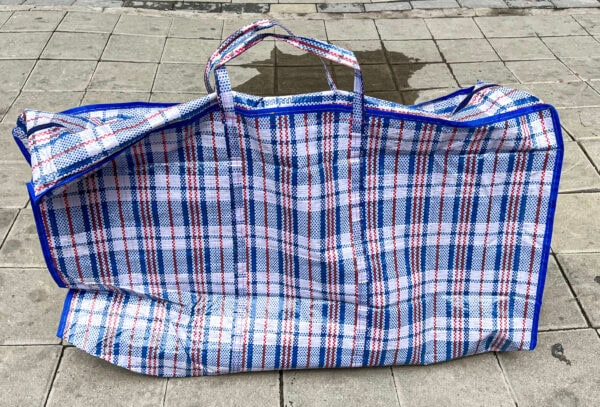
N509FZ/Wikimedia Commons/CC BY-SA 4.0
The red-white-blue bag originated in East Asia. Its story began in Japan in the 1960s, when a new fabric was produced from polyethylene. The resulting material was widely used for industrial purposes, especially in construction. In the 1970s, manufacturers in Taiwan exported the material to Hong Kong, where a local tailor and fabric merchant, Lee Wah, decided to make bags from it. His product was water resistant, durable, and well liked by Hong Kong citizens, who started to use it for everyday needs and travels to mainland China.
Later on, the red-white-blue bag surfaced in West Africa. The 1970s economic boom attracted migrants to Nigeria from other parts of West Africa, but a decade later, oil prices crashed. In 1983, the Nigerian government ordered expulsions: Roughly two million undocumented migrants, including nearly one million Ghanaians, were scapegoated and forced to leave the country. Most did not have enough time to pack their belongings, and the red-white-blue bag—affordable and spacious—was all that they carried. The bag immediately assumed its new local name—the “Ghana must-go bag.” Gradually, the bag’s use spread across the African continent, every time emerging in places where people had to abandon their homes and move.
By the early 1990s, the red-white-blue bag had made its way to the former Soviet countries. When the Soviet Union collapsed, its citizens rushed abroad to shop for deficit goods and resell them. Unemployment pushed millions into shopping and sometimes working in this informal trade. China, Turkey, Poland, Germany, or Finland—whichever foreign country lay closest became the destination for those looking to import cheap goods. Newly emerged post-Soviet countries, which had been “free” from capitalism and “speculation” for decades, right away turned into a huge bazaar. For going back and forth, novice entrepreneurs earned the name shuttle traders, or chelnoki, and the red-white-blue bags in which they transported goods were named chelnok bags.
Since the 2000s, the red-white-blue bag has transformed into a cultural icon. Hong Kong artist Stanley Wong created the Red White Blue series, featuring an apartment covered by red-white-blue fabric. Dan Halter and Nobukho Nqaba made similar exhibitions about the bag in Africa, featuring flags, world maps, and a figure of a crawling human—all made from the bag’s fabric. Ukrainian artists Sergiy Petlyuk and Oleksiy Khoroshko decorated spaces with neon-lit red-white-blue bags, while Russian street artist Slava PTRK painted graffiti, inscribing bags into a Soviet cartoon. In some post-Soviet countries, the bag was commemorated in monuments to shuttle traders. The Boris Yeltsin Presidential Center included a chelnok bag in an exhibition on the 1990s. When Louis Vuitton, Céline, and Balenciaga started to sell rebranded red-white-blue bags and clothing for hundreds of dollars, the bag became a Westernized commercial product and a high-end accessory.
Today, the red-white-blue bag evokes a multitude of pasts. In East Asia, particularly in Hong Kong, it symbolizes the working class, local culture, and the city’s dynamism. In Africa, the bag stands for involuntary migration, poverty, and uprootedness. In post-Soviet nations, the bag is one symbol of the Soviet collapse, the “wild 1990s,” and national heroism during the transition to a market economy. Once a mere carrier of goods, the red-white-blue bag now carries multiple names and meanings, reflecting, like a mirror, its ties to people: global or local, personal or indifferent, about “us” or “them.” But for many around the world, it is just a bag—either a cheap carryall or a fashion item.
Mikhail Svirin is a PhD student in history at the University of Chicago. He studies modern Russia, the Soviet Union, and post-Soviet states.
This work is licensed under a Creative Commons Attribution-NonCommercial-NoDerivatives 4.0 International License. Attribution must provide author name, article title, Perspectives on History, date of publication, and a link to this page. This license applies only to the article, not to text or images used here by permission.