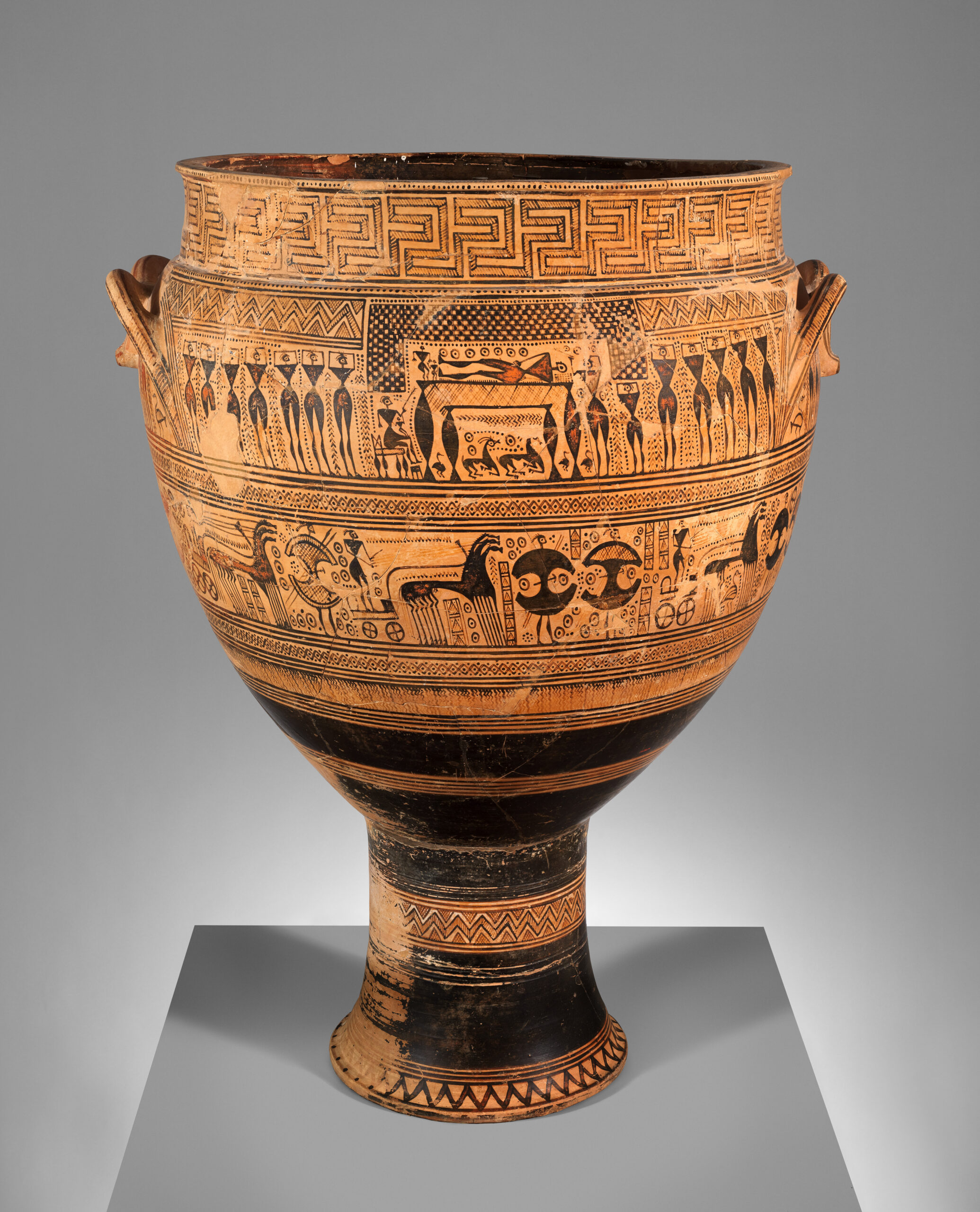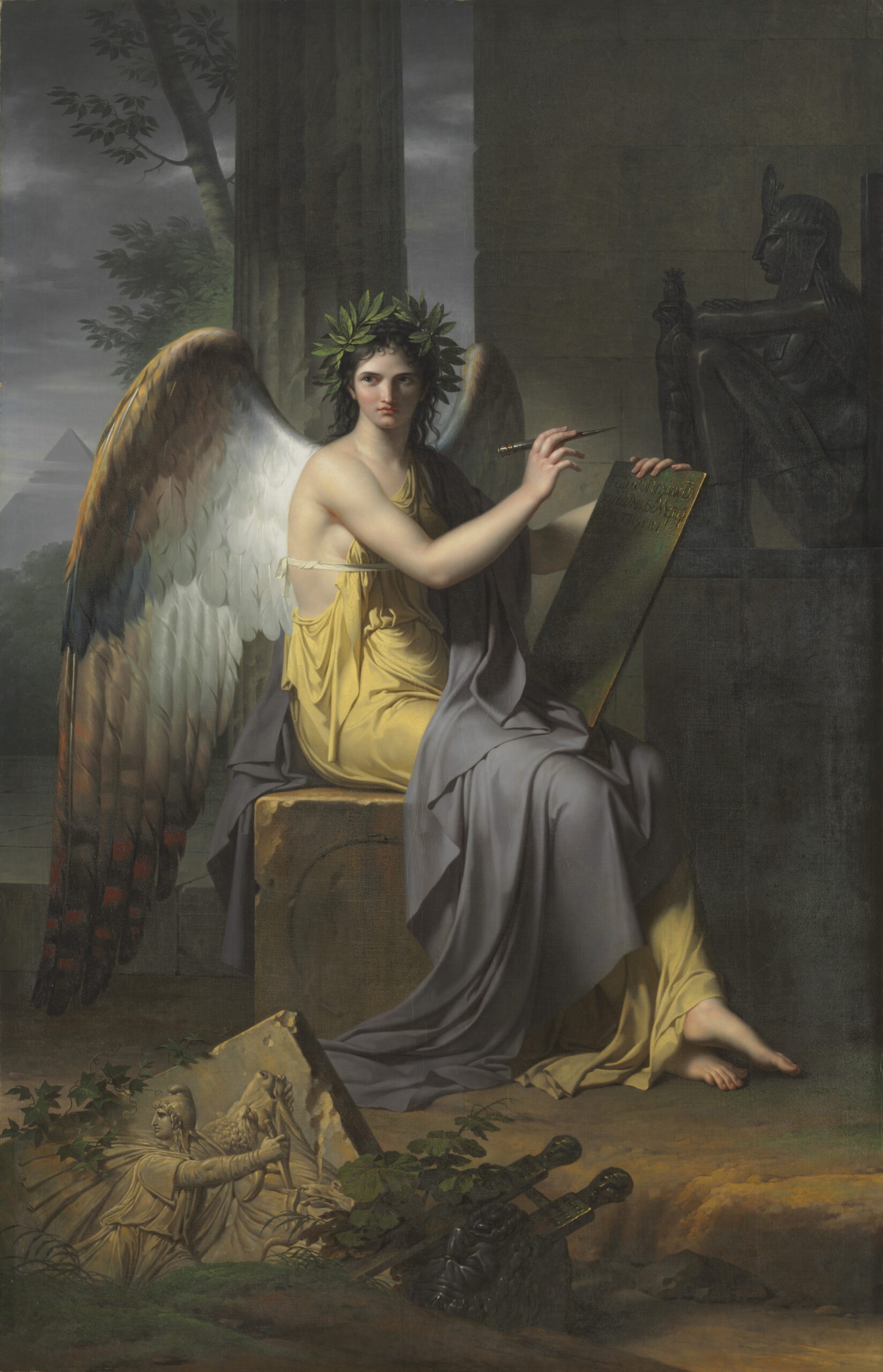
Having devoted more than 30 years to the study of the afterlife of the ancient world, of course I had been eagerly awaiting Christopher Nolan’s The Odyssey. I read the complaints, both before the release and after: The costumes and casting aren’t archaeologically and ethnographically accurate; the story is too compressed; the dialogue is too colloquial; there is gratuitous violence (though surprisingly not sex); and Nolan has added didactic moral messages of which Homer had no clue. Having now seen the movie, I happen to agree with some of this, most especially about the flatness of the dialogue. But I am also struck by the familiarity of such criticisms, most of which were once exerted on an ancestral form of historical communication entirely out of fashion today: history painting. This form, too, played fast and loose with classical myth and history, for reasons we too rarely contemplate. Perhaps reviewing that legacy will help us avoid hating Nolan’s movie, or at least hating it for the wrong reasons.
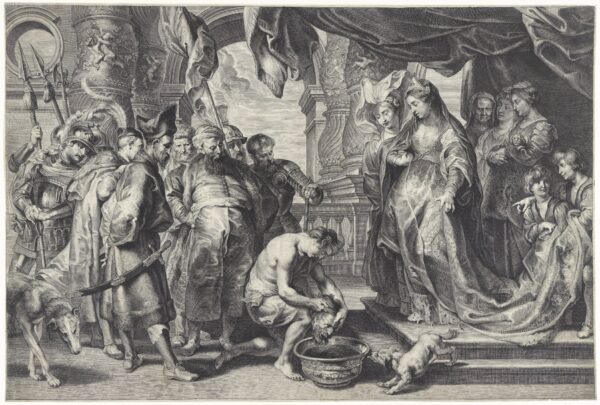
This engraved copy of Rubens’s Tomyris (first painted around 1630) is one of many that circulated on the European print market, often with moralizing captions attached. Rijksmuseum / public domain
Ancient and medieval painters depicted historical scenes, but unquestionably the early modern period marked history painting’s greatest hour. From at least the time of Leon Battista Alberti’s De pictura (1435) until its fin de siècle fizzle, history painting was the highest form of visual art to many humanists and artistic academies. It was revered because it raised painting above the mere copying of nature, and resulted in the production of imaginative works whose lessons could be appreciated by artists and connoisseurs alike. Like the history lessons taught to princes, history painting was supposed to provide examples for emulation, and, in the words of the 17th-century Dutch humanist and art theorist Franciscus Junius, “it also arouses the desire to emulate and kindles the spirit to attain virtue. It gives not only knowledge but also willpower, and makes us not only spectators but also actors.” Similarly, Junius believed, good history paintings not only trained the mind, but could effect a “true and hearty reconciliation” among persons of warring religious and political factions. At least in theory, history painting was inspirational moral instruction, and effective community-building; contemplating the deeds of Alexander or Mary Magdalene was a useful means of learning how to lead or how to love.
In theory, history painting was inspirational moral instruction, and effective community-building.
Notably, what early modern painters and their patrons counted as history was a much more capacious and flexible category than we would allow, including biblical scenes and representations of mythological stories. Unlike, say, sign painters, history painters were relatively well educated. But this doesn’t mean they did in-depth research into their subjects. Most painted today from Ovid, tomorrow from Plutarch, and the next day from the book of Genesis. They were hardly alone in their cherry-picking; elite schoolboys and lay readers were also heavy consumers of books of aphorisms, excerpts, and summaries—as they are today. Artists’ interests in a particular scene, too, were often driven by a patron’s commission, or by the desire to show off their skills in representing, for example, exotic hats or horses’ behinds. But they did, usually, choose subjects their audiences would recognize, while updating the story with distinctive, signature twists.
Is there a pattern in the subjects they chose? Recently I stumbled on a terrific source that might help actually count early modern historical canvases—almost all of them classical—and separate them from the biblical and mythological themes. Andor Pigler’s Barockthemen (Baroque Themes; 1956; 2 vols.) was published when the author had just become general director of Szépművészeti Múzeum in Budapest. Pigler’s work is composed of lists of paintings, and some drawings, from collections across the continent. Volume 1 is devoted to biblical subjects, but because volume 2 contains a section devoted to Greek and Roman history, Barockthemen gives us the opportunity to survey the landscape of secular subjects (we will overlook for now the slippage across the mythological/historical divide). In this remarkable preinternet synthesis, Pigler surely missed things, but his work gives us the opportunity to tease out some interesting and telling patterns in the depiction of secular historical tales.
A first observation is that many history painters leaned heavily on Plutarch’s Parallel Lives, the most popular historical work from the Renaissance to the 19th century, or on the first-century Roman compiler Valerius Maximus’s Nine Books of Memorable Deeds and Sayings. Valerius condensed favorite stories into easily readable Latin, making his work, in the words of the Rubens scholar Elizabeth McGrath, “almost tailor-made for translation into images.” Valerius also helpfully divided his content into particular categories of instruction, allowing artists to choose scenes that dramatized marital fidelity, for example, or public integrity, or parents who acted severely toward their children. It is noteworthy that the stories are at once heroizing and monitory, teaching noble actions but also allowing readers to experience calamities at a safe distance. Perhaps this explains why so very many paintings inspired by Valerius warn rulers against evils such as avarice, unbridled passion, and intolerance, even as they flatter them, in scenes such as Queen Esther begging her royal husband Ahasuerus not to kill the Jews of Persia. There are also a disturbingly large number that feature voyeuristic scenes (Diana, Susanna and the Elders, Candaules and Gyges) or severed heads (Tomyris, Judith and Holofernes, Pompey, Salome, and John the Baptist). Filmmakers like Christopher Nolan are not the first or last artists to recognize that violence sells, and he seems to still be trying to warn us about hubris, and the dire consequences of failing to see gods in strangers.
But let’s look at some of the most popular scenes in more detail, and see what we might learn about such history lessons in this period. In an era in which Europe was ruled mostly by princes, painters offered relatively few scenes of republican or democratic heroes such as Caesar, Brutus, and Cato, not to mention Themistocles or Pericles. There are, by contrast, a lot of scenes of Alexander, a very large number treating the theme of his clemency in sparing the family of Darius III. Homeric scenes have always been popular, including Achilles sulking in his tent (don’t do that!) and Penelope waiting by her loom (good wives wait!). Another highly popular theme is that of the continence of the Roman general Scipio, who, according to Livy, not only spared the life of a captured beauty but returned her unharmed to her beloved. Both of these are scenes of rape averted (as are also the stories of Lucrezia and Judith), perhaps capitalizing on the drama embedded in the stories to subtly dissuade oversexed conquering kings.
But early modern painters also frequently depicted powerful queens with their own violent brands of sexuality, such as Dido, Tomyris, and Cleopatra. Despite her incestuous backstory, early modern history painters lavished attention, too, on Artemisia II of Caria, famed for making herself a living commemoration of her brother-husband by drinking his ashes. After all, this scene (for Valerius, one of remarkable marital fidelity) gave painters the opportunity to depict in a single frame a scintillating if rather icky story that required the inclusion of bejeweled queens and fancy pots. One of the greatest early modern history painters, Peter Paul Rubens, completed two versions of barbarian queen Tomyris, who not only succeeded in vanquishing the Persian king Cyrus but then happily dipped his severed head in a vat of blood as she exulted: “Now, great king, have you had your fill of blood?”
Some history painters added modern themes in the guise of ancient histories.
History painters, of course, had an even greater challenge than the aphorists and moralizing schoolmasters: Once they gave up the medieval habit of sequential story panels, they had to condense their stories and lessons into a single frozen pose. Perhaps this explains why deathbed scenes were so common; at the moment of death, it was widely thought, the whole character of the person was revealed. And so we find in Pigler’s collection large numbers of death scenes—of Cleopatra and Socrates, Germanicus and Alexander, Cato and Porcia, Caesar and Agrippina. For painters with less high-minded ambitions, the choice of scene might involve animals—including Daniel, Hercules, or the Christians facing lions; Romulus and Remus or Cyrus mothered by wolves; or just about any modern ruler on horseback. Some also clearly enjoyed painting disasters, such as Nero burning Rome or the destruction of Babylon or Carthage. The English Romantic painters J. M. W. Turner and John Martin excelled in panoramic disaster scenes such as the plagues of Egypt and Hannibal’s army succumbing to snowstorms. It might be observed that TV producers today cater to similar tastes: for murder mysteries, animal shows, and blockbuster disaster films. As the saying goes, life is short, but art is long.
Now it should be noted that before 1800, artists paid only scant attention to historicizing detail. Rubens and Rembrandt added turbans and “orientalizing” robes, but those were largely costumes they saw in contemporary Mughal paintings or images of Turks. I have long dreamed of writing an essay entitled “Table Settings for the Last Supper,” as paintings of the scene completed before the 19th century often blithely depict the disciples drinking from Renaissance glassware and eating improbably shaped buns from contemporary pewter chargers. One 18th-century Peruvian “Last Supper” depicts an Andean sacrificial guinea pig and local fruits. The idea was to deliver a recognizable scene that made spectators feel they could be the actors, not to make the setting and the props period-perfect.
Some 19th-century history painters, such as Jean-Léon Gérôme and Lawrence Alma-Tadema, attempted to make their works more archaeologically and ethnographically correct, only to be accused of sacrificing grandeur in favor of “exhibition of archaeological gewgaws” and turning history painting into “a curiosity shop.” They also added some modern themes in the guise of ancient histories. A good example is Edwin Long’s panoramic Babylonian Marriage Market (1875), which depicted, with painstaking archaeological accuracy, a scene from Herodotus’s Histories. Painting the piece when Britain was convulsed by debates over women’s rights in marriage, Long may have meant to criticize the “selling” of women in the modern marriage markets of Paris and London—John Ruskin, in any case, thought so. Or Long was capitalizing on orientalist themes of white slavery and the harem. In any event, critics wanted a lesson, as well as a thrill, from a canvas that aspired to raise Long’s social status. In this painting, Long got the formula exactly right. Not only did the painting lift Long into the ranks of the most respected painters, but it made the artist’s fortune as well. When D. W. Griffith filched the Babylonian Marriage Market for a scene in his movie Intolerance, he staged a stroppy bride strutting on the auction platform—and arguing her way out of the sale.
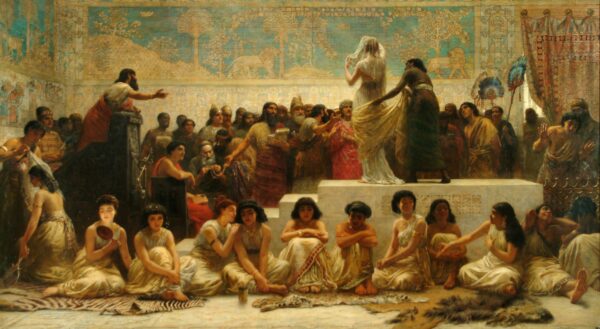
Edwin Long’s Babylonian Marriage Market (1875) was an artistic sensation—and sufficiently cinematic for D. W. Griffith to filch it for a scene in his movie Intolerance (1916). Courtesy Royal Holloway, University of London
We might safely say that the genre of history painting died around 1890—but film was there to fill the gap, taking over its penchant for voyeurism, its love of violence, and its aspirations to teach moral virtues, now to a much wider audience. Historical films, I would submit, still read history through previous artistic or excerpted frameworks; they still sacrifice archaeological accuracy for resonance with the present; they still aim to show us how (or how not) to lead or to love. There are still lots of near-death (or near-rape) scenes, fierce queens, and interesting animals. The stakes are higher, as they were for history painters, because we think we know the story, and we have strong ideas about how it should be updated (or not) for our own time. Especially in taking on classical (or biblical) subjects that are so well known, a filmmaker is taking a major risk; it is no easy thing to be Rubens or Long. And most of all, we can be grateful that Nolan has invited us to converse, once again, about a great ancient poem.
This work is licensed under a Creative Commons Attribution-NonCommercial-NoDerivatives 4.0 International License. Attribution must provide author name, article title, Perspectives on History, date of publication, and a link to this page. This license applies only to the article, not to text or images used here by permission.