As a person who has spent the last three decades reading and writing about the history of archaeology, I have to admit that I find the opening scene from Indiana Jones and the Last Crusade (1989) hilarious. It is 1938, and “Professor” Jones is finishing a college lecture about archaeological techniques. He instructs the class full of doe-eyed coeds that “70 percent of all archaeology is done in the library” and that “X never, ever marks the spot.” He tells them that next week’s lecture will discuss the Egyptological work of Flinders Petrie at Naucratis in 1885. (He means Matthew Flinders Petrie, one of the leading Egyptologists of the fin de siècle.) Just after class is dismissed, however, Jones jumps out a window to start his treasure hunt. It appears that about one minute of scholarly archaeology was all that director Steven Spielberg thought Hollywood audiences could take—and he was probably right.
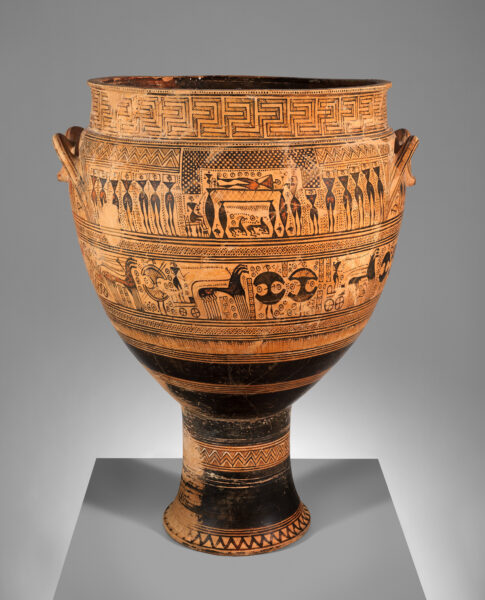
This terra-cotta krater (ca. 750–735 BCE) seems to depict a funerary cortege, in which tiny-headed warriors cover their midriffs with what seem to be apple-core-shaped “Dipylon” shields. Attributed to the Hirschfeld Workshop, Metropolitan Museum of Art, public domain
The clip highlights the great incongruities that form archaeology’s history and practice, especially as concerns classical and Near Eastern archaeology, the subfield about which I am best informed. On the one hand, there is the now well-known history of imperious and imperialist archaeological extraction, stretching from about 1780 until 1940 or so, in which European scholars and adventurers, like Jones, fanned out across the Mediterranean, and when possible, plunged deeper into Eurasia and western China, in search of increasingly eclectic storehouses of loot. On the other, there is that one scholarly minute—about which the general public, including most of us garden-variety historians, ought to be better informed, especially as it turns out that of all sources for history, today’s public most trusts museums, with which and for which so many archaeologists work.
Today, I think it is fair to say that the story of colonial archaeology, and the consequences of the competitive and escalating expropriations that we might call the “antiquities rush” for the massive enrichment of European museums, is well known. In the last 30 years, the scholarship on these depredations has exploded, and we have explored, too, the previously unacknowledged contributions of local scholars, collectors, dealers, and political figures. Deepened knowledge of these colonial legacies has further chastened on-site archaeologists, who now partner with local teams and entrust virtually all artifacts to host countries. Inquiry and criticism from those whose treasures were pilfered, and from curators and historians appalled by the practices of their forebears, has resulted in the restitution of some objects, the most high-profile of which are the Benin Bronzes. In the case of Native American materials, federal legislation now requires that grave goods be restored to surviving tribal groups. At a recent conference on the future of the ancient Mediterranean galleries at the British Museum, I learned that the museum is working in partnership with the government of Greece, and it is no longer impossible to believe that some, or even all, of the Parthenon Marbles might return to Athens in the coming years.
One might say that the Indiana Jones films represented a sort of nostalgia for the bad old days of colonial extraction—though the fact that most rapacious of Jones’s competitors were Nazis perhaps already signaled some anxiety about the probity of this “crusade.” In 2026, I hope and believe that most of this nostalgia has evaporated. What I think has been less publicly discussed is one underlying aspect of colonial archaeology’s mythos: the idea that material finds can be easily reconciled with textual history, that books could have led Professor Jones to find an ancient cup that could be proven to be the singular scriptural Holy Grail. The gap between the history of material culture and histories as recounted in written sources is well known to archaeologists, but I think less so to historians, who, as frequent users of archaeological evidence, ought to know more about how this form of knowledge is made.
Historians, as frequent users of archaeological evidence, ought to know more about how this form of knowledge is made.
I first came into contact with this sort of archaeology in a graduate course at the University of Chicago. I was assigned a project about a very different sort of vessel: the so-called Dipylon kraters. These are gigantic Greek vases, dating to the latter decades of the Geometric period between the 770s and 730s BCE, before we have surviving Greek texts. They get their name Dipylon from the find spot, the great cemetery of Athens, just beyond the city’s main fifth-century entrance (the Dipylon Gate), and, given this context, they were probably used to receive funerary libations. Specifically, I was to study one aspect of the ornament on these spectacular vases: the apple-core-shaped “Dipylon” shields carried in what seem to be funerary military processions, possibly related to hero cult worship.
What fascinated me in reading about these gigantic pots was the painstaking effort of archaeologists to attempt to understand and properly date these scenes. I was accustomed to doing a great deal of often tedious reading to grasp Dostoevsky’s symbolism or the origins of Alois Riegl’s art historical theories. But interpreting Geometric vases opened a whole new level of challenges. Archaeologists such as Anthony Snodgrass and J. N. Coldstream—standing on the shoulders of previous investigators—had read in close detail the few ancient Greek texts that might be relevant. But these were of little use compared to the vast repositories of comparanda (comparative, typological examples) they had studied. Pottery was particularly useful in this endeavor, as local potters across the Mediterranean adopted distinctive shapes and styles of ornament at various times. This made pottery particularly susceptible to the method of “seriation,” perfected by none other than Flinders Petrie. Using this method, Petrie was able to create elaborate typological series that offered at least relative chronologies in the absence of any textual records or references. Like Petrie, Snodgrass and Coldstream knew their pots, cold. And yet they demurred when it came to deciding a seemingly simple question: Did the ornamentation depict mythological or real ways of war?
As is so often the case in starting new research, I quickly realized that I was coming in on a much older conversation, one with much at stake for cultural and military historians as well as for archaeologists. The fundamental question required deciding whether painters of these pots had drawn from real life or from legend. This question was made immensely more difficult by the fact that no examples of actual Dipylon shields had been found in excavations and the recognition that the Homeric poems were the tip of a lost legendary iceberg. If the shield’s odd shape was meant to evoke the figure eight–style shields well attested in Mycenaean art, scholars argued, pots with depictions of these distinctive shields might suggest some kind of continuity of memory across the 500-odd years that separate the end of Mycenaean civilization and the period of Geometric pottery. They might help date the origins of hoplite warfare, with its characteristic round shields. But, skeptics said, wasn’t it simpler to assume that one shield shape didn’t immediately displace others? If no shields had been found, perhaps this was because they were made of perishable wicker, or wood and hide, and simply did not survive. At the most basic level, it was impossible to fully differentiate fiction from reality, and thus archaeologists were compelled to operate with what Fernando Echeverría called “a cultural construct, full of historical information.”
This form of archaeological humility is very far from the Indiana Jones–informed idea of the field, but in some ways has been with us all the time, stretching back, at least, to the antiquaries of the 16th century. So-called antiquaries collected—in textual descriptions, sketches, casts, or real artifacts—material objects, generally because they were intrigued by the things themselves: coins, or burial urns, or swords and shields. Some of the most elite might have focused on the material world of “civilized” people (Romans, Greeks, Egyptians, Israelites), but most assembled humble remains associated with their local “barbarian” histories of Britons, Saxons, or Franks. They organized their catalogs or studies not chronologically but often by manners and customs (scenes relating to death or mythological figures) or by type (weapons, sculptures). Most were not really interested in art, or in documenting, say, the life of Augustus. Nor did they write histories—which were supposed to be complete and exemplary—as their evidence was too fragmentary for that. It was often sufficient for material remains to arouse further curiosity, wonder, and conversation (sometimes hallucinatory), about human behavior, religious symbolics, and the implements of everyday life. They, too, would have been riveted by Dipylon shields, without needing to know for sure whether, or how, ancient Greeks had used them.
Material remains aroused further curiosity, wonder, and conversation.
Our histories of 19th-century archaeology, like our movies, have been skewed by our failure to emphasize the continuities in this antiquarian tradition, through the period of the antiquities rush. Even at the most famous sites, most finds were hard to square with textual records and aesthetic ideals. Heinrich Schliemann claimed to have found Priam’s Treasure at Troy—but his account is fishy, and he may have assembled this “treasure” himself. What Schliemann unquestionably did find were scores of prehistoric, owl-headed vases he had no love for and no means of interpreting. At Olympia, excavators failed to locate Phidias’s gigantic statue of Zeus and instead unearthed large quantities of early bronze figurines, which the lead excavator himself described as “rubbish.’” German Chancellor Otto von Bismarck was so dissatisfied that he pulled the plug on state funding.
Priam’s Treasure and the monumental Hermes that the Olympia excavators uncovered made headlines, but this made little difference to historians. What did matter was all the hard work stay-at-home antiquarians did in the basements of the Berlin museums to understand the owl-headed vases and figurines. It is this largely unsung archaeological labor that has helped us to understand the everyday lives and religious worldviews of the textually inaccessible archaic world of the eastern Mediterranean.
This history of the struggle to interpret artifacts outside of textual contexts is one in which Jones’s Egyptological exemplar, Flinders Petrie, did indeed play a starring role. Petrie’s background was engineering, and he was never a devoted textual scholar. It seems to have been useful to him to identify the Greek Egyptian Naucratis and its sister city Daphnae (ancient Tahpanhes) with cities mentioned by Herodotus and the biblical Jeremiah. His real interests lay elsewhere, however: in measuring things, and in collecting data, especially with respect to prehistoric sites. Petrie was no hero; he certainly profited from empire, and he made some ill-advised conjectures about ancient racial history. Nor was he the swashbuckling type; he spent years living, together with his wife and collaborators, in Egyptian tombs (cooler and more stable than tents) and subsisting, Margaret Drower has shown, on a diet of canned peas and jam. One legacy of his Naucratis excavation was a huge cache of erotic statuettes, which he ignored, but which hardworking antiquaries will surely one day endeavor to explain.
To tell the story of Flinders Petrie’s antiquarian tendencies and exhausting endeavors would hardly be Hollywood fodder. But his story might help to remind us that archaeologists work with the material remains of the past in ways we historians do not but can still value. Personally, I admire their willingness to develop new skills to cope with material culture’s intransigence to interpretation, and their dedication to inquiry without the pretense that we do or can know it all. I find it commendable that they don’t mind spending long hours studying “rubbish” or arguing about Dipylon shields. Archaeologists do this work out of care for the objects themselves, but by proceeding so deliberately, they also try to ensure that inquiry is open ended and that historians who might use their work do not adopt false dates or premises. We ought to be grateful for their humility and their care. If featured for only one minute in Indiana Jones, the 70 percent of their work in libraries and museums is much more valuable to historians than any grail.
This work is licensed under a Creative Commons Attribution-NonCommercial-NoDerivatives 4.0 International License. Attribution must provide author name, article title, Perspectives on History, date of publication, and a link to this page. This license applies only to the article, not to text or images used here by permission.