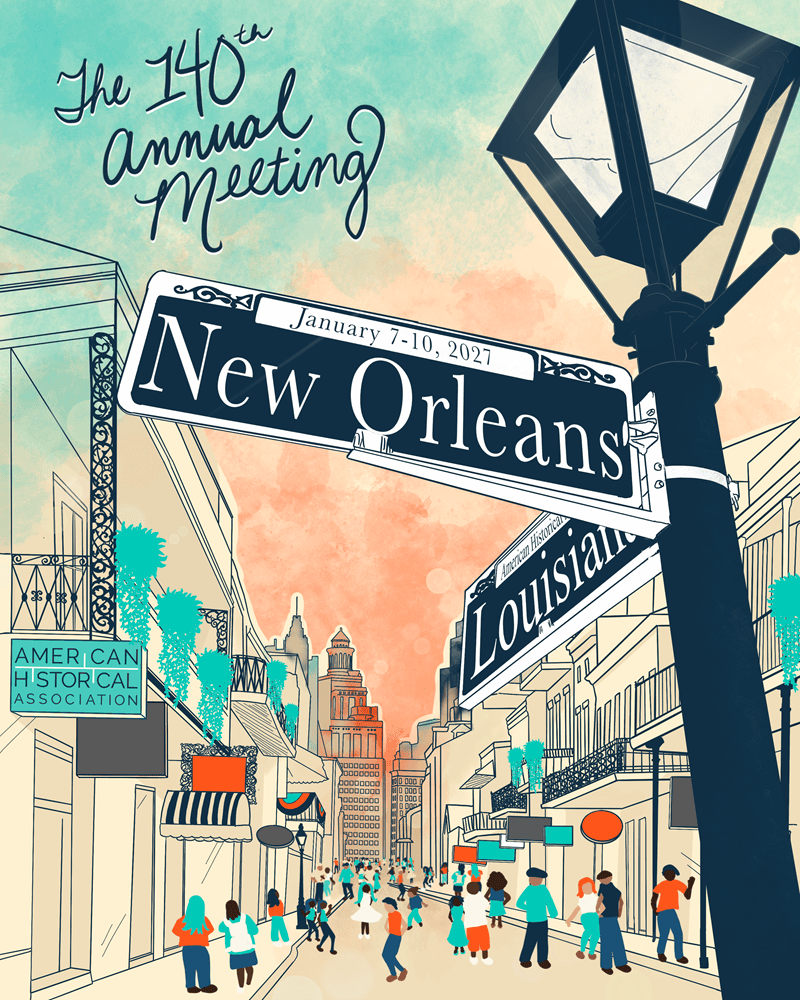
When historians gather in New Orleans for the 2027 AHA annual meeting from January 7–10, 2027, they will find a city that does much more than provide a beautiful backdrop. New Orleans invites us to encounter history everywhere—in its neighborhoods and music clubs, its archives and museums, its sacred traditions, its struggles for justice, and its enduring culture of celebration.
As co-chair of the Local Arrangements Committee and a historian who has spent much of my career studying African American history in Louisiana, I am especially excited to welcome colleagues to a conference that brings the city’s complicated past into conversation with many of the questions historians are asking today. In New Orleans, history is not confined to the archive. It lives in our streets, family stories, music, memory, and in the communities that continue to shape the city.
Several sessions bring these histories to life through the experiences of the region’s communities. I am particularly looking forward to Katrina and Its Afterlives, which explores disaster, rebuilding, displacement, inequality, environmental change, and the COVID-19 pandemic in 21st-century New Orleans. The roundtable asks us to consider what society labels a disaster and who bears its greatest burdens.
Another session that has caught my attention is Asian Americans in Louisiana, which examines Japanese rice farmers, the erasure of Asian identities in official records, and Vietnamese American activism. This panel offers fresh perspectives on immigration, race, and the diverse communities that have shaped New Orleans and the American South.
In New Orleans, history is not confined to the archive.
I am also excited about the sessions that center Black life, activism, family, and memory in Louisiana. Generational Experiences of Black Louisiana: At the Juncture of Genealogy and History brings together genealogy, oral history, archival research, and community memory. The panel explores how Black families have navigated slavery, Reconstruction, migration, segregation, environmental displacement, education, faith, land ownership, and cultural preservation. Placing family histories alongside traditional historical analysis allows us to recover voices and experiences too often absent from official records.
Public history and community collaboration are also central to the program. Behind the Scenes: Don’t Stand Alone—Black Labor Organizing in New Orleans explores the making of a traveling exhibition on Black workers’ activism from the late 19th century to the present. Waterfront workers, domestic workers, teachers, hotel workers, sex workers, and industrial workers all appear in this history of organizing for fair working conditions and racial equality. Panelists will also discuss what it means to build a project collaboratively with scholars, students, artists, community leaders, and labor organizers.
Captive State: Louisiana and the Making of Mass Incarceration connects Louisiana’s present-day incarceration crisis to New Orleans’s role in the domestic slave trade. Drawing on a Historic New Orleans Collection exhibition and its accompanying book, the roundtable places historians in conversation with public-history professionals and people directly affected by incarceration. The session offers an opportunity to consider the connections between history, accountability, and reform.
Another session takes up one of the city’s most recognized, but frequently misunderstood, traditions. Voodoo in New Orleans: From Origins to Contemporary Practice traces the religion from the colonial Mississippi River Valley into the present. Speakers will consider efforts by local institutions to suppress Voodoo, the racial and legal politics surrounding its practice, and the spiritual customs that remain embedded in New Orleans family and community life, even when practitioners do not call them Voodoo.
Of course, experiencing New Orleans history should not be limited to conference meeting rooms. The annual meeting’s tours will give attendees an opportunity to encounter the city and region firsthand. A tour of the Historic New Orleans Collection will introduce participants to original materials documenting free people of color in antebellum New Orleans, including portraits by Julien Hudson, Louisiana’s first native-born portraitist. At Whitney Plantation, participants will visit a site dedicated to the history and legacies of slavery while also learning about the environmental transformation of the River Parishes and the region commonly known as Cancer Alley. A tour of the National WWII Museum will explore both the American experience of World War II and New Orleans’s connection to the war effort.
Because no visit to New Orleans is complete without music, the Frenchmen Notes tour will celebrate 50 years of Frenchmen Street’s music scene through neighborhood stories and a live performance. Paired with the Thursday evening plenary, New Orleans Jazz, Past and Present—Live in Performance, these events will offer a wonderful exploration of the city’s music. For me, they capture what makes New Orleans so special: the close connection between history and living culture.
These events capture what makes New Orleans so special: the close connection between history and living culture.
Between sessions, I hope attendees will take time to explore neighborhoods shaped by African, Caribbean, Indigenous, French, Spanish, and American influences; visit our museums and historic sites; listen to live music; and, of course, enjoy the food. New Orleans rewards curiosity. A walk through the French Quarter, Tremé, Marigny, or along the Mississippi River can reveal layers of history that complicate familiar stories about both the city and the nation.
I look forward to welcoming historians to New Orleans in January. Come ready for rigorous scholarship and meaningful conversations in the meeting rooms—but also make time to leave the hotels and experience the city around you. Listen to the music. Eat well. Explore a neighborhood you have never visited. Talk to the people who call this place home. New Orleans reminds us that history is not simply something we study—it is something people live, remember, preserve, and pass on.
And while you are here, laissez les bons temps rouler! Let the good times roll!
Sharlene Sinegal-DeCuir is professor of history at Xavier University of Louisiana and co-chair of the Local Arrangements Committee for the 2027 annual meeting.
This work is licensed under a Creative Commons Attribution-NonCommercial-NoDerivatives 4.0 International License. Attribution must provide author name, article title, Perspectives on History, date of publication, and a link to this page. This license applies only to the article, not to text or images used here by permission.