Growing up in Barcelona in the 1970s, I could see the church of La Sagrada Família from the rooftop terrace of my apartment building. As I helped my mother hang clothes out to dry, we would look toward the unfinished church. We never imagined that La Sagrada Família would be completed in our lifetimes, a feeling shared by most barcelonins. Back then, as my family strolled through the park in front of La Sagrada Família on Sunday mornings, only a handful of tourists took snapshots of the church. It stood as a testament to the creative spark of the architect Antoni Gaudí’s genius—magnificent, yet incomplete.
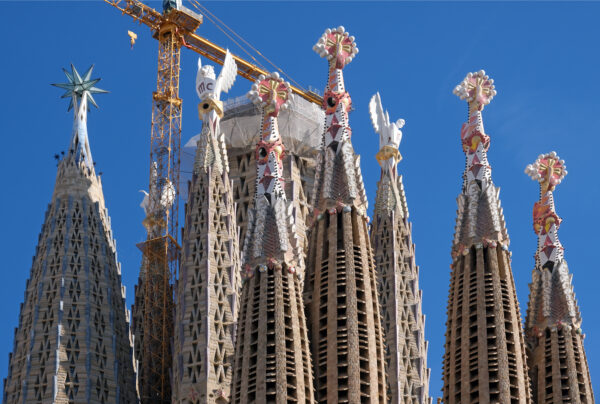
After nearly 150 years of construction, La Sagrada Família in Barcelona will finally be completed in June. Kallerna/Wikimedia Commons/CC BY-SA 4.0
Fast-forward five decades, and the view could not be more different: La Sagrada Família’s nearing completion has transformed the church from a local project left in limbo into an international architectural icon, embodying Barcelona’s new global aspirations. In 2025 alone, close to five million people visited the church, with 15,000 daily visitors paying €26 to enter the site. And it is not enough to simply visit; in our social media world, one needs to visually document the experience. My brother works at the Sagrada Família metro stop, whose entrance opens directly onto the church, and a few years ago he witnessed a viral trend develop. Under hashtags like #escalatortrend, #SagradaFamíliaMetro, and #LaSagradaEscalator, visitors filmed themselves emerging from the metro escalator with the basilica rising dramatically behind them. The trend quickly became disruptive. TikTokers repeatedly rode the escalators up and down, blocking residents’ access and prompting complaints to metro authorities. Filming on the metro escalator is now prohibited, though of course this has not stopped people from trying.
What happened? How did we go from viewing Gaudí as a local eccentric to seeing his church as a world-renowned icon? To understand why finishing this masterpiece matters, we need to look at the history of La Sagrada Família’s construction. First conceived by Josep Maria Bocabella i Verdaguer, a bookseller, philanthropist, and devotee of Saint Joseph, La Sagrada Família was a religious counterpoint to the rapid industrialization of 19th-century Barcelona. Construction began in 1882 under Francisco de Paula del Villar, who envisioned a conventional neo-Gothic church. However, following a dispute over costs, a year later the project was handed over to Gaudí, who radically reimagined the site. The young Catalan architect blended Modernisme (Catalan art nouveau) with organic forms and “ruled geometry”—curved surfaces generated by straight lines. Though these shapes appear bent or twisted, they are composed of countless straight paths. Gaudí worked with intricate physical models, which became the blueprints for the church’s construction. His unorthodox vision drew both fascination and fierce criticism—often reflected in the biting satirical magazines of the era—while his models were frequently featured in architectural journals. Of the 18 towers originally planned, Gaudí lived to see only the Tower of Sant Bernabé completed in November 1925. He died on June 10, 1926, three days after being struck by a tram while walking to confession. He was buried in the crypt of the building that had become his life’s work.
Gaudí famously remarked that his “client” (God) was in no hurry, fully aware that the basilica would be a project of generations rather than a single lifetime. He viewed his role not as the finisher but as the one who established the structural DNA for those who would follow. To this end, he left behind a workshop filled with large-scale plaster models—an “architectural legacy” designed to guide the church’s eventual completion long after his death. However, the Spanish Civil War nearly extinguished the possibility of completing his masterpiece. In 1936, anarchists broke into the church, destroying most of the original 3D models and sparking a long-standing debate: If future architects could no longer be certain of the master’s exact intentions, was there any sense in continuing?
La Sagrada Família remained a local project, fueled by community offerings and annual fundraisers.
These philosophical doubts, coupled with technical hurdles and a reliance on private donations, kept construction painstakingly slow for decades. As an expiatory church “for the people, by the people,” La Sagrada Família remained a local project, fueled by community offerings and annual fundraisers held on March 19—the Feast of Saint Joseph and the anniversary of the first stone. But the pace shifted dramatically in the 1980s, when the temple transitioned from a community-funded “stone puzzle” into a high-tech engineering marvel supported by millions of international visitors. This era was defined by the adoption of 3D printing and aerospace software, as architects realized that Gaudí’s complex, organic curves shared the same mathematical logic as aircraft wings.
While technical difficulties subsided and financial challenges were gradually overcome, controversy surrounding the completion of La Sagrada Família only intensified. Because the original models and the drawings were destroyed during the Spanish Civil War, critics—including renowned architects such as Charles-Édouard Le Corbusier and Walter Gropius—argued that the building should have been left unfinished as a “monumental fragment,” comparable to the Parthenon. From this perspective, any further construction represents an interpretation rather than an authentic work by Gaudí. This opposition culminated in a 2008 manifesto signed by more than 400 experts calling for a halt to construction. Prominent Catalan architect Beth Galí has likewise dismissed the ongoing work as a commercial tourist enterprise rather than architecture intended for religious devotion.
The central argument for leaving the church unfinished is that a work of art is inseparable from the hand of its creator; in this view, the “true” Sagrada Família died with Gaudí. There are also practical concerns—particularly the construction of the Great Stairway imagined by Gaudí, which would require building a massive bridge-like structure over the street and demolishing several residential buildings. Current estimates suggest that, if approved by the city, the monumental entrance would not be completed until 2034. Conversely, proponents—including current lead architect Jordi Faulí i Oller, who has directed the project since 2012—have relied on surviving fragments of Gaudí’s models and advanced digital technologies to reconstruct his complex geometric logic. They argue that by adhering to his underlying “geometric code” and mathematical principles, the basilica remains a living project that is faithful to Gaudí’s original vision.
La Sagrada Família is more than an architectural marvel; it is the physical manifestation of Antoni Gaudí’s spiritual obsession. While he was initially viewed as a local eccentric hero—a man whose singular vision seemed almost too radical for his time—his relationship with the basilica eventually transcended mere professional duty. As he transitioned from a secular architect to a devoted mystic, his life became inseparable from the basilica’s construction. This total devotion is captured in his own words: “I have no family, no clients, no fortune . . . I can give myself completely to the Temple.” His ambition was to create a space that evoked the “infinite attributes” of the Divine. Because the building is so uniquely tied to Gaudí’s personal faith, it has become a site of religious pilgrimage as much as an architectural landmark. This culminated in 2000 with the start of his canonization process, leading to Pope Francis declaring him “Venerable” on April 14, 2025. Ultimately, this transition from a local eccentric to a venerable mystic reveals that Gaudí did not merely build a church; he poured his soul into the stone, ensuring that the completion of the basilica is not just an architectural milestone but the silent prayer of a life fully consecrated to the Divine.
If Antoni Gaudí’s life consecrated La Sagrada Família in spirit, the following decades have consecrated it in the eyes of the world. A pivotal shift occurred in 2010 when Pope Benedict XVI designated the site a minor basilica, transforming it from a mere construction zone into a sacred space for worship. Its legacy was further cemented by UNESCO recognition and the completion in February 2026 of the 172.5-meter Tower of Jesus Christ, making La Sagrada Família the tallest church in the world. As Barcelona serves as the 2026 World Capital of Architecture, the basilica stands alongside icons like the Eiffel Tower—a destination so singular that travelers visit Barcelona specifically to witness it.
Pope Benedict XVI designated the site a minor basilica, transforming it from a mere construction zone into a sacred space for worship.
Returning to the TikTokers, La Sagrada Família’s escalator trend could represent a commercialization of Gaudí’s church, a distortion of its original purpose: to create a magnificent work of architecture in honor of God. Or perhaps not. Could it be that these TikTokers are, unexpectedly, fulfilling Gaudí’s desire for a church for the people and by the people? Gaudí envisioned a church so tall and monumental that it could be seen from anywhere in the city, with bells loud enough to be heard from afar. In this sense, witnessing the grand structure suddenly emerge in the background as one rises from the metro may fit that vision.
I myself have not returned to La Sagrada Família. Perhaps I am among those who feel nostalgia for the unfinished church—a testament to the power and beauty of incompletion, akin to the fragmented verses of Sappho. Or perhaps the reason is more mundane. I am overwhelmed by crowds, and I wonder whether I could still feel the breath of the Divine when surrounded by dozens—hundreds—of people pressing around me. I have chosen to live with the uncertainty of never fully answering this question. Yet La Sagrada Família is scheduled for completion on June 10, the 100th anniversary of Gaudí’s death, marking the end of what is perhaps one of the most celebrated architectural journeys in the world.
Marta V. Vicente is Ahmanson-Murphy Professor of Medieval and Renaissance History at the University of Kansas.
This work is licensed under a Creative Commons Attribution-NonCommercial-NoDerivatives 4.0 International License. Attribution must provide author name, article title, Perspectives on History, date of publication, and a link to this page. This license applies only to the article, not to text or images used here by permission.