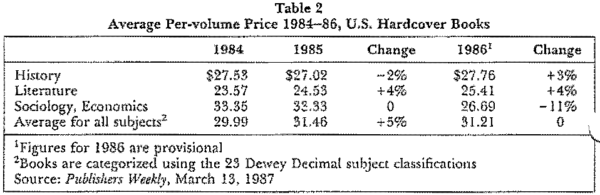
Books may not necessarily be the lifeblood of the historical profession but they are certainly important. Using statistics compiled by R.R. Bowker and disseminated by Publishers Weekly, Table 1 shows the number of new titles published in the United States in 1984, 1985, and 1986 (this excludes reprints, new editions of previously published works, and imported titles). From these figures it is evident that the production of history titles has fluctuated significantly over the past two years, increasing by a modest 3 percent in 1985 but then falling by 16 percent according to preliminary figures for 1986. This decline is part of a general trend (the number of titles published fell 14 percent overall in 1986), but must be worrisome for historians nevertheless. To provide a broader perspective on the production of history titles we have included the figures for literature (which are in general comparable to history) and sociology and economics (a combined category that is responsible for over three times as many titles as history).
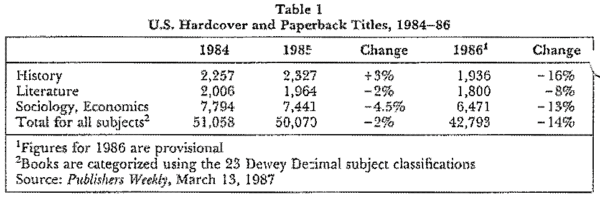
While the production of new titles in history is falling off, prices have started to rise once more. The average retail price of hardcover history books is about $3.50 less than the overall average, and even with a 3 percent increase in 1986 prices are only slightly higher than the 1984 average. This is a small increase in real terms, although it comes at a time of stable prices overall and a dramatic drop in the average price of books in sociology and economics. What the increase in the average price of history books means is that prices are keeping pace with inflation, which is not necessarily bad news for faculty members whose salaries are now increasing on average at a rate faster than the rate of inflation, but is bad news for graduate students whose “income” is now taxed by the federal government.