When I embarked on my doctoral dissertation, I set out to write a legal history of a single technological object: Syncom II, a stout satellite no wider than a bicycle wheel. Launched in 1963—six years after the Soviet Union sent earth’s first artificial satellite (Sputnik I) into space and six years before the moon landing—Syncom II, with its sister satellite, connected two-thirds of the planet’s surface and became the model for the first generation of communications satellites. The result of a partnership between Hughes Aircraft Company, the National Aeronautics and Space Administration (NASA), and the Department of Defense, the satellite also became a tool of economic, political, and military power during the global Cold War.
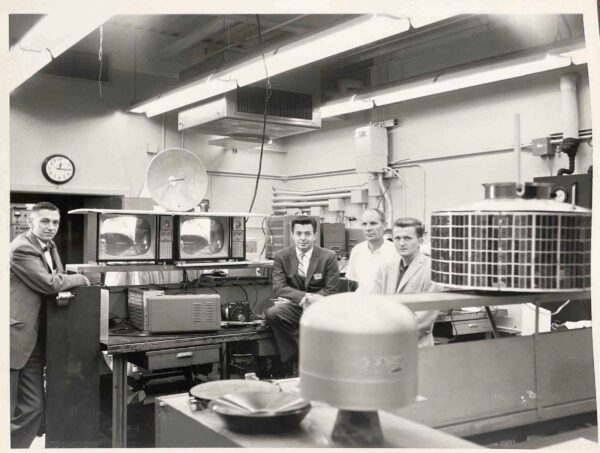
The team of Hughes engineers behind Syncom II—John Mendel, Harold Rosen, Tom Hudspeth, and Donald Williams—in their laboratory in Culver City, with one of the satellites they built for NASA under the Syncom program, circa 1963. Special Collections and Archives, University of Nevada–Las Vegas, Hughes Electronics Collection
Over the course of my doctoral work, I realized that the engineers behind the satellite—a team of four men experienced in military radar technology, mostly trained at the California Institute of Technology—believed law was crucial to the satellite’s development and, with varying success, used the law to their advantage. That engineers had the forethought to maneuver through the legal system is an insight with far-reaching implications for historians of law and technology, who stand to benefit from one another’s methods and objects of study. I learned this lesson while navigating a career from engineering to law and history.
It is a widely held assumption that law lags behind technology, always struggling to catch up to new developments. But law can also precede technology, “releasing energy” (as the legal historian J. Willard Hurst put it) for economic growth. Historians of technology have gone further, taking law as neither product nor trigger of innovation but as one of several factors—alongside politics, economics, and society—that are enmeshed with technology in an array of contingent relations.
But these grand narratives look different when engineers imagine and participate in legal practice. In Syncom II’s story, law was not only a driving, reactive, or contingent force in the satellite’s development. Rather, law itself was a conceptual object: The engineers of Syncom II internalized the very narratives about law that were later constructed around their project. Whether or not law in fact released energy, spurring technological development, the engineers believed it could. This idea sparked their legal imaginations and became central to the satellite’s development. Stitching it into Syncom II’s construction, operation, and maintenance, they transformed the relationship between law and technology as they prophesized and proselytized it.
These grand narratives look different when engineers imagine and participate in legal practice.
To arrive at this knotty conclusion required combining the methods used by historians of law and technology: attention to the internal work of law and lawyers on one hand, and technological objects and stories built around them on the other. I wanted to write about the satellite as an object around which a unique set of discourses traveled, transformed, or stabilized, shaping the satellite’s development much as the satellite shaped its world. I had in mind the classic debate in science and technology studies over New York urban planner Robert Moses’s bridges: What mattered was not whether Moses intentionally and effectively designed Long Island bridges as infrastructures of gentrification but how stories of Moses’s bridges were constructed.
Researching extraterritoriality and US patent law, I worked back to the first major case on the subject, Rosen v. NASA (Board of Patent Appeals and Interferences, 1966), which applied US patent law to Syncom II’s location in orbit and its ground stations in decolonizing Nigeria and apartheid South Africa. Meanwhile, studying the law and economics movement led me to revisit its forerunners and critics—specifically Richard Posner, Ronald Coase, and Charles Reich—all of whom alluded to Syncom II in foundational works on regulation of property, communications and public utilities, and monopolies. Lastly, investigating postcolonial histories of space law, I discovered that claims lodged by developing nations over segments of orbit above their territories, formally articulated in 1976, originated in debates over a decade earlier, triggered by the launch of Syncom II. From my scholarly perch in the 2020s, these ostensibly unrelated threads gravitated toward the satellite, its legal detritus, just as the satellite itself (now defunct) continues to drift in a wobbling orbit above the Indian Ocean, one of the oldest existing pieces of space debris.
Legal disputes over Syncom II resembled the storied battles around Robert Moses’s bridges. The satellite triggered and invoked debates over patents behind the satellite design, government contracts and subsidies, legislation on public utilities and monopolies, frequency regulations, bilateral agreements over African ground stations, and outer space law. The four men (they were all men) behind Syncom II traversed a web of overlapping legal discourses, taking alternate positions depending on time, place, and the issue before them. When selling the design to Congress as the model for a statutory corporation meant to run the first generation of communications satellites, the Hughes men emphasized their design’s capacity to facilitate a global empire. But, when persuading representatives of developing nations to agree to overhaul international frequency regulations, they promised this new, global communications system would not repeat the exploitative practices of the past.
As I combed through archives in Cuba, the United Kingdom, Switzerland, and the United States, I saw that engineers at Hughes anticipated the satellite’s legal worlds before participating in them. The design was devised in 1959 by a group of engineers in Culver City, California. Immediately after, the economics of the project were taken on by an army of managers and executives with engineering degrees. Everyone foresaw that the satellite would encounter an array of legal issues: public utilities legislation, government contracts, frequency regulations, agreements between NASA and the military, patents, permissions to operate ground stations abroad, and claims over orbital “real estate.” The engineers turned to law as the crucible for realizing their design—both an obstacle to and a lever in its development. They were oracles, purveyors of the future. Looking out from 1959, they proved adept at what law professors call “issue spotting.” Anticipating the satellite’s future like a fact pattern in a law school exam hypothetical, they predicted nearly every legal dispute that would accumulate around the satellite. In part, they knew what to expect from the legal infrastructure of postwar research and development. But they were also transforming that infrastructure.
Everyone foresaw that the satellite would encounter an array of legal issues.
Oracles often create the future they foresee: The Hughes men created the legal worlds of the satellite as they foresaw them. They sought patents that would ensnare them in four decades of disputes in the Patent Office and courts; advocated rehauls of frequency regulations that would trigger powerful responses from coalitions of developing nations; and pursued agreements for ground stations that would raise as many suspicions of US meddling as they quelled. They also encountered foils: US and foreign judges, bureaucrats, executives, and diplomats, many of them former engineers who now occupied professions in the world of “formal” law. In these encounters, law was a double-edged sword. It did not provide an equal playing field in the contestations between public and private, or between the United States and its would-be foreign subjects. But it set conditions within which those debates operated—conditions partly erected, for good or ill, by the men from Culver City.
Throughout, law was not an abstract category that struggled to catch up to the satellite’s development. Nor was it merely one of several factors enmeshed in a set of relations with technology, as historians have found in other contexts. Rather, law was an object whose relationship with technology was reflexively conceptualized and maneuvered by the engineers behind the satellite. I arrived at this insight by toggling between histories of law and technology.
How unique was it to Syncom II’s story that its engineers thought about law? I once believed that it was particular to the novelty of the technology, or to the fact that aerospace and communications were heavily regulated. Now I wonder if the technology’s novelty was one of those stories of the satellite that Hughes engineers promulgated to garner regulatory. After all, the prevalence of regulation preexisted but was also perpetuated by these men. Regulation in this story was used to establish legal certainty and secure commercial success rather than existing as merely a flat backdrop against which the Hughes engineers operated.
Perhaps it was not so extraordinary that engineers behind Syncom II directly engaged with the legal system. After all, I initially applied to law school after working as an engineering student at a Boeing satellite facility in El Segundo, California, where law seemed to be everywhere. I was halfway through my doctorate when I realized I had worked in a sister facility to the one that had built Syncom II more than 50 years earlier, acquired by Boeing when it bought Hughes in 2000. For many engineers, working out the law may be as ordinary as making the things it governs.
Haris A. Durrani is a Prize Fellow in Economics, History, and Politics at Harvard University. He was previously a law clerk in the US Court of Appeals for the Federal Circuit and a NASA Fellow in the History of Space Technology. He holds a JD/PhD from Columbia Law School and Princeton University.
This work is licensed under a Creative Commons Attribution-NonCommercial-NoDerivatives 4.0 International License. Attribution must provide author name, article title, Perspectives on History, date of publication, and a link to this page. This license applies only to the article, not to text or images used here by permission.