
The “Employment Information Bulletin” (EIB) published in Perspectives offers one guide to the number of academic positions available for historians. This analysis of EIB will seek to illustrate the configuration of job openings by rank and by type (long-term or short-term, teaching or nonteaching) and address in particular the concerns of academic historians entering the job market for the first time.
The Sample
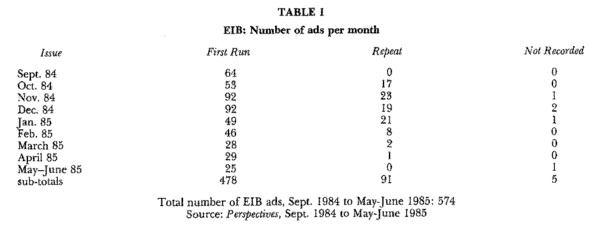
The EIB listings for the past academic year (1984-85) have been tabulated under various heads broadly arranged into the three categories of rank, time-scale, and duties. Nine consecutive issues of Perspectives, constituting a single academic year, formed the basis for this analysis, from September 1984 (v.22 no.6) to May-June 1985 (v.23 no.5). These nine issues contained a total of 574 advertisements, of which the first run ads (numbering 478) were included in this survey. Ninety-one repeat ads were excluded and five others were discounted on the basis that they did not offer substantive opportunities or failed to present specific, detailed information (see Appendix). It should be noted that we do not know what percentage of openings in history are advertised in the EIB. There is evidence that some very senior academic posts are not filled through open advertising and the same seems to be true of many part-time positions.
It could be argued that using the academic year as our sample has distorted the picture of openings in history, a picture accurately reflected in the calendar year. This does not, however, seem to be the case: the majority of new openings are for university or college positions and are advertised m the November and December issues (see Table 1), the time of year when soon-to-be graduating PhD candidates begin their job search. This also reflects the annual decision-making cycle within the academy itself (who is leaving, what positions must be filled, and what additional needs should be met). The only problem with this cycle is that it often does not reflect fiscal realities (when funds will be allocated and how much will be made available); hence a number of listings carry the proviso “projected opening.” In general, though, the openings exist at the time of going to press, and we must assume that the openings advertised in the EIB are genuine opportunities for history doctorates.
Methods and Problems
Methodologically, the collection of data was deceptively simple. After eliminating repeated ads run in consecutive issues, the number of new ads was counted and tabulated by category (rank, time-span, and duties) and subcategory. The process of categorization was not a particularly easy one: despite a list of suggested items of information, there is no standard form that ads must follow, and—worse—no minimum amount of information an ad must contain. Thus it is important to determine accurately which ads offered tenure-track or tenured positions and which did not, and it is often difficult to denote the rank of the appointment.
The three categories used each presented their own problems. Some advertisers omitted ranks altogether (tabulated under the “not specified” column) while others offered a range of ranks they would consider for a single opening (recorded as one-half, or the appropriate fraction, for each rank). Many advertisers failed to mention whether theirs was a tenure-track opening, and many of those who did mention tenure did not specify rank (assumed where the opening was “tenure-track” to be assist an professor). The issue of tenure raised another problem when identifying the time period of any one position. This was overcome by creating the two subcategories “long-term” and “short-term,” although a third subcategory or “part-time” was necessary for those positions that fell outside the two initial subcategories and a fourth subcategory of “not specified” was also added. Eliminating the possibility of identifying tenured positions certainly detracts from the overall utility of the survey, but the ability to identify which positions were temporary and which seemed to hold out the promise of permanent or semi permanent work was retained.
The third category of “duties” was divided into four subcategories, “teaching,” “administrative or nonteaching,” “nonacademic,” and “not specified,” and, although a fifth category of “research positions” might have been useful, this category proved fairly easy to tabulate.
Findings
According to the National Research Council, the number of doctoral degrees granted in history fell by 11 per cent between 1981-82 and 1982-83 (from 692 to 616) and, while that figure remained at 616 in 1983-84, it seems likely that it will continue to drop. Assuming, therefore, a 10 percent decrease in 1984-85, there could have been 555 new doctorates available for positions in that year. On the face of it, this is a rosy picture, with 478 advertisers offering 487 openings for those 555 graduates, not all of whom would have been actively seeking employment in higher education.
This is a distorted view for two reasons. First, in addition to recent doctoral recipients trying to find work in the academy, there are others from previous years continuing their search for an academic post and still others in temporary positions seeking a tenure-track opening. Second, and most significant, the number 487 does not by any means represent the total number of openings for which new or recent doctorate recipients are eligible.
(a) Rank
Hidden within that statistic “487 openings” is a breakdown that eliminates recent doctorates from up to a third of all openings advertised. The ranks for which recent doctorates can be considered eligible are assistant profes sor, instructor, lecturer, and fellow; these totalled 334 openings (69 percent) out of 487 (see Table 2). The other 31 percent was made up of the ranks of professor (54, or 11 percent), associate professor (42, or 8 percent), and not specified (57, or 12 percent). The most surprising figure here is the large number of openings for full professors (professor or associate professor: 19 percent, almost one-fifth of the whole) large, that is, relative to the number of openings advertised and not to the number of full professors employed in the United States.
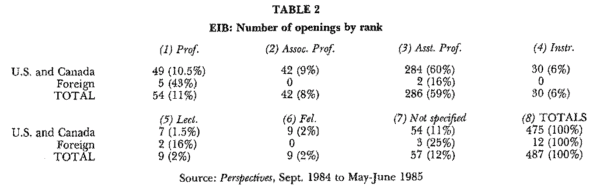
“!’here is also a notable geographic quirk. The large majority of openings were in North America (97.5 percent), but of those in the rest of the world, 43 percent (5 out of 12) were for senior professors, while just 16 percent (2 out of 12) were for assistant professors and another 16 percent were for lecturers (Table 2). This may reflect the greater mobility professors are assumed to command, or the greater marketability of established academics compared with recent doctorates.
(b) Long-term vs. Short-term Job Opportunities
Table 3 demonstrates the length of tenure (“time-scale” and not tenure in the technical sense) the EIB advertisements were offering. Long-term positions (those offering full-time employment for three years or more) constituted 78 percent (378 out of 487) of the total while short-term positions represented some 18 percent (89 out of 487).
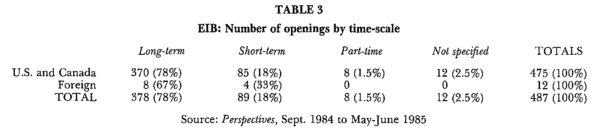
Unfortunately, it is impossible to determine from these ads alone which, while offering long-term employment as defined above, were not tenure-track. Only 1.5 percent (8 out of 487) were explicitly part-time (that is, teaching positions that did not demand a full teaching load), but this may be the most misleading conclusion these results point to.
(c) Duties
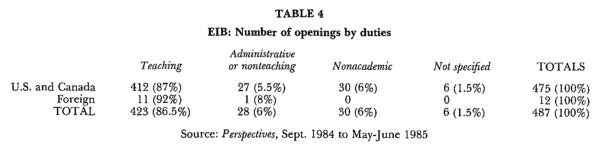
As would be expected, the large majority of EIB ads were for teaching positions at universities and colleges (422 out of 487, or 86.5 percent: Table 4). An additional 6 percent (28 out of 487) were administrative positions within the academy, essentially departmental chairs or other academic posts emphasizing nonteaching duties. The nonacademic openings were also primarily administrative jobs in organizations such as museums, archives, or historical agencies.
(d) Conclusion
This survey is not all-inclusive. Any quantitative analysis of the nature and extent of academic opportunities in history cannot answer the more qualitative questions raised by the prospect of seeking employment in academia. Moreover, certain quantitative questions fall beyond the purview of this survey. The original premise was to determine how the EIB can illuminate the structure of job opportunities in history by rank and prospect, but not to reveal what other factors, such as sex, race, degree-granting institution, or prior experience, come into play in the hiring process. This survey does indicate that the academy is not able to absorb all those qualified for an academic position in history, and probably will not be able to in the near future. Furthermore, a large percentage of those openings suitable for recent doctorates are short-term, and another significant percentage represents lateral or vertical moves for doctorates already established in the academy.