Congressman Mark Takano’s father and mother were two and one years old, respectively, when they were incarcerated with their families at relocation centers, his father at California’s Tule Lake and his mother at Wyoming’s Heart Mountain. These centers were part of the federal government’s World War II Japanese internment policy, about which today, as Takano argues, “We look back on that era of history as shameful one.” In a recent speech on the House floor, Takano wondered, “Will Americans generations from now visit Alligator Alcatraz and think to themselves, ‘How could our government do this?’”
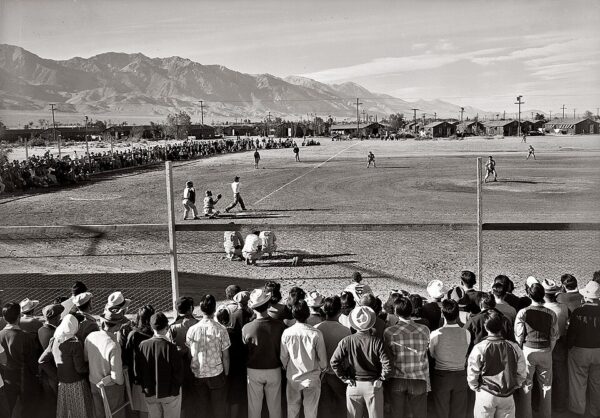
There were more than 100 baseball teams at Manzanar during World War II. Ansel Adams Photographs of Japanese-American Internment at Manzanar collection, Library of Congress Prints and Photographs Division, public domain
I agree with Takano that we still have much to learn from the era of Japanese incarceration, when 120,000 Japanese Americans were forcibly removed from their homes in the western United States. And when we better remember those painful histories and truly grapple with what they reveal about the worst of which we’re collectively capable, we likewise can celebrate and be inspired by the consistent, multilayered forms of resistance practiced by incarcerated Japanese Americans.
That resistance took countless forms. At California’s Manzanar, there were mass protests, like the December 1942 uprising, and the creation of communal spaces, such as the Japanese-style garden that Kuichiro Nishi built with a sign reading, “To the memory of fellow Japanese immigrants who, although ushered to this place with the breaking of friendly relations between the two countries, have come to enjoy this quiet, peaceful place.” There were individual actions, like when photographer Toyo Miyatake smuggled in materials to make a homemade camera to document life in Manzanar, and collective efforts, such as the journalists who founded and published grassroots newspapers and magazines at every camp.
In “Diamond in the Rough,” the recently concluded second season of my narrative history podcast Baseball, Bigotry, and the Battle for America, I focused on a particularly striking example of collective resistance at Manzanar and all 10 of the incarceration camps: baseball. The sport had been an essential element of the Japanese American community for a half century, and despite a wide array of challenges, incarcerated Japanese Americans found ways to make it equally central to the camps. They did so to keep joy and passion and community alive in these dark places and times, which I would define as exemplary everyday resistance.
Incarcerated Japanese Americans found ways to make baseball equally central to the camps.
Those efforts started with the construction of full diamonds and stadiums amid the desolate and inhospitable landscapes where the camps were purposefully located. At Manzanar, the semiprofessional star Pete Mitsui—a two-way player legendary a century before Shohei Ohtani—organized his fellow volunteer firefighters to water the field each morning. At Arizona’s Gila River camp, Kenichi Zenimura—the semipro player, manager, and stadium designer known as the Dean of the Diamond—somehow secured a bulldozer to build his most stunning diamond yet. Then, with his two teenage sons, he spent every morning clearing rocks from the field so the day’s games could commence.
Those games became a focus for a huge percentage of the incarcerated Japanese Americans. At Manzanar alone, there were more than 100 men’s baseball teams, meaning that more than 900 of the camp’s approximately 5,000 incarcerated men were part of a squad. The camp also fielded 14 women’s baseball teams, with one, the Dusty Chicks, that competed against and beat men’s teams. Along with intracamp play, these squads hosted exhibition games against outside teams, which bridged the gap between these isolated relocation centers and the rest of America. In 1943, for example, Zenimura coached the Gila River camp’s Butte High School Eagles (featuring both of his sons) to a hard-fought victory over the three-time state champions from Tucson High School. Tucson player Bernie Weinstein later reflected, “In the back of our mind we wanted to make up for Pearl Harbor,” but “I saw the fence and said, ‘God, this is like a prison.’” He went on, “It was a game that most of us will never forget. I realized that these people were Americans, just like myself. The more I thought about it, the more I thought, what a big mistake we made by putting these people in this relocation camp.”
Offering an even more direct challenge to the incarceration system’s discriminatory logic was a July 1943 road trip undertaken by an all-star team from Idaho’s Minidoka relocation center. The all-stars traveled to the Fifth Annual Idaho State Semi-Professional Tournament in Idaho Falls. After dominating wins in the early rounds, the quarterfinals matched the Japanese American squad against the Hunt Military Police, a team composed of guards from their camp. I don’t know if that was a striking coincidence or a purposeful choice from the tournament organizers, nor what (if any) conversations went into that highly charged affair. But I do know that the Japanese American team won the game, dominating the guards by a score of 14–1.
Every example of resistance from the Japanese incarceration camps forces us to confront the inhumanity and horror of such incarceration systems.
Every example of resistance from the Japanese incarceration camps forces us to confront, through these reminders of the humanity and community of the incarcerated people, the inhumanity and horror of such incarceration systems. The more we learn about these systems, what they do to our fellow Americans and humans, and what they take from all of us and our society, the more we’re brought face-to-face with the worst of both our past and our present alike. But baseball at the camps likewise illustrates a complementary and crucial point: that in our most painful times and places, we can and do find examples of the best of America, models of joyful communal resistance that we can all celebrate, the legacies of which we can build on as we seek to challenge the worst of our own moment.
Ben Railton is professor of English and American studies at Fitchburg State University and the author of six books, two podcast seasons, and numerous columns on the worst and best of American history and identity.
This work is licensed under a Creative Commons Attribution-NonCommercial-NoDerivatives 4.0 International License. Attribution must provide author name, article title, Perspectives on History, date of publication, and a link to this page. This license applies only to the article, not to text or images used here by permission.