When I start a new class every semester, before I tell my students that I have a PhD in Chinese history, I tell them, “I am a hula dancer.” Most look surprised and curious about what I have to say next. Although I don’t wear a mu‘umu‘u to class, hula is important to my teaching. I started learning history and hula around the same time. Hula and my career have intertwined for the past decade and changed the way I approach teaching history, providing opportunities in the realm of course content, illuminating key pedagogical similarities, and highlighting challenge as a core component in the learning process. I dance in the classroom—as my career advances, hula continues to provide insights for me to rethink classroom authority by showing my own vulnerability and preparing students to be lifelong learners.
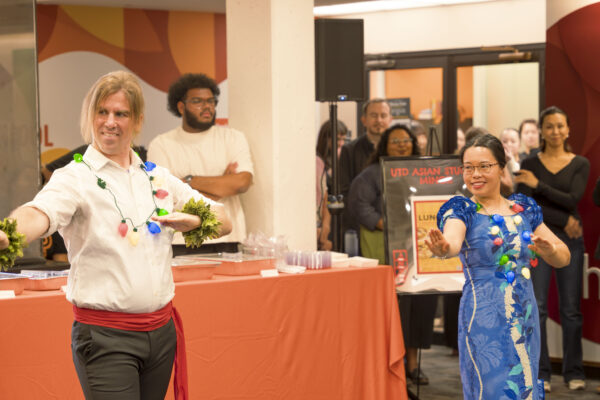
By sharing her hula dancing with her students, En Li models vulnerability while learning. Courtesy En Li
Featuring chanted poetry and interpretive movements, hula dance originated as a religious performance dedicated to Hawaiian goddesses and gods, preserving Hawaiian stories of creation and other significant events. I entered the world of hula at a Midwestern research university in 2008, one year after I moved to the United States from China for my doctoral degree in Chinese history. My boyfriend, who later became my husband, was a member of the university’s Hawaiian Club and regularly participated in club events. The first number he showed me was “Ka Uluwehi O Ke Kai,” a song by Aunty Edith Kanaka‘ole (1913–79) that describes the similarities between gathering the ocean’s seaweed and courting a lover. Growing up in mainland China in the 1980s, I partook in a Sunday-morning math class as my only extracurricular activity since many parents who’d experienced China’s radical 1950s–1970s when education access was limited valued scholastic work over artistic pursuits. I was eager to learn something new, and hula was my first experience with dance besides some awkward social dances at college. As a typical Hawaiian mele, or love song, “Ka Uluwehi O Ke Kai” has four verses, and each verse is sung twice. The hand and feet movements are relatively slow paced and simple, with the hands acting out the lyrics (for example, gathering seaweed), and the music is relaxing and cheerful. Compared to my graduate studies in history that focused on reading, writing, and class discussion, I was intrigued by hula dance as a different way to tell stories about history.
From a combination of curiosity about a new expression, a craving to cultivate an artistic talent, and a stubborn drive to learn a new skill, hula and my teaching career started to intertwine. Besides learning at the university’s Hawaiian Club, I took classes from different kumu hula, master teachers, while I did dissertation research in Taipei and Hong Kong. Whenever I moved to a new city as my academic career advanced, my husband and I looked for a hālau, or hula school, to join before we looked for a place to live. We regularly attended workshops across the United States and even planned a visit to Hawaii around viewing luaus. After I took my first job as an assistant professor in Asian and world history, we became dancers for the only Polynesian dancing troupe in Iowa. Once, a casino in Sioux City, Iowa, invited the troupe to perform and I received $500 plus two nights of hotel accommodations—more than the typical honorarium for talks on my first book about legalizing gambling in 19th-century China published by a major university press.
Hula dance as a different way to tell stories about history.
During these early years in my classroom, I started to draw connections between learning hula and teaching history. Hula is first a unique and generative content portal to Asian and world history. For example, I have used videos of different dancing and costume styles to showcase the turning point of Hawaiian history in the context of 19th-century colonialism, specifically with the arrival of American Protestant missionaries in the 1820s. I have also used hula to challenge students’ gender stereotypes—few are aware of the important role of male hula dancers in this sacred tradition. In my East Asian history class, I use hula as an example of how different cultures pass knowledge across generations. Hawaiian history was largely remembered in chants and interpreted through dancing. When I describe how people in 1000 BCE China used oracle bones to record history and how people developed their own phonetic alphabet in 15th-century Korea, I incorporate hula to explore the beauty and diversity of cultural communication with students.
As my career advances, hula also provides insights into teaching practice, especially as I wrestle with two interconnected mid-career crises: avoiding the danger of losing freshness and invention after repetitively teaching the same materials and being the only authority in the classroom. After years of teaching, I started to realize that excessive structure could limit students’ creativity, and more importantly, an overly planned session may take away instructors’ spontaneity. This spontaneity is easily forgotten, but vitally important to a genuine interaction.
I have learned through hula that spontaneity and repetition are intertwined. Repetition gives dancers power, as many kumu hula emphasize. Both dancing and teaching share structural similarities of improvised exchange between instructors and students that is built on routine and repetition. During a two-hour weekly hula practice session, the first third is typically dedicated to basic techniques. While many humanities classes emphasize creativity demonstrated in spontaneous discussions, informed by my hula practice sessions, I understood the value of more structured classes with clear learning goals and routines that build a solid foundation for later creative expression. Consistent instructions and classroom routines enable a sense of “trained spontaneity” that is like the routines and patterns in dancing. If students feel like a certain class goes well, that’s probably because of all the purposeful components by instructors through years of experimenting and fine-tuning. Just like in “Cook Ting,” one of Zhuangzi’s most famous parables—it was said that Cook Ting was able to dissect an ox as if he were dancing in perfect rhythm only after years of practice.
Repetitively teaching the same materials, however, inevitably contributes to a loss of the initial interest and fresh eyes for the material, which risks losing the important connection with the students who are new to the material. Moreover, like other junior women faculty and non-native English-speaking instructors, oftentimes I have felt like I had to “know it all” to establish and maintain my classroom authority and to compensate for the fact that I did not look or sound like a “typical” professor, which can make it particularly challenging to connect with students on a personal level.
To further remind myself of the uneasiness of a new learner, I bring hula into the classroom by dancing a hula number that I have learned recently in class. Even during the pandemic semesters, I continued the tradition online. This performance, happening in the same classroom as teaching history, is important to my teaching. Dancing hula provides another opportunity for me to experience vulnerability as a learner. Every hula troupe regularly prepares new numbers and shows, so a practice session is usually a mixture of old and new numbers to expand the repertoire. After settling in a new city, no matter how experienced I was as a dancer, I had to learn a new set of numbers and work my way up from the back row in the local troupe. Every week, my body gets used to new combinations of steps and to new formations of different combinations of dancers. I inevitably make mistakes, to say nothing of many moves that are constantly adjusted during different phases of practice before they are finalized for a show. Compared to the pleasure and confidence of performing the numbers after years of perfection, this learning process is unpleasant, insecure, and full of discomfort.
Dancing hula provides another opportunity for me to experience vulnerability as a learner.
Therefore, although I have danced hula for over a decade, I still feel nervous to dance in front of my students. I know hula much less well than I know Chinese history. My nervousness surrounding hula reminds me of the vulnerability of “performing” while learning: the confusion when students are introduced to a new subject, the mistakes they might make, the time they need to digest the information, the courage they need to raise questions, and the hesitancy that they have responding to my questions. These are factors I and probably other experienced teachers have taken for granted after years of teaching the same subjects. Thus, my dancing in class serves as a model of the patience and courage it takes to overcome the discomfort in the learning process, and this modeling is especially important to students. Students today seem increasingly wary of being wrong, sometimes afraid to speak up and to risk being corrected. Showing vulnerability through dancing helps me connect with students beyond the subject that I teach. A classroom, in addition to a stage for the instructor, is also a space where students can feel confused; can make mistakes; and, most importantly, with the teacher’s instructions to practice, can overcome the temporary discomfort, learn, and grow stronger.
In the last class of a semester, I encourage students to think about what they can do with the new knowledge and how they can continue to explore the subject beyond the classroom. Although I still feel inadequate compared to many hula dancers who started as children, I hope the hula journey starting in my 20s also encourages other teachers to undertake similar practices of modeling learning and performing for students and to prepare students to appreciate the world as a classroom with all the learning skills we have taught them. As I typically end a hula show not with “Goodbye” but with “Aloha ‘oe, a hui hou,” or “Until we meet again,” as teachers, we shall be excited to see students move to center stage and show us all the new knowledge that they have discovered on their own, until we meet again.
En Li is associate professor of modern East Asian history at the University of Texas at Dallas.
This work is licensed under a Creative Commons Attribution-NonCommercial-NoDerivatives 4.0 International License. Attribution must provide author name, article title, Perspectives on History, date of publication, and a link to this page. This license applies only to the article, not to text or images used here by permission.