The December 2025 issue of the American Historical Review features articles on fascism in postcolonial Korea, transportation history, and revisiting the “Comfort Girls” of Report 49. The History Lab includes a diverse collection of works on Indigenous history, retrodiction, and museum exhibit curation and an #AHRSyllabus module on collective biography in feminist digital humanities.
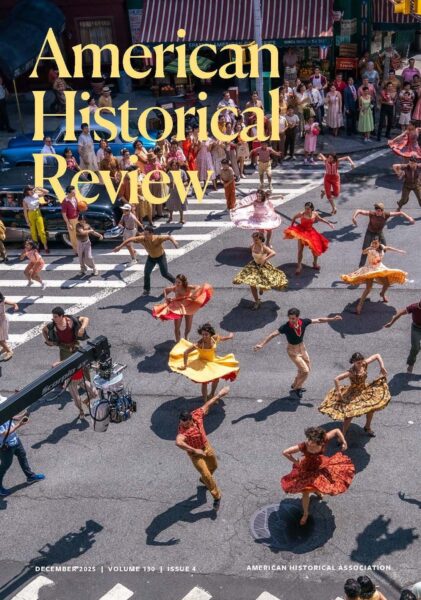
This issue’s cover features a photograph from the filming of West Side Story (2021) in relation to a forum on the creation of the Museum of the City of New York’s exhibit This Is New York: 100 years of the City in Art and Pop Culture. A centennial celebration of the institution’s founding in 1923, the exhibit “sought to capture how artists have represented the city in film, television, music, fashion, poetry, literature, and the visual and performing arts,” with galleries organized by theme to emphasize representations of New Yorkers’ everyday experiences. This image is included in the galley “You Are Here,” an immersive film mash-up of hundreds of film clips about the city, showcasing a uniquely New York blend of music, theater, and film, right on the streets of the city. Photo by Niko Tavernise, courtesy of Photofest and the Museum of the City of New York.
In “The Highest Stage of Nationalism,” Sungik Yang (Arizona State Univ.) examines fascist ideologies and movements beyond interwar Europe. Arguing that such scholarship has long been dominated by Eurocentric perspectives, he explores nationalist discourses in postcolonial Korea. Though these discourses resembled European fascism, he shows that earlier scholarship has excluded Korea from what is considered fascism for not meeting the specific criteria determined by European historical experiences. With this study, Yang demonstrates that fascism can exist outside Europe and in anticolonial nationalisms, highlighting a need to rethink broader approaches to the concept of fascism.
Kate McDonald (Univ. of California, Santa Barbara), in “What Makes Transportation History,” examines why, since the 19th century, transportation has been understood as a measure of historical change. She argues “transportation” as a concept itself has a history, complicated by two conflicting interpretations—transport devices as a mark of historical difference and as objects of livelihood. McDonald shows that centering these conflicts provides a principle for approaching this complicated history of transportation that can reshape how historians approach transportation as both an economic foundation and a “measure and maker of history.”
In “Revisiting the ‘Comfort Girls’ of Report 49,” Amy Stanley (Northwestern Univ.) reassesses the famous historical document “Japanese Prisoner of War Interrogation Report No. 49,” which focused on 20 captured Korean comfort women who had escaped from Myitkyina, Burma. She argues that it emerged as part of a multisided struggle over women’s bodies in conflicts of empire and decolonization in Burma, and that the document’s elevation as a generic piece of evidence obscured a “larger history in which concerns about ‘sex slavery’. . . emerged, retreated, and reemerged over the course of the war.”
This issue’s History Lab opens with a forum on a recent exhibit at the Museum of the City of New York (MCNY). With contributions by Pedro A. Regalado (Stanford Univ.), Sarah Miller-Davenport (Columbia Univ.), Anna Danziger Halperin (New York Historical), Sarah M. Henry (MCNY), Angel “Monxo” López (MCNY), Frances Rosenfeld (MCNY), Lilly Tuttle (MCNY), and Gabriel S. Tennen (Baruch Coll.), “Curating New York’s ‘Raw Material’” delves into the making of the exhibit This Is New York: 100 Years of the City in Art and Pop Culture, which “sought to capture how artists have represented the city in film, television, music, fashion, poetry, literature, and the visual and performing arts.” The forum includes a roundtable interview with the exhibition’s curatorial team; an in-depth guide with López, MCNY’s first Latinx permanent curator, on how he selected specific images for a galley; and several essays on city museums, fostering audience engagement, and public and museum collaboration.
At the 2024 AHA annual meeting, the AHR organized a roundtable of six historians whose works draw from both history and Native American and Indigenous studies (NAIS). An edited version of that conversation appears as “Methodologies in Indigenous History,” in which William Bauer (Univ. of California, Riverside), Dmitri Brown (Univ. of California, Berkeley), Keith L. Camacho (Univ. of California, Los Angeles), Elizabeth Ellis (Princeton Univ.), Katrina M. Phillips (Macalester Coll.), and Joshua L. Reid (Univ. of Washington) discuss the methodological turn in Indigenous history and progress to be made in incorporating NAIS in history, noting that “NAIS’s interdisciplinarity shows historians how to think beyond chronology and to approach sources, theories, and methodologies in new ways.”
In “Predicting the Past,” David Gill (Univ. of Nottingham) explores the challenges and opportunities driven by gaps in the historical record. His research group analyzes “retrodiction”—a method for historians to “outline their assumptions and explicitly [predict] what they believe to have occurred in the absence of evidence”—and the different ways, such as retrodiction tournaments, that historians can make and test their retrodictions to highlight future avenues for research.
The December AHR includes two History Unclassified pieces. In “Notes on a Roman Holiday,” Vinayak Chaturvedi (Univ. of California, Irvine), inspired by the writing of Carlo Ginzburg, examines Rome as an archive of connected Italian and Indian histories. Chaturvedi draws intellectual connections among Benito Mussolini, M. K. Gandhi, B. S. Moonje, and Antonio Gramsci and Indian nationalism, Italian fascism, and Communism.
Sarah Balakrishnan (Duke Univ.), in “Colonizing Accra,” looks to narrative history and storytelling as an approach to the archive. In studying the Ghanaian capital, she argues that certain events there have been left out of the historical record because “historians mine the archives for data, not for stories.” Stories unearth more than anecdotes and can offer a new framework for “understanding the movement of history.”
The issue rounds out with the latest #AHRSyllabus module. In “Sharing Stories from 1977,” Judy Tzu-Chun Wu (Univ. of California, Irvine), Nancy Beck Young (Univ. of Houston), and Leandra Zarnow (Univ. of Houston), along with multimedia support from Peggy Lindner (Univ. of Houston) and Elizabeth Rodwell (Univ. of Houston), use the 1977 National Women’s Conference in Houston to foreground the use of “big biography,” feminist digital humanities, and crowdsourcing methodology in the classroom. The module includes two lesson plans to use the Sharing Stories 1977 project with students, as well as behind-the-scenes content by Rodwell and Lindner about the process of building a collective biography.
Go behind the scenes of the AHR to explore the who, what, how, and why of doing history in the 21st century with History in Focus. Join host Daniel Story for a deeper dive into historical content and practice through interviews and immersive storytelling as we seek to peel back the curtain on the AHR and the work of history more broadly. Listen to season 4 now.
This work is licensed under a Creative Commons Attribution-NonCommercial-NoDerivatives 4.0 International License. Attribution must provide author name, article title, Perspectives on History, date of publication, and a link to this page. This license applies only to the article, not to text or images used here by permission.