
What do historians do after they receive their PhD degrees? According to conventional wisdom, they drive taxicabs or wait on tables while looking for a job, and if they are one of the lucky few who land jobs in their field, then they don’t have to bother filling out those law or business school applications. The problem with this scenario, at least according to a new National Research Council (NRC) report, is that it is largely a myth.
The NRC, part of the National Academy of Sciences, has used its biennial Survey of Doctorate Recipients as the data base for a study of employment patterns in the humanities in 1983. The NRC’s findings appear in Humanists on the Move: Employment Patterns for Humanities PhDs (National Academy Press, 1985).
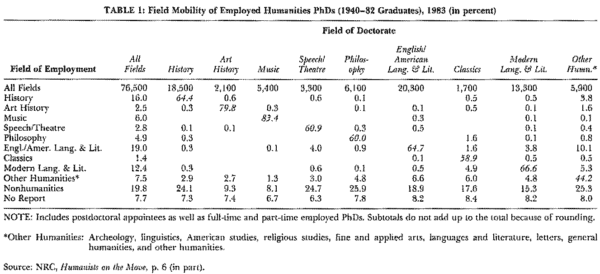
The total labor force population of humanities PhDs is estimated at 77,900. Humanists on the Move charts the progress of a sample taken from this group (7,733 persons) to learn whether or not individuals find jobs or pursue careers that match their training. There are two categories that help sort people out: those who have in-field or out-of-field employment mobility, and those who have in humanities or out-of-humanities employment. “Field” refers to the specific discipline of the PhD (e.g., History). “Humanities” refers to the fields comprising this broad group (see Table 1).
Among the positive findings of the report for the total humanities doctorate population who are employed are the following:
Over 90 percent of those in the labor force hold full-time positions, and over half of those working part-time are doing so by choice.
The majority of humanities PhDs (80 percent) are employed in jobs that can be defined as part of the humanities. Seventy-two percent are holding positions that match their doctoral fields. Gender and minority group status seem to have no predictive value in determining who is more likely to be working outside his or her doctoral field. Put another way, women and minorities are evenly represented in the in-field and out-of-field populations.
Almost all of the humanities doctorate population who said they worked in education in 1981 were working in the same sector in 1983 (97 percent). This means there has been very little movement out of education over the intervening two years covered by the NRC surveys. Most of those who said in their survey returns that they held jobs in their doctoral fields listed teaching as their primary work (82 percent).
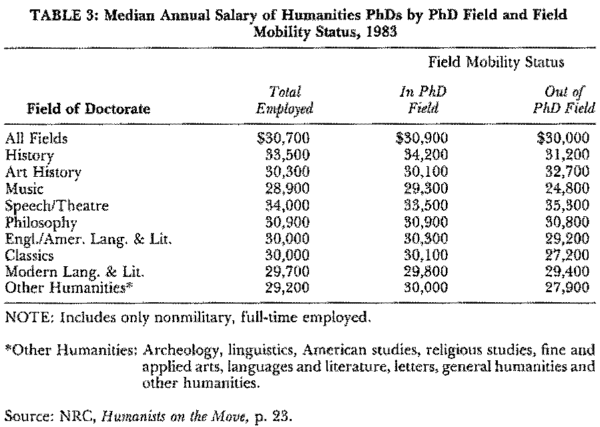
The salary differences between humanities professionals working inside or outside their doctoral fields are minimal.
The report’s authors (Mary Belisle and Betty D. Maxfield of the NRC staff) conclude that humanists for the most part are doing what they were trained to do. PhDs have not been forced out of their fields, or at least out of the humanities, in droves. The problem of oversupply of PhDs would not seem to be as great as commonly perceived. And there are only marginal income differences between persons working in- and out-of-field. “Humanities PhDs,” in the report’s language, “have transferrable (‘fungible’) skills. In other words, training in the humanities helps these PhDs develop skills that are marketable outside academe as well as outside the PhD field in academe.” At a time when so many things in the humanities seem tracked on a downward spiral (enrollments, majors, PhD output, jobs), this is a bright sign.
There are, however, “some less encouraging findings.” If 80 percent of humanities PhDs are working in humanities fields, then 20 percent are working outside the humanities entirely, many involuntarily because of a persistently tight job market. This crunch has hit the under-45 age group hardest, according to the data in the report, and many in this age group said they needed still more training beyond the PhD to land the jobs they were holding at the time of the the survey.
Table I tracks field mobility by discipline. Over one-third of the history PhDs are employed outside their field of training. Moreover, out-of-field mobility has increased over time, at least if examined from the benchmark year of 1977 when NRC first began collecting data on humanities PhDs. In that year 24 percent of the history PhDs in the labor force worked in non-history jobs; in 1983 the percentage was 35.6.
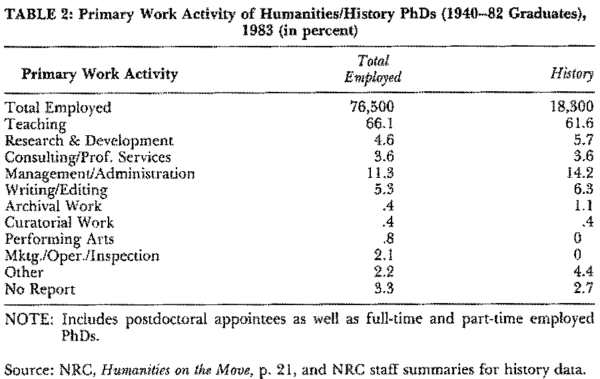
Table 2 lists the primary work activity of history PhDs in 1983. The AHA obtained this data from NRC staff; unfortunately the data cannot be correlated with field mobility. That is, we cannot tell who among the history PhDs are doing history-related work. Still, field mobility probably can be inferred from the nature of the work activity, suggesting again a strong tendency among historians to leave the field—at least when compared with other humanities fields. Notably, almost 40 percent occupied nonteaching positions in 1983.
With respect to income level, history PhDs have excelled. Compared with all humanities fields (see Table 3), the history doctorate population earned the second highest median annual salary in 1983 ($33,500), behind only speech/theatre ($34,000). Historians working in field (“doing” history) earned the highest median annual salary of all fields, in part a reflection of the higher than average age and rank of college and university historians. Historians working outside the field did less well, but still registered median incomes higher than the total humanities out-of-field population. Again, age may also explain some of this difference since out-of-field history doctorates are comparatively younger.
The report pays little attention to part-time employment as a discrete category, but the report does note that of the 18,300 history PhDs in the labor force, 91.7 percent are full-time employees, 5.8 percent part-time employees (approximately half by choice), 1.2 percent unemployed and seeking employment, and 1.3 percent postdoctoral fellows.
Humanists on the Move challenges a number of conventional notions about doctorate employment in the humanities. There is a low incidence of PhD unemployment and part-time employment. The latter is especially surprising in light of the high rate of part-time academic employment, by some estimates between 30 percent and 40 percent of the teaching faculty in many institutions. History doctorates command higher than average incomes compared to other humanities fields; this is also true of historians who leave the field. A more puzzling and disturbing note is the high percentage of historians who for one reason or another leave history.
Projecting employment trends into the future is about as reliable as predicting stock market swings. PhD output has declined from a peak of 1,215 in 1973 to a little over 600 a year, where it has been stable for the past two years. EIB advertisements in Perspectives show about 400 new listings a year. If some of the out-of-field movement is voluntary, then academic history employment is probably closer now to a supply and demand balance than it has been in the last decade—if we count only PhD output. Others reenter the market each year from temporary jobs, and it is by no means evident that out-of-field movement is voluntary.
The trend toward non-tenure-track hiring poses an entirely new set of problems. In AHA’s 1982 report, Survey of the Profession: Academia, 1981-82, two-thirds of all new history hirings at 590 colleges and universities were of a temporary nature. Persons holding “terminal” positions are on a most precarious perch. If the crisis of the last decade was unemployment, the dominant theme of the 1980s and into the immediate future is insecurity of employment.
It is unclear what effect, if any, the swing “back to basics” in the college curriculum will have on history teaching. Many undergraduate colleges are reinstituting history requirements, but it is too early to tell if the impact will be widespread. If so, then more teachers will be needed. Balanced against this early and uncertain trend that may produce an employment boomlet is a shrinking college age population. Between 1985 and 1995, the number of 18- to 24-year-olds in the US will decrease by 18 percent.
There are some difficulties with the report. It would be useful to know more about part-time employment, especially since it is so prevalent in higher education today. It is also difficult to learn from the data who is doing history where. For example, it is possible that a history PhD who is categorized as “Teaching” may not be teaching history, while one categorized with “Management/Administration” may be in the history field. This is not so much a criticism of how NRC sets up its data as a warning of limitations in using NRC studies. Thus it is difficult—almost impossible—to chart academic and applied or public history employment.
There is a tendency in the report to glamorize some of the findings, to search for silver linings in the data. To note that humanists are highly successful at landing jobs for which they have some training, when these positions may not actually be what they prepared for or expected, may detract from the continuing seriousness of the job market predicament for newly minted doctorates. But the report is balanced and tells a part of the story that needs to be told again and again: humanists have critical skills with potentially wide applications.
Humanists on the Move, as the title suggests, is an upbeat report that shows a surprisingly healthy doctorate population, one that seems to be adapting to changing employment demands. But the report has little to say about changes just on the horizon-changes that still must be characterized as cloudy if not quite so threatening.
Copies of the report, Humanists on the Move: Employment Patterns for Humanities PhDs, may be obtained by writing: National Research Council, Survey of Doctorate Recipients, Room JH634, 2101 Constitution Ave. NW, Washington, DC 20418.