History, said Voltaire, is a pack of tricks we play on the dead. The survey course in Western civilization is surely a “pack of tricks” we teachers play on college freshmen, most of whom come into our classrooms thinking they will be learning lists of dates, solid facts, and all the “lessons of the past.”
That popularly held view of history as a collection of unchanging dates and unchallenged conclusions, however, is long gone from most college courses. It was, to be sure, the history I studied thirty-five years ago, a history based on a coherent philosophy of nationalism and a sense that what counted were the great leaders and the great states. In today’s classroom that confident view of history has been replaced by a conglomeration of topics and viewpoints, most drawn from the perspective on the past that is called social history.
The teaching of history, even at the introductory level, has been affected by the winds of change in the graduate schools and among research-directed historians. In my own classroom the emphasis has shifted in subtle ways, and without conscious planning. The time I once spent on the causes of the fall of Rome is now spent on urban planning in the Empire. Gladstone and Disraeli have been replaced by “Victorian values,” and Napoleon III, that “pygmy tyrant of a great people,” in Victor Hugo’s ringing phrase, has stepped off stage to make way for industrialism. Holy Roman Emperor Henry IV no longer can be seen standing barefoot in the snow at Canossa, and Madame Pompadour’s impact on the Diplomatic Revolution no longer seems as important as Mary Wollstonecraft’s “Vindication of the Rights of Women.”
A lot of good stories are gone, giving up their place to social history, which is neither so easy nor so entertaining. The definition of social history is far from precise and, indeed, its very significance is questioned by many historians. In an article in History Today (March, 1985) seven prominent British scholars offered commentaries on “What is Social History?” They agreed, in general, that it involves “major new areas of scholarly inquiry,” requires a new methodology which recognizes diverse sources, is largely quantitative, and offers a new approach to the past which de-emphasizes political events and individual action in favor of slow societal change and group experience.
This “new history,” which has been so much influenced by the social sciences, is not universally applauded. Jacques Barzun, for example, in a speech given to the Organization of American Historians and published in The History Teacher (August, 1986), characterized it as “retrospective sociology,” and others have warned that historians have ventured into sociologism. But most historians seem to have found the new history to be the particular pack of tricks of our time, perhaps in the spirit in which Lynn White, jr. as early as 1963, in an article entitled “The Life of the Silent Majority,” (Medieval Religion, and Technology, University of California Press, 1978), said that “the novel task of our generation is to create a democratic culture to match our political and economic structures.”
The two confident young men, standing on either side of a table laden with globes, scientific implements, a lute, an open hymnal, and a rich Turkish carpet, are the yuppies of their age.
In any case, social history is trickling down through all the levels of historical study to the basic survey course. Carolyn Lougee, writing in this column in September 1986, discussed some of the problems of integrating social history into the introductory course. History seen as experience rather than action, from the viewpoint of society rather than the state, loses the clear periodization of traditional narrative. The subject matter of the course, now ranging from women’s history to labor movements and popular culture to army life, appears to the student as “spongy, vague and sprawling,” to use Lougee’s descriptive phrase. In matters of methodology, students resist attempts to use quantitative data. As Lougee said, they “do not expect numbers in a history course.” Other materials used by social historians, such as oral anecdotes, private records, folklore, and items from popular culture, are difficult to find in a format usable in a survey course.
Solutions to the problem of introducing the work of social historians in the survey of Western civilization or the advanced placement course in European history range from adopting readings and textbooks oriented toward social history to using computer programs and devising individualized projects. My own modest proposal, faced as I am with five Western civilization classes of thirty-five students each in an open admissions community college, is to use pictures. I have a sizeable collection of slides, some purchased from commercial sources, some picked up in museum visits, some prepared at my request by the media department. As much as possible I try to use the “masterpieces” of art for the twofold reason that there is more information available on famous paintings, and it serves students better to be given some of the great images from the history of art.
The use of art with history is, of course, not a novel approach. Every textbook is liberally illustrated with paintings, statues, and examples of architecture from every historical period. Commercially prepared filmstrips depend on contemporary prints and paintings, and the close relationship between art and history has long been established.
What is new, however, is that art is being recognized as one of the artifacts available for research in social history. Historians are using works of art not as examples of the culture of a period but as evidence of attitudes and mentalities, or as clues to the experience of people in past ages. This seems to be a relatively recent development. Just over ten years ago Merritt Abrash could argue in The History Teacher (August, 1975) that art is misused in history classes. “First and foremost,” he wrote, “a work of art speaks in aesthetic terms. These considerations are in the domain of art history, which, in fact is a specialization quite outside the education of most [historians].”
Yet, today, many historians are finding works of art very much a part of their own domain. The summer 1986, issue of the Journal of Interdisciplinary History was dedicated to “The Evidence of Art,” and contained the work of a number of historians who have used works of art as source material for their research. The influential social historians Fernand Braudel and Philippe Aries have used art works as documentary evidence in their books, and an increasing number of articles in history periodicals incorporate paintings and sculptures as source material.
In the classroom pictures can be a good substitute for the lost stories of traditional political history. A painting can be dramatic, poignant, arresting, or bizarre. The role played by Holbein’s portrait of Anne of Cleves in the disastrous one-night marriage of Henry VIII and his fourth wife is a romantic comedy. The involved planning and final composition of David’s painting of Napoleon’s coronation, as well as the sheer size of the thirty-nine foot canvas, offers a behind-the-scenes example of effective propaganda. Gericault’s Raft of the Medusa, considered to be the first of the great paintings of the Romantic Movement, is still able to evoke fascination and horror with its scene of agony and death. Salvador Dali’s Premonition of Civil War is a shocking image of the dismemberment of the Spanish nation.
As teaching tools, art slides have the advantage of being flexible and adapt able. Pictures can be used alone or in various combination, discussed at length if the class responds or quickly dispensed with if time is short or if they fail to meet the objective of the class period. In planning the use of pictures in class, I have found it helpful to think of them in three different groups or categories. The first is made up of slides that I have used for a number of years as illustrations of the cultural life of an age, but which can be reinterpreted in the light of recent research in social, technological, or economic history. When these pictures are viewed as artifacts or evidence, new kinds of questions must be asked, such as why the art was commissioned, who viewed it, and what does it tell us about the society that produced it? Content becomes less important than context.
For example, the murals ascribed to Giotto, narrating the life of St. Francis, are an attractive way to introduce an important historical figure, but the famous frescoes in Assisi can also be used to discuss town life in the fourteenth century, changes within the Franciscan order, and the rise of a new, more naturalistic art in response to the popular culture of the time .James H. Stubblebine’s Assisi and the Rise of Vernacular Art (Harper & Row, 1985) helps place the St. Francis cycle within its social setting and focus attention on the audience rather than the art. Books such as Henry Kraus’ The Living Theatre of Medieval Art (University of Pennsylvania Press, 1967) help to interpret stained glass and cathedral sculpture. Thanks to the work of Robert Mark in explaining how medieval cathedrals were con structed (“The Cathedral and The Bridge: Structure and Symbol” with David Billington, Technology and Culture, January, 1984), examples of Gothic architecture become more than “Bibles in stone” and can be used to explain the guild system and the transmission of new technologies from town to town. The plates from the great Encyclopedia of Diderot show the lifestyles of the rich and famous of the eighteenth century, but they are even more useful as a survey of pre-industrial technology. Brueghel’s paintings mirror the lives of ordinary men, women, and children of the sixteenth century.
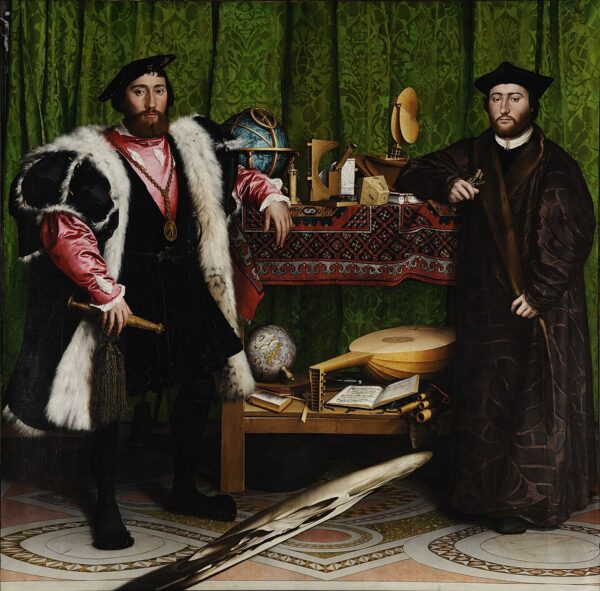
Hans Holbein the Younger, Public domain, via Wikimedia Commons
A second category of slides includes those single, notable paintings so full of information, drama, and clues to social themes that they can be analyzed and discussed in some depth. The use of a single picture is sometimes more effective than a group of slides or a sequence of rapidly changing images. The Ambassadors by Holbein, for example, can be discussed on many levels. The two confident young men, standing on either side of a table laden with globes, scientific implements, a lute, an open hymnal, and a rich Turkish carpet, are the yuppies of their age. Politically they represent the development of diplomacy in international affairs. They represent the interests of the King of France in the negotiations by which Henry VIII separated the English church from Rome. Their awareness of voyages of exploration and the new science of their age is demonstrated by the choice of objects displayed between them. The religious tensions of the time are alluded to in the broken string of the lute and the open hymn book. The new interest in optics and the medieval theme of the Dance of Death combine curiously in the distorted “memento mori” of the skull which Holbein imposes on the foreground of the painting. David Piper’s Enjoying Paintings (Penguin, 1973) is one of a number of sources for information on this painting, and John Berger, in Ways of Seeing (Penguin, 1973), offers additional insights into the psychology behind the art.
There are a number of other art works which, like The Ambassadors, seem to represent their age in its social, economic, and political aspects. David’s “great and gentle portrait” of the chemist Lavoisier and his wife, painted five years before Lavoisier’s death on the guillotine, offers a basis for discussing aspects of the Enlightenment, the role of tax farmers in the pre-Revolutionary French government, and the life of privileged men and women. The Merode Altarpiece by Robert Campin is more than a masterpiece of Flemish painting; it is an early example of the change from aristocratic to bourgeois sponsorship of art, a picture of a fifteenth century town household, and evidence of a change of consciousness in the representation of the Virgin Mary, not as Queen of Heaven, but as a middle class wife, and in the portrayal of Joseph in his new role as hard-working house holder. The publication of Witold Rybczynski’s Home: A Short History of an Idea (Viking, 1986) brings added appreciation of the kinds of furniture and room arrangements shown in this picture. El Greco’s Dream of Philip II embodies many aspects of the Counter Reformation, Ford Madox Brown’s Work is excellent for discussing some of the assumptions of the Victorian middle class, and Fernard Leger’s 1917 revision of Cezanne’s The Card Players converts the earlier painting into a mechanical representation of machine-men, reflecting Leger’s experiences in World War I.
Finally, in addition to re-evaluating familiar art works in the light of new knowledge, or selecting single outstanding paintings for close analysis, a third use of a slide collection is to combine pictures from many periods as a way to present a topic from social history. By grouping pictures from a number of historical periods, the long view of social history can be fitted into the fast-paced narrative of a survey course. At appropriate places in the syllabus, pictures can be shown which demonstrate the duration of certain ideas and institutions, show slow-changing concepts over time, or offer the opportunity to introduce the work of prominent social historians. For example, a survey of the idea of monarchy through Western history is appropriate at the beginning of the second semester when the Age of Absolutism is the subject. A selection of royal portraits might include the Emperor Justinian wearing the Imperial nimbus as a sign of his divinity, the Holy Roman emperors bearing orb and scepter, the worldly Henry VIII, the majestic Louis XIV, and, finally, the bourgeois and popular monarchs of the modern era. The history of women can be presented pictorially in many ways, and the nineteenth century, with the changes brought by industrialism, offers an appropriate place to discuss the status of women. I have used Victorian narrative paintings to show the life choices of middle-class women and to contrast the education of boys and girls in their separate roles. Some of the pictures from this era can be used with medieval pictures, such as the Limbourg brothers’ Book of Hours and Renaissance marriage portraits, to explain changes in the status of women.
Changing concepts of childhood is another topic on which much has been written by social historians, and for which there are illustrations from art history. Pictures of social protest (by Damier, Kollwitz, and Grosz) or containing anti-war statements (by Callot, Goya, and Picasso) can be brought together. A survey of the “faces of Jesus” using concepts from Jaroslav Pelikan’s Jesus Through the Centuries (Yale University Press, I985) fits in well with early medieval history. Finally, at the end of the course, a brief reshowing of selected slides serves as a review of the semester’s work and, at the same time, can demonstrate the changing role of the artist in Western society.
This article has suggested three ways that art history slides can be used in a survey course in Western civilization or an advanced placement course in European history to introduce some of the topics, methods, and conclusions of the new social history while maintaining the traditional narrative structure of the course. It is argued that pictures are more acceptable to students than statistical evidence and may be used to introduce some of the ideas and conclusions of social historians. Using major art works in this way may seem to the specialist or art historian to be a misuse, for the classroom teacher cannot have the expert knowledge of the research scholar. However, if works of art can serve to demonstrate to beginning students, in what may be their only history course, that the study of the past is not limited to a certain body of facts but is composed of a limitless body of questions, those pictures will have been well used.
Some students may conclude, despairingly, that history is indeed a constantly changing pack of tricks played on the dead. On the other hand, some may realize that the study of history is a fascinating search for knowledge through diverse and ingenious means, and may decide to pursue it further. In either case, the survey will have met its purpose as an introduction to the kinds of history being studied and the kinds of questions being asked by historians today.
Shirley MacKenzie Wilton is associate professor of history at Ocean County College, Toms River, New Jersey. She holds a BA from Connecticut College, 1948, studied at St. Andrews University. Scotland, and earned her Master's degree from the University of Michigan, 1952.